
Print Friendly Version Page

2502127 Search Results

The cathedrale de Rouen, the portal sun morning, blue harmony Detail, 1893 (oil on canvas)

JLJ4611727: The cathedrale de Rouen, the portal sun morning, blue harmony Detail, 1893 (oil on canvas), Monet, Claude (1840-1926) / Bridgeman Images

The elliptical galaxy NGC 4660 - The elliptical galaxy NGC 4660 - The galaxy NGC 4660 is located 49 million years ago - light from Earth, in the Virgin's cluster. Image obtained by the Hubble Space Telescope. The elliptical galaxy NGC 4660 lies at a distance of 49 million light - years from the Sun in the spring constellation Virgo. This image was made from data taken with Hubble space telescope

PIX4611798: The elliptical galaxy NGC 4660 - The elliptical galaxy NGC 4660 - The galaxy NGC 4660 is located 49 million years ago - light from Earth, in the Virgin's cluster. Image obtained by the Hubble Space Telescope. The elliptical galaxy NGC 4660 lies at a distance of 49 million light - years from the Sun in the spring constellation Virgo. This image was made from data taken with Hubble space telescope / Bridgeman Images

Colliding galaxies NGC 4676 in Berenice's Hair - Colliding galaxies NGC 4676 - The galaxy NGC 4676 is located about 300 million years away - light from Earth. It is a system of two spiral galaxies that collide and eventually become one galaxy. This image was obtained by the Hubble Space Telescope in April 2002. Located 300 million light - years away in the constellation Coma Berenices, the colliding galaxies have been nicknamed “” The Mice”” because of the long tails of stars and gas emanating from each galaxy. Otherwise known as NGC 4676, the pair will eventually merge into a single giant galaxy. Image obtained by the Hubble space telescope in April 2002

PIX4611830: Colliding galaxies NGC 4676 in Berenice's Hair - Colliding galaxies NGC 4676 - The galaxy NGC 4676 is located about 300 million years away - light from Earth. It is a system of two spiral galaxies that collide and eventually become one galaxy. This image was obtained by the Hubble Space Telescope in April 2002. Located 300 million light - years away in the constellation Coma Berenices, the colliding galaxies have been nicknamed “” The Mice”” because of the long tails of stars and gas emanating from each galaxy. Otherwise known as NGC 4676, the pair will eventually merge into a single giant galaxy. Image obtained by the Hubble space telescope in April 2002 / Bridgeman Images

Wall Street in Manhattan, New York (United States).

TEC4611915: Wall Street in Manhattan, New York (United States). / Bridgeman Images

Spiral galaxy NGC 4725 in Berenice's Hair - Spiral galaxies NGC 4725 and NGC 4712 on the right. Composite image obtained with Subaru and Hubble telescopes (HST). Spiral galaxies NGC 4725 and NGC 4712 (at right).Composite image from Hubble space telescope and Subaru data sources

PIX4611920: Spiral galaxy NGC 4725 in Berenice's Hair - Spiral galaxies NGC 4725 and NGC 4712 on the right. Composite image obtained with Subaru and Hubble telescopes (HST). Spiral galaxies NGC 4725 and NGC 4712 (at right).Composite image from Hubble space telescope and Subaru data sources / Bridgeman Images

Centaurus A elliptical galaxy (NGC 5128) in Centaurus - The radio galaxy Centaurus A (NGC 5128) - The galaxy NGC 5128 is located about 13 million years away from Earth in the southern constellation of Centaurus. A broad dark band crosses it in the middle, a probable vestige of a collision with a spiral galaxy. This giant galaxy is a powerful radio source known as Centaurus A. It is an active galaxy whose energy comes from a supermassive black hole. Image obtained with a 35 cm telescope, 11 hours of cumulative poses. NGC 5128 is the nearest large elliptical galaxies to our sun at about 13 million light years. It is also the nearest of the giant radio galaxies, possessing an active galactic nucleus (AGN) and optically one of the most luminous galaxies in the sky. In 1949, NGC 5128 was found to be a loud source of radio energy, in fact the loudest radio source in its region of the sky (second overall to Cygnus A), earning it the designation Centarus A. As a radio galaxy it releases 1000 times the radio energy of the Milky Way in the form of large bi - directional radio lobes that extend some 800,000 light years into intergalactic space. The source of the radio emission is very compact, about 10 light days across and is believed to be a supermassive black hole in the galaxy's center with a total mass of 200 million to possibly one billion suns. As a radio galaxy, NGC 5128 belongs to the subgroup of galaxies called Active Galaxies, which include Quasars, Seyfert galaxies, Blazars and Radio Galaxies. Active galaxies are distinguished by their prodigious energy output which cannot be explained by their stellar populations and must have another source. Active galaxies have in common an “Active Galactic Nucleus (AGN)”” which is believed responsible for their prodigious energy output. Supermassive black holes are almost certainly the central engines of Active Galactic Nuclei, powering the enormous outflows of energy whi

PIX4612271: Centaurus A elliptical galaxy (NGC 5128) in Centaurus - The radio galaxy Centaurus A (NGC 5128) - The galaxy NGC 5128 is located about 13 million years away from Earth in the southern constellation of Centaurus. A broad dark band crosses it in the middle, a probable vestige of a collision with a spiral galaxy. This giant galaxy is a powerful radio source known as Centaurus A. It is an active galaxy whose energy comes from a supermassive black hole. Image obtained with a 35 cm telescope, 11 hours of cumulative poses. NGC 5128 is the nearest large elliptical galaxies to our sun at about 13 million light years. It is also the nearest of the giant radio galaxies, possessing an active galactic nucleus (AGN) and optically one of the most luminous galaxies in the sky. In 1949, NGC 5128 was found to be a loud source of radio energy, in fact the loudest radio source in its region of the sky (second overall to Cygnus A), earning it the designation Centarus A. As a radio galaxy it releases 1000 times the radio energy of the Milky Way in the form of large bi - directional radio lobes that extend some 800,000 light years into intergalactic space. The source of the radio emission is very compact, about 10 light days across and is believed to be a supermassive black hole in the galaxy's center with a total mass of 200 million to possibly one billion suns. As a radio galaxy, NGC 5128 belongs to the subgroup of galaxies called Active Galaxies, which include Quasars, Seyfert galaxies, Blazars and Radio Galaxies. Active galaxies are distinguished by their prodigious energy output which cannot be explained by their stellar populations and must have another source. Active galaxies have in common an “Active Galactic Nucleus (AGN)”” which is believed responsible for their prodigious energy output. Supermassive black holes are almost certainly the central engines of Active Galactic Nuclei, powering the enormous outflows of energy whi / Bridgeman Images

The payment of the dime or the Deombrement has Bethlehem Detail (oil on canvas)

JLJ4612293: The payment of the dime or the Deombrement has Bethlehem Detail (oil on canvas), Brueghel, Pieter the Younger (c.1564-1638) / Bridgeman Images

Portrait of young man (oil on wood, 1475-1480)

LRI4612399: Portrait of young man (oil on wood, 1475-1480), Veneziano, Jacometto (fl.1472-97) (attr. to) / Bridgeman Images

Priest of Sarapis w/ priestly crown, 18th c. copy of 120-130 AD sculpture, 18th century (stone)

JLJ4612418: Priest of Sarapis w/ priestly crown, 18th c. copy of 120-130 AD sculpture, 18th century (stone), Unknown artist, (18th century) / Bridgeman Images

Spiral Galaxy M51 in Hunting Dogs - Spiral galaxy M51 in Canes Venatici - The spiral galaxy M51 (NGC 5194) is located about 31 million years ago - light from Earth. This galaxy is double; two galaxies interact: the largest, NGC 5194, the smallest NGC 5195. M51 (NGC 5194) is located 31 million light - years away in the constellation Canes Venatici (the Hunting Dogs). It was one of the first discoveries made by Charles Messier in 1773, and it was the first galaxy where spiral structure was observed, by Lord Rosse in 1845. A faint companion galaxy, NGC 5195, seen here to the left of M51, is interacting with M51

PIX4612462: Spiral Galaxy M51 in Hunting Dogs - Spiral galaxy M51 in Canes Venatici - The spiral galaxy M51 (NGC 5194) is located about 31 million years ago - light from Earth. This galaxy is double; two galaxies interact: the largest, NGC 5194, the smallest NGC 5195. M51 (NGC 5194) is located 31 million light - years away in the constellation Canes Venatici (the Hunting Dogs). It was one of the first discoveries made by Charles Messier in 1773, and it was the first galaxy where spiral structure was observed, by Lord Rosse in 1845. A faint companion galaxy, NGC 5195, seen here to the left of M51, is interacting with M51 / Bridgeman Images
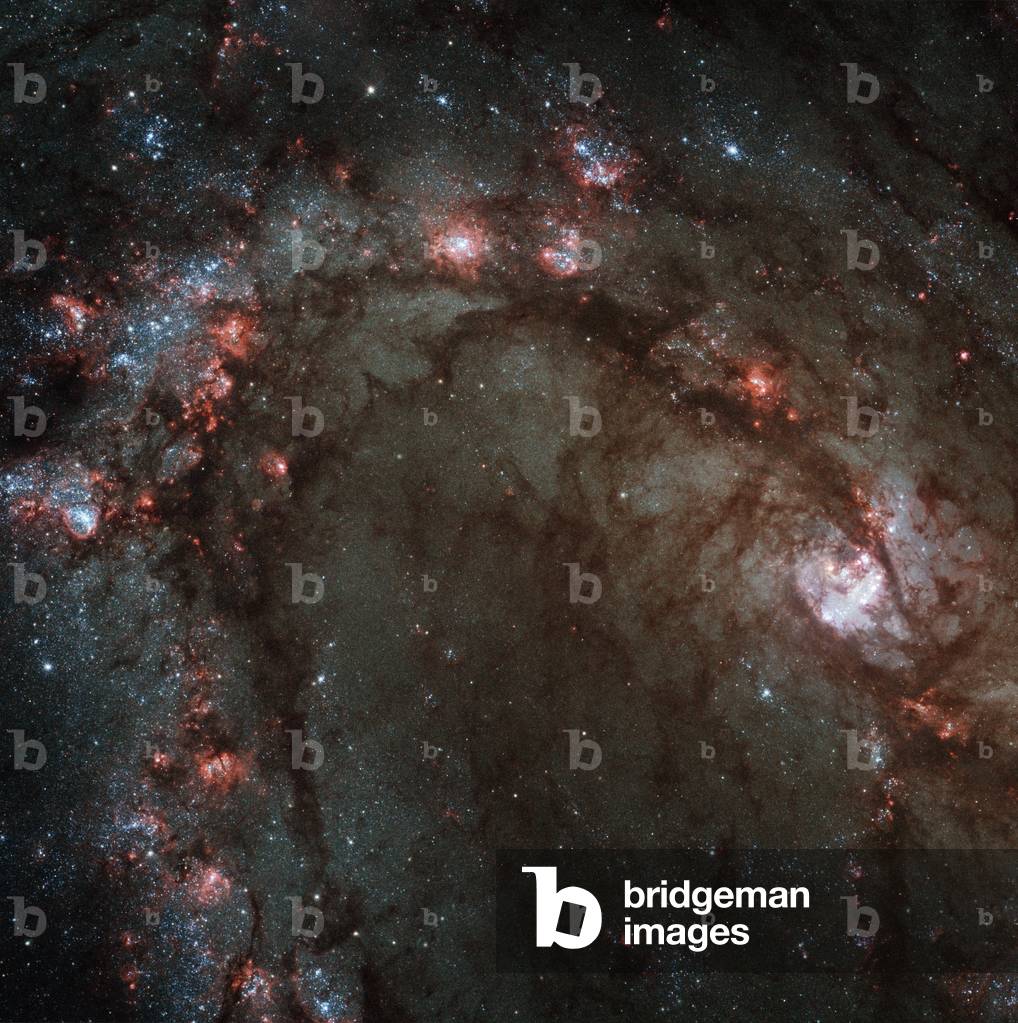
Star Formation in Galaxy M83 - Star Birth in Spiral galaxy M83 - Close-up of star-forming zones in the arms and near the nucleus (white region on the right) of the M83 galaxy. In red appear the hydrogen clouds in which the stars are born. The new stars are concentrated in blue clusters visible by hundreds on this image. The galaxy M83 (NGC 5236) is located about 15 million light years away from Earth in the constellation Hydra. This galaxy is intermediate between a classic spiral and a barree spiral. Image obtained by the Hubble space telescope with its wide field camera 3 (WFC3) in August 2009. Nicknamed the Southern Pinwheel, M83 is undergoing more rapid star formation than our own Milky Way galaxy, especially in its nucleus. The sharp “” eye”” of the Wide Field Camera 3 (WFC3) has captured hundreds of young star clusters, ancient swarms of globular star clusters, and hundreds of thousands of individual stars, mostly blue supergiants and red supergiants. The image, taken in August 2009, provides a close - up view of the myriad stars near the galaxy's core, the bright whitish region at far right. WFC3's broad wavelength range, from ultraviolet to near - infrared, reveals stars at different stages of evolution, allowing astronomers to dissect the galaxy's star - formation history. The newest generations of stars are forming largely in clusters on the edges of the dark dust lanes, the backbone of the spiral arms. These fledgling stars, only a few million years old, are bursting out of their dusty cocoons and producing bubbles of reddish glowing hydrogen gas. The excavated regions give a colorful “” Swiss cheese””” appearance to the spiral arm. Gradually, the young stars' fierce winds (streams of charged particles) blow away the gas, revealing bright blue star clusters. These stars are about 1 million to 10 million years old. The older populations of stars are not as blue. A bar of stars,

PIX4612521: Star Formation in Galaxy M83 - Star Birth in Spiral galaxy M83 - Close-up of star-forming zones in the arms and near the nucleus (white region on the right) of the M83 galaxy. In red appear the hydrogen clouds in which the stars are born. The new stars are concentrated in blue clusters visible by hundreds on this image. The galaxy M83 (NGC 5236) is located about 15 million light years away from Earth in the constellation Hydra. This galaxy is intermediate between a classic spiral and a barree spiral. Image obtained by the Hubble space telescope with its wide field camera 3 (WFC3) in August 2009. Nicknamed the Southern Pinwheel, M83 is undergoing more rapid star formation than our own Milky Way galaxy, especially in its nucleus. The sharp “” eye”” of the Wide Field Camera 3 (WFC3) has captured hundreds of young star clusters, ancient swarms of globular star clusters, and hundreds of thousands of individual stars, mostly blue supergiants and red supergiants. The image, taken in August 2009, provides a close - up view of the myriad stars near the galaxy's core, the bright whitish region at far right. WFC3's broad wavelength range, from ultraviolet to near - infrared, reveals stars at different stages of evolution, allowing astronomers to dissect the galaxy's star - formation history. The newest generations of stars are forming largely in clusters on the edges of the dark dust lanes, the backbone of the spiral arms. These fledgling stars, only a few million years old, are bursting out of their dusty cocoons and producing bubbles of reddish glowing hydrogen gas. The excavated regions give a colorful “” Swiss cheese””” appearance to the spiral arm. Gradually, the young stars' fierce winds (streams of charged particles) blow away the gas, revealing bright blue star clusters. These stars are about 1 million to 10 million years old. The older populations of stars are not as blue. A bar of stars, / Bridgeman Images

Construction of a building in Chelsea, New York, United States.

TEC4611998: Construction of a building in Chelsea, New York, United States. / Bridgeman Images

Central Park in Manhattan, New York, United States.

TEC4612040: Central Park in Manhattan, New York, United States. / Bridgeman Images

Spiral galaxy NGC 5033 in Hunting Dogs - Seyfert galaxy NGC 5033 in Canes Venatici - The spiral galaxy NGC 5033 is located about 43 million years ago - light from Earth. It is a galaxy of Seyfert whose core houses a supermassive black hole. This spiral galaxy is a Seyfert galaxy with a nucleus containing a supermassive black hole. NGC 5033 is located at about 40 million light year away

PIX4612090: Spiral galaxy NGC 5033 in Hunting Dogs - Seyfert galaxy NGC 5033 in Canes Venatici - The spiral galaxy NGC 5033 is located about 43 million years ago - light from Earth. It is a galaxy of Seyfert whose core houses a supermassive black hole. This spiral galaxy is a Seyfert galaxy with a nucleus containing a supermassive black hole. NGC 5033 is located at about 40 million light year away / Bridgeman Images

View of the city of Zaragoza (Zaragoza) in 1646 (oil on canvas)

JLJ4612536: View of the city of Zaragoza (Zaragoza) in 1646 (oil on canvas), Mazo, Juan Bautista Martinez del (1612-67) / Bridgeman Images

Spiral galaxy NGC 5364 in Virgo - Spiral galaxy NGC 5364 in Virgo - Spiral galaxy located in the constellation Virgo. At the bottom of the picture, the galaxy NGC 5360. Image obtained with a telescope 61 cm in diameter. Spiral galaxy located in Virgo constellation. Below, the edge - on galaxy NGC 5360. Image taken with a 24 - inch telescope

PIX4612577: Spiral galaxy NGC 5364 in Virgo - Spiral galaxy NGC 5364 in Virgo - Spiral galaxy located in the constellation Virgo. At the bottom of the picture, the galaxy NGC 5360. Image obtained with a telescope 61 cm in diameter. Spiral galaxy located in Virgo constellation. Below, the edge - on galaxy NGC 5360. Image taken with a 24 - inch telescope / Bridgeman Images

Oriental antique art: Electrum cup, c.1200 BC (gold and silver)

JLJ4612596: Oriental antique art: Electrum cup, c.1200 BC (gold and silver), Iranian School / Bridgeman Images

Center of the Spiral Galaxy M101 - Spiral galaxy M101 in constellation Ursa Major - The galaxy M101 (NGC 5457) is located about 27 million years - light from Earth. Composite image obtained by the Hubble Space Telescope. The spiral galaxy M101 is about 27 million light - years away in the constellation Ursa Major. Image of the core of M101 taken by the Hubble space telescope (HST)

PIX4612732: Center of the Spiral Galaxy M101 - Spiral galaxy M101 in constellation Ursa Major - The galaxy M101 (NGC 5457) is located about 27 million years - light from Earth. Composite image obtained by the Hubble Space Telescope. The spiral galaxy M101 is about 27 million light - years away in the constellation Ursa Major. Image of the core of M101 taken by the Hubble space telescope (HST) / Bridgeman Images

Project for a hotel room, 1967 (Acrylic on canvas)

LRI4612746: Project for a hotel room, 1967 (Acrylic on canvas), Adami, Valerio (b.1935) / Bridgeman Images

Homage to the Square: slale and late sky, 1961 (painting)

LRI4612782: Homage to the Square: slale and late sky, 1961 (painting), Albers, Josef (1888-1976) / Bridgeman Images
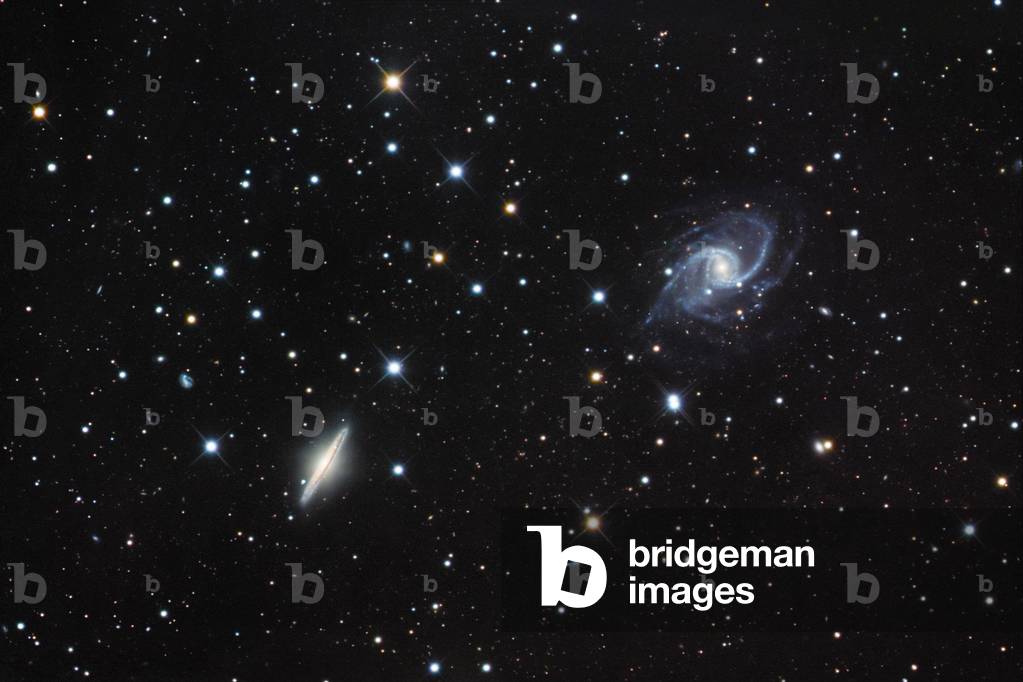
Spiral galaxies NGC 5905 and NGC 5908 in Dragon - Spiral galaxies NGC 5905 and 5908 in Draco - These galaxies are located approximately 140 million years ago - light in the constellation of Dragon. NGC 5905, on the right, is a barree spiral galaxy, NGC 5908, a spiral galaxy seen from the edge. These galaxies are about 140 million light years in the constellation Draco. Right is the NGC 5905 barred spiral galaxy, left the edge - on NGC 5908 spiral galaxy

PIX4612826: Spiral galaxies NGC 5905 and NGC 5908 in Dragon - Spiral galaxies NGC 5905 and 5908 in Draco - These galaxies are located approximately 140 million years ago - light in the constellation of Dragon. NGC 5905, on the right, is a barree spiral galaxy, NGC 5908, a spiral galaxy seen from the edge. These galaxies are about 140 million light years in the constellation Draco. Right is the NGC 5905 barred spiral galaxy, left the edge - on NGC 5908 spiral galaxy / Bridgeman Images

The promenade planted on the High Line in New York (New York), United States (United States). Photography 26/09/10

TEC4612243: The promenade planted on the High Line in New York (New York), United States (United States). Photography 26/09/10 / Bridgeman Images

Prophet Zechariah (Marble Sculpture, 16th century)

LRI4612249: Prophet Zechariah (Marble Sculpture, 16th century), Vittoria, Alessandro (1525-1608) / Bridgeman Images

Cafe Pastis, 9th Avenue, Chelsea, New York (New York), United States (United States). Photography 26/09/10

TEC4612266: Cafe Pastis, 9th Avenue, Chelsea, New York (New York), United States (United States). Photography 26/09/10 / Bridgeman Images

Spiral Galaxy M51 in Hunting Dogs - Spiral galaxy M51 in Canes Venatici - The spiral galaxy M51 (NGC 5194) is located about 37 million years ago - light from Earth. This galaxy is double; two galaxies interact: the largest, NGC 5194, the smallest NGC 5195. M51 (NGC 5194) is located 31 million light - years away in the constellation Canes Venatici (the Hunting Dogs). It was one of the first discoveries made by Charles Messier in 1773, and it was the first galaxy where spiral structure was observed, by Lord Rosse in 1845. A faint companion galaxy, NGC 5195, seen here to the left of M51, is interacting with M51

PIX4612349: Spiral Galaxy M51 in Hunting Dogs - Spiral galaxy M51 in Canes Venatici - The spiral galaxy M51 (NGC 5194) is located about 37 million years ago - light from Earth. This galaxy is double; two galaxies interact: the largest, NGC 5194, the smallest NGC 5195. M51 (NGC 5194) is located 31 million light - years away in the constellation Canes Venatici (the Hunting Dogs). It was one of the first discoveries made by Charles Messier in 1773, and it was the first galaxy where spiral structure was observed, by Lord Rosse in 1845. A faint companion galaxy, NGC 5195, seen here to the left of M51, is interacting with M51 / Bridgeman Images

Spiral Galaxy M83 in Hydra - Galaxy M83 in Hydra - The Galaxy M83 (NGC 5236) is located about 15 million years away from Earth. This galaxy is intermediate between a classic spiral and a barree spiral. Image obtained by the Hubble Space Telescope (HST). M83 (NGC 5236) is located in the southern constellation Hydra at 15 million light years from the sun. It is classified as intermediate between normal and barred spiral galaxies. Image taken with the Hubble space telescope (HST)

PIX4612516: Spiral Galaxy M83 in Hydra - Galaxy M83 in Hydra - The Galaxy M83 (NGC 5236) is located about 15 million years away from Earth. This galaxy is intermediate between a classic spiral and a barree spiral. Image obtained by the Hubble Space Telescope (HST). M83 (NGC 5236) is located in the southern constellation Hydra at 15 million light years from the sun. It is classified as intermediate between normal and barred spiral galaxies. Image taken with the Hubble space telescope (HST) / Bridgeman Images

The Prairie of San Isidro (San Isidro) View of the City of Madrid from the Hermitage of San Isidoro, 1788 (oil on canvas)

JLJ4612864: The Prairie of San Isidro (San Isidro) View of the City of Madrid from the Hermitage of San Isidoro, 1788 (oil on canvas), Goya y Lucientes, Francisco Jose de (1746-1828) / Bridgeman Images

Equestrian portrait of Isabelle of France (1602-1644), 1616 (oil on canvas)

JLJ4612887: Equestrian portrait of Isabelle of France (1602-1644), 1616 (oil on canvas), Velazquez, Diego Rodriguez de Silva y (1599-1660) / Bridgeman Images

The Chrysler Building in Manhattan (New York, USA).

MDA4612963: The Chrysler Building in Manhattan (New York, USA)., Alen, William Van (1883-1954) / Bridgeman Images

Spiral galaxy NGC 6744 in the constellation Peacock - Spiral galaxy NGC 6744 in Pavo - The galaxy NGC 6744 is about 25 million years away - light from Earth. This galaxy interacts with a dwarf galaxy. Image obtained with a telescope of 35 cm, 12 hours of poses. NGC 6744 is a majestic spiral galaxy in the southern constellation of Pavo. It has great similarities to the Milky Way galaxy in both form and structure. It lies at a distance of approximately 25 million Light Years. At its northern tip NGC 6744 is interacting with a dwarf companion galaxy much in the same way the Milky Way interacts with the Large Magellanic Cloud. The northernmost spiral arm is most likely being stretched and its stars and gas stripped due to tidal pull from the dwarf companion. Likewise the stars of the companion will likely be engulfed and the companion will ultimately merge with NGC 6744 at a far off future time. Image taken with 14.5”” RCOS telescope, 12 Hours of exposure

PIX4612972: Spiral galaxy NGC 6744 in the constellation Peacock - Spiral galaxy NGC 6744 in Pavo - The galaxy NGC 6744 is about 25 million years away - light from Earth. This galaxy interacts with a dwarf galaxy. Image obtained with a telescope of 35 cm, 12 hours of poses. NGC 6744 is a majestic spiral galaxy in the southern constellation of Pavo. It has great similarities to the Milky Way galaxy in both form and structure. It lies at a distance of approximately 25 million Light Years. At its northern tip NGC 6744 is interacting with a dwarf companion galaxy much in the same way the Milky Way interacts with the Large Magellanic Cloud. The northernmost spiral arm is most likely being stretched and its stars and gas stripped due to tidal pull from the dwarf companion. Likewise the stars of the companion will likely be engulfed and the companion will ultimately merge with NGC 6744 at a far off future time. Image taken with 14.5”” RCOS telescope, 12 Hours of exposure / Bridgeman Images

Port of Lisbon in the 16th century Miniature in

JLJ4613101: Port of Lisbon in the 16th century Miniature in "Chronicle of King Alfonso Henri", 16th century (miniature), Unknown Artist, (16th century) / Bridgeman Images

Elliptical Galaxy Centaurus A (NGC 5128) - The galaxy Centaurus A - The galaxy NGC 5128 is located about 13 million light years away from Earth in the southern constellation of Centaurus. This giant galaxy is a powerful radio source known as Centaurus A. The central dark band would be the rest of dust in a spiral galaxy smaller than the giant galaxy would have cannibalized. Centaurus A is an active galaxy whose energy comes from a supermassive black hole. Image made with an amateur instrument, a 130 mm bezel. Designated as radio source Centaurus A, NGC 5128 is one of the most peculiar galaxies in the sky. It is bisected by a dark lane that is considered the dust remnant of a smaller spiral galaxy that was cannibalized by the larger elliptical galaxy. The collision resulted in a burst of star formation. A gigantic black hole equivalent to one billion solar masses resides inside NGC 5128

PIX4612235: Elliptical Galaxy Centaurus A (NGC 5128) - The galaxy Centaurus A - The galaxy NGC 5128 is located about 13 million light years away from Earth in the southern constellation of Centaurus. This giant galaxy is a powerful radio source known as Centaurus A. The central dark band would be the rest of dust in a spiral galaxy smaller than the giant galaxy would have cannibalized. Centaurus A is an active galaxy whose energy comes from a supermassive black hole. Image made with an amateur instrument, a 130 mm bezel. Designated as radio source Centaurus A, NGC 5128 is one of the most peculiar galaxies in the sky. It is bisected by a dark lane that is considered the dust remnant of a smaller spiral galaxy that was cannibalized by the larger elliptical galaxy. The collision resulted in a burst of star formation. A gigantic black hole equivalent to one billion solar masses resides inside NGC 5128 / Bridgeman Images

The temptation of Saint Anthony, 1869 (oil on canvas)

JLJ4612255: The temptation of Saint Anthony, 1869 (oil on canvas), Isabey, Louis Eugene Gabriel (1803-86) / Bridgeman Images

View of the room of Emperor Napoleon I (1769-1821) at the castle of Malmaison, at Rueil Malmaison., 19th century (photo)

JLJ4612270: View of the room of Emperor Napoleon I (1769-1821) at the castle of Malmaison, at Rueil Malmaison., 19th century (photo), French School, (19th century) / Bridgeman Images

Sunset A landscape of cliffs and rocks on the sea, with fishermen in the foreground. Detail, 18th century (painting)

JLJ4612290: Sunset A landscape of cliffs and rocks on the sea, with fishermen in the foreground. Detail, 18th century (painting), Lebel, Antoine (1705-93) / Bridgeman Images

The Chelsea Market in New York (New York), United States (USA).

TEC4612318: The Chelsea Market in New York (New York), United States (USA). / Bridgeman Images


Back to top