
Print this page or go back to standard view.

TEC4612338: The MoMA (Museum Modern of Art), 11 West 53 St Midtown, Manhattan, New York (New York), United States (United States). Architecture of Rafael Pelli, Cesar Pelli, Edward Durell Stone and Fred Clarke in 1984. Philip Goodwin in 1939. Photography 26/09/10 / Bridgeman Images

JLJ4612393: Marie F. des Ursins, Duchess of Montmorency and the poet Theophile de Viau in Chantilly, 1895 (oil on canvas), Merson, Luc-Oliver (1846-1920) / Bridgeman Images

JLJ4612578: Art Mesopotamia: Statue of Intendant Ebih-il, 2900-2200 BC (albaster), Mesopotamian, (25th century BC) / Bridgeman Images

PIX4612741: Spiral galaxy M101 in the Great Bear - Spiral galaxy M101 in constellation Ursa Major - The galaxy M101 (NGC 5457) is located about 27 million years ago - light from Earth. Composite image obtained from the Hubble space telescope and a 50 cm telescope. The spiral galaxy M101 is about 27 million light - years away in the constellation Ursa Major. Composite image, Hubble space telescope and 50 cm telescope datas / Bridgeman Images

JLJ4612764: Frule perfume or hand warmer from Syria, late 15th-early 16th century (gold, silver and black paste), Syrian School, (16th century) / Bridgeman Images

LRI4612783: Pentacromogramma, 1975-1977 (serigraphy), Alviani, Getulio (b.1939) / Bridgeman Images

JLJ4612819: Monument to the heart of Anne, lord then first Duke of Montmorency (1493-1567), 1571 (bronze, marble), French School, (16th century) / Bridgeman Images

PIX4612824: Lenticular Galaxy M102 (NGC 5866) in the Dragon - Edge - on view of M102 (NGC 5866) in Draco - This galaxy from the slice is located 44 million years - light from Earth. Its diameter is 60,000 years - light. Image obtained by the ACS camera of the Hubble space telescope in February 2006. The lenticular galaxy NGC 5866 is about 44 million light - years from Earth in the Northern constellation Draco. Its diameter is approximately 60,000 light - years, two - thirds the diameter of the Milky Way, and its mass is similar to our galaxy. Hubble image taken with the Advanced Camera for Surveys in February 2006 / Bridgeman Images

PIX4613137: Spiral galaxy NGC 7331 in Pegase - Spiral galaxy NGC 7331 in Pegasus - The galaxy NGC 7331 is located about 50 million years away - light from Earth. The small galaxies around them form a cluster much farther away. NGC 7331 is located 49 million light years away. The smaller galaxies visible are much farer / Bridgeman Images

JLJ4613153: The Portuguese navigator Vasco de Gama (1459-1524) arrived in Calicut in India in 1498, detail, tapestry, 1498 (tapestry) / Bridgeman Images
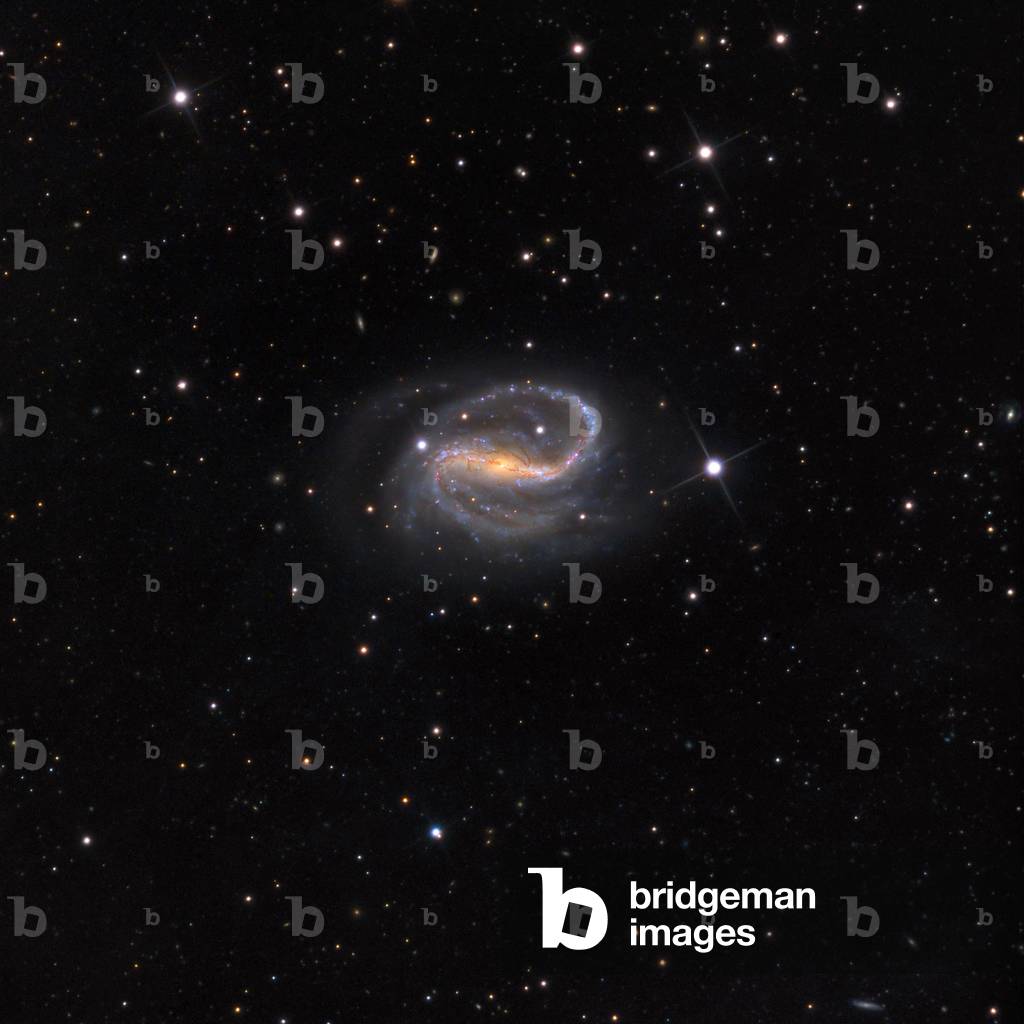
PIX4613178: Barree spiral galaxy NGC 7479 in Pegase - Barred spiral galaxy NGC 7479 in Pegasus - Its distance is estimated to be about 105 million light years away / Bridgeman Images

JLJ4613189: Baptistere basin in copper and silver made, (14th century). From Egypt or Syria, 14th century (copper and silver), Ibn-Al-Zayn, Muhammed (14th century) / Bridgeman Images

JLJ4613231: The Venus de Milo Sculpture depicting Aphrodite in marble. 100 BC (marble), Greek school, (1st century BC) / Bridgeman Images

PIX4613248: Spiral Galaxy NGC 7814 in Pegase - Spiral galaxy NGC 7814 in Pegasu / Bridgeman Images
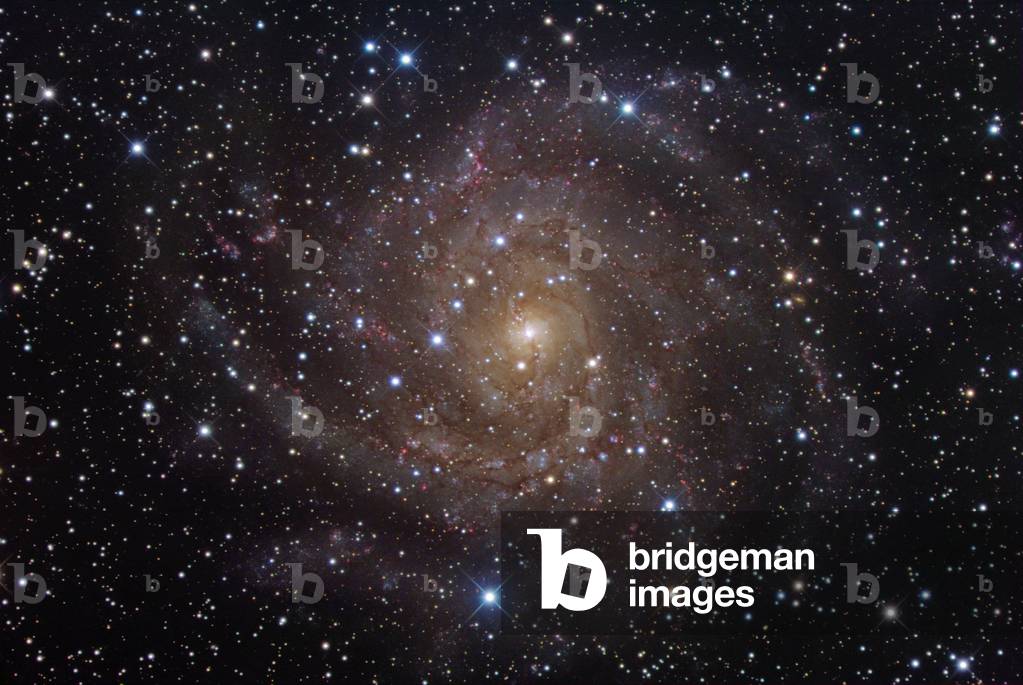
PIX4613273: Spiral galaxy IC 342 in the Giraffe - Spiral galaxy IC 342 in Camelopardalis - Spiral galaxy IC 342 located about 14 million years ago - light in the Giraffe. Image obtained with a 50 cm telescope. 15 hours of installation. Spiral galaxy located 14 million light year away / Bridgeman Images

MDA4613381: New York Time Tower, New York, United States. This 279-metres high tower is a very interesting technical feature. The agency has developed a second skin on the outer surface, giving the illusion of a large floating sail, passing the top of about thirty meters., Denance, Michel / Bridgeman Images

JLJ4613405: Persian art: terracotta cup with an ibex, 10th century (terracotta), Persian School, (10th century) / Bridgeman Images

PIX4613427: The Large Magellanic Cloud - The Large Magellanic Cloud - The Great Magellan Cloud galaxy is located about 160,000 light years away from Earth in the southern constellation of Dorado. Visible with the naked eye in the southern hemishere it is one of the closest galaxies to us. It contains large star-forming zones such as the Tarantula Nebula (30 Sea bream, visible to the left), the most active star-forming regions of the local group. Image obtained by the 1.2m UK Schmidt telescope from Siding Spring, Australia. The Large Magellanic Cloud (LMC) is the nearest galaxy to the Milky Way but less than one tenth as massive; even so it contains the equivalent of over ten billion solar masses of material in the form of stars, gas and dust. The LMC is at a distance of 160,000 light years and is visible to the unaided eye from southern latitudes, rather like a detached piece of the Milky Way. The nearness of the LMC ensures that it is well resolved into stars in quite a modest telescope, and deep photographs reveal it to be a highly complex system with large numbers of clusters, nebulae and dust clouds scattered apparently at random across the face of the galaxy. The bright red patch at the eastern end of the galaxy is the star - forming region 30 Doradus / Bridgeman Images

JLJ4612563: Portrait of Elisabeth Charlotte d'Orleans (1676-1744), 1698 (painting), Gobert, Pierre (1662-1744) (studio of) / Bridgeman Images

JLJ4612731: Furniture, 18th century (screen painting on maroufle paper), Lajoue, Jacques de (1687-1761) / Bridgeman Images

LRI4612759: False Bumblebee (Fake Bumblebee), 1952 (Painting), Basaldella, Afro (1912-76) / Bridgeman Images

JLJ4612849: The Actions of Prince Louis II of Bourbon Conde, 17th century (oil on canvas), Le Conte, Sauveur (1659-94) / Bridgeman Images
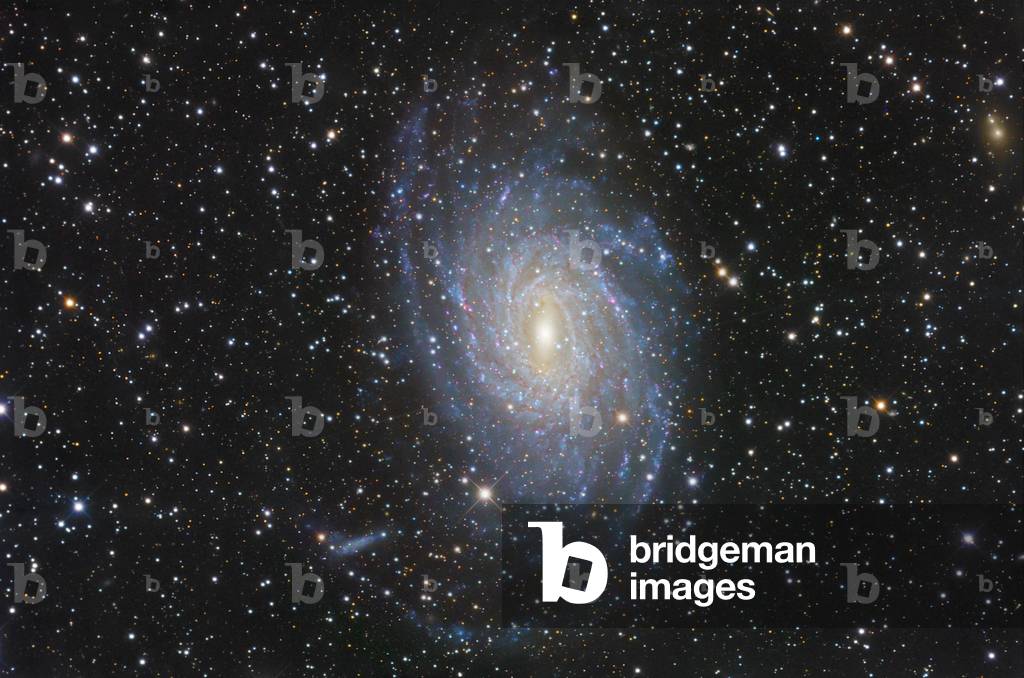
PIX4612975: Spiral galaxy NGC 6744 in the constellation Peacock - Spiral galaxy NGC 6744 in Pavo - The galaxy NGC 6744 is about 25 million years away - light from Earth. Image obtained with a telescope of 35 cm, 12 hours of poses. NGC 6744 is a majestic spiral galaxy in the southern constellation of Pavo. It has great similarities to the Milky Way galaxy in both form and structure. It lies at a distance of approximately 25 million Light Years. At its northern tip NGC 6744 is interacting with a dwarf companion galaxy much in the same way the Milky Way interacts with the Large Magellanic Cloud. The northernmost spiral arm is most likely being stretched and its stars and gas stripped due to tidal pull from the dwarf companion. Likewise the stars of the companion will likely be engulfed and the companion will ultimately merge with NGC 6744 at a far off future time. Image taken with 14.5”” RCOS telescope, 12 Hours of exposure / Bridgeman Images

PIX4613003: Interacting galaxies NGC 6786 and LEDA 62867 - Interacting galaxies NGC 6786 and LEDA 62867 - The galaxy NGC 6786, on the right, is about 350 million years away - light from Earth in the constellation of the Dragon. It interacts with another spiral galaxy, LEDA 62867, on the left; it will probably swallow it in the distant future. Image obtained by the Hubble Space Telescope on March 10, 2002. This Hubble image displays a beautiful pair of interacting spiral galaxies with swirling arms. The smaller of the two, dubbed LEDA 62867 and positioned to the left of the frame, seems to be safe for now, but will probably be swallowed by the larger spiral galaxy, NGC 6786 (to the right) eventually. There is already some disturbance visible in both components. The pair is number 538 in Karachentsev's Catalog of Pairs of Galaxies. A supernova was seen to explode in the large spiral in 2004. NGC 6786 is located in the constellation of Draco, the Dragon, about 350 million light - years away. Image taken by the Hubble space telescope on march 10, 2002 / Bridgeman Images

PIX4613037: Irregular galaxy NGC 6822 in Sagittarius - Nearby irregular galaxy NGC 6822: The galaxy NGC 6822 is located about 1.8 million light years away from Earth. It belongs to our local group. - NGC 6822 is located approximately 1.6 million light-years from Earth, in the constellation Sagittarius. It is a member of the Milky Way galaxy's Local Group / Bridgeman Images

JLJ4613090: Art Nouveau: support cabinet made, 1924 (oak, metal and ivory), Legrain, Pierre E. (1889-1929) / Bridgeman Images

JLJ4613482: The Death of Napoleon, 5/05/1821 at Saint Helene Detail representing Jean Abraham Noverraz (1790-1849), 1821 (lithograph), Jazet, Jean Pierre Marie (1788-1871) / Bridgeman Images

TEC4613645: Cinema MK2, 14 quai de la Seine Paris 19th arrondissement. / Bridgeman Images

TEC4613703: Round point Paris 19th arrondissement. / Bridgeman Images

LRI4612943: Composition, 1977 (Acrylic on canvas), Barbanti, Giuliano (1936) / Bridgeman Images

PIX4610122: Colliding galaxies NGC 2623 in Cancer - Colliding galaxies NGC 2623 - The galaxy NGC 2623 (Arp 243) is located about 250 million years ago - light from Earth in the constellation of Cancer. It is a system of two spiral galaxies colliding and eventually forming only one galaxy. This image was obtained by the Hubble Space Telescope in 2007. Located 250 million light - years away in the constellation of Cancer, these colliding galaxies are in the late stages of the merging process with the centres of the original galaxy pair now merged into one nucleus. Image obtained by the Hubble space telescope in 2007 / Bridgeman Images

JLJ4610341: A book binder, in "New assembly of the manouvries habilles", 18th century (engraving), Engelbrecht, Martin (1684-1756) / Bridgeman Images

PIX4610496: Galaxies NGC 3169, NGC 3166, NGC 3165 in the Sextant - Galaxies NGC 3169, NGC 3166, NGC 3165 in Sextans - Group of spiral galaxies located about 60 million light years away from Earth. On the left is the galaxy NGC 3169, in the center is the galaxy NGC 3166, in the bottom right is the galaxy NGC 3165. Group of spiral galaxies at about 60 million light years away. Left is NGC 3169, center is NGC 3166, bottom right, NGC 3165 / Bridgeman Images

JLJ4610541: Portrait of Mrs Tuder, 1818 (oil on canvas), Constable, John (1776-1837) / Bridgeman Images

PIX4610013: Spiral Galaxy NGC 2397 - Galaxy Spiral NGC 2397 - The galaxy NGC 2397 is a classic spiral galaxy located about 60 million years ago - light from Earth in the southern constellation of Flying Fish. The central part houses old yellow and red stars while new stars form in the outer arms. This image obtained by the space telescope on 14 October 2006 shows the brightest of these young blue stars. The 2006bc supernova, which exploded in March 2006, is also visible near the central region, while its lightning shrinking. Located nearly 60 million light - years away from Earth, the galaxy NGC 2397 is typical of most spirals, with mostly older, yellow and red stars in its central portion, while star formation continues in the outer, bluer spiral arms. The brightest of these young, blue stars can be seen individually in this high resolution view from the Hubble's Advanced Camera for Surveys (ACS). One typical feature of this Hubble image is the view of supernova SN 2006bc taken when its brightness was on the decrease. SN 2006bc was discovered in March 2006. The images were obtained on 14 October 2006 with Hubble's Advanced Camera for Surveys (ACS) through three different colour filters (blue, green and near - infrared) / Bridgeman Images

PIX4610072: Galaxy NGC 2403: Spiral galaxy NGC 2403 distant about 11-12 million light years in the constellation Giraffe. Composite images obtained from the Hubble Space Telescope (HST) and the Subaru Telescope. NGC 2403 is a galaxy located 11 million light-years from Earth. Composite of images taken by the Hubble space telescope (HST) and Subaru telescope / Bridgeman Images