Search options

Orientation
Colour

Display options

View

Print

To print search results, use print friendly version of this page.

2502117 Search Results
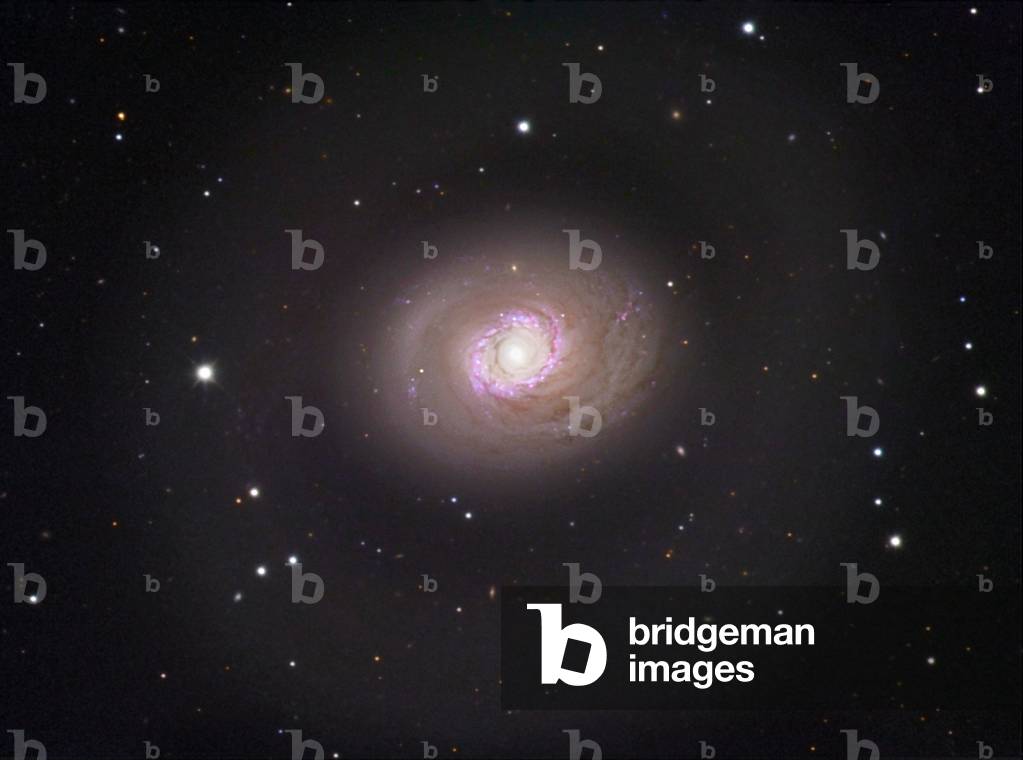
Spiral Galaxy M94 in Hunting Dogs - Spiral galaxy M94 in Canes Venatici - The spiral galaxy M94 (NGC 4736) is located about 15 million years ago - light from Earth. The M94 spiral galaxy was classified as Sab because of the extreme luminosite of its central region. This galaxy has several ring zones of star formation, one of which is very active. M94 is a spiral galaxy located 15 million light - year away. Several active regions of star formation have been identified there

PIX4611948: Spiral Galaxy M94 in Hunting Dogs - Spiral galaxy M94 in Canes Venatici - The spiral galaxy M94 (NGC 4736) is located about 15 million years ago - light from Earth. The M94 spiral galaxy was classified as Sab because of the extreme luminosite of its central region. This galaxy has several ring zones of star formation, one of which is very active. M94 is a spiral galaxy located 15 million light - year away. Several active regions of star formation have been identified there / Bridgeman Images

Wall Street in Manhattan, New York (United States).

TEC4611970: Wall Street in Manhattan, New York (United States). / Bridgeman Images

Portrait of Two English Gentlemen (oil on canvas, circa 1635-1640)

LRI4612022: Portrait of Two English Gentlemen (oil on canvas, circa 1635-1640), Dyck, Anthony van (1599-1641) (school of) / Bridgeman Images

Buildings in New York (New York), United States (United States).

TEC4612069: Buildings in New York (New York), United States (United States). / Bridgeman Images
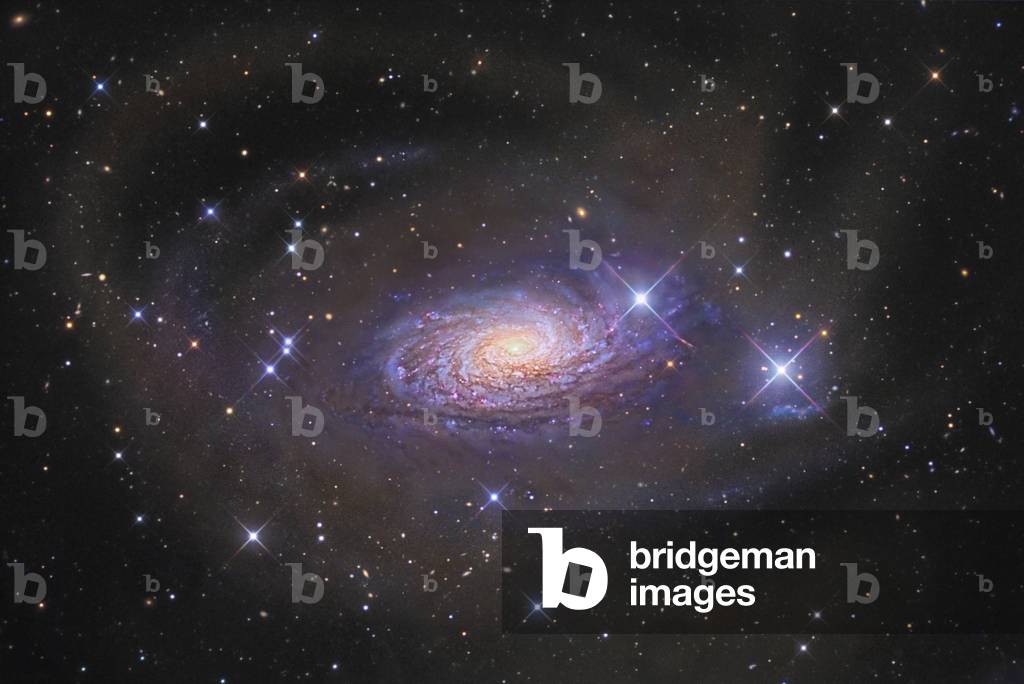
Spiral Galaxy M63 in Hunting Dogs - Spiral galaxy M63 in Canes Venatici - The spiral galaxy M63 (NGC 5055) is located about 35 million years ago - light from Earth. In this image obtained with a 50 cm telescope, the halo around the galaxy is visible and shows a stream of stars from a dwarf satellite galaxy. M63 (NGC 5055) is a spiral glaxy in the contellation Canes Venatici at about 35 million light - years from Earth. Visible in this image is a very faint, giant arc - loop feature in the halo of the galaxy Messier 63; this feature is the stellar stream of a disrupted dwarf satellite galaxy

PIX4612127: Spiral Galaxy M63 in Hunting Dogs - Spiral galaxy M63 in Canes Venatici - The spiral galaxy M63 (NGC 5055) is located about 35 million years ago - light from Earth. In this image obtained with a 50 cm telescope, the halo around the galaxy is visible and shows a stream of stars from a dwarf satellite galaxy. M63 (NGC 5055) is a spiral glaxy in the contellation Canes Venatici at about 35 million light - years from Earth. Visible in this image is a very faint, giant arc - loop feature in the halo of the galaxy Messier 63; this feature is the stellar stream of a disrupted dwarf satellite galaxy / Bridgeman Images

Rejouissances given by the city of Paris aux Halles on 21/01/1782 (oil on canvas)

JLJ4612195: Rejouissances given by the city of Paris aux Halles on 21/01/1782 (oil on canvas), Debucourt, Philibert Louis (1755-1832) / Bridgeman Images

Galaxy NGC 4449 in Hunting Dogs - Dwarf irregular galaxy NGC 4449 in Canes Venatici - Dwarf galaxy irregular located in the constellation Hunting Dogs

PIX4611355: Galaxy NGC 4449 in Hunting Dogs - Dwarf irregular galaxy NGC 4449 in Canes Venatici - Dwarf galaxy irregular located in the constellation Hunting Dogs / Bridgeman Images

French Revolution: a mortuary mask of the French revolutionary Jean Paul Marat (1743-1793), 1793 (carving)

JLJ4611388: French Revolution: a mortuary mask of the French revolutionary Jean Paul Marat (1743-1793), 1793 (carving), French School, (18th century) / Bridgeman Images

The roofs of Manhattan seen from a tower. New York (United States). Photograph 10/04/03.

TEC4611482: The roofs of Manhattan seen from a tower. New York (United States). Photograph 10/04/03. / Bridgeman Images
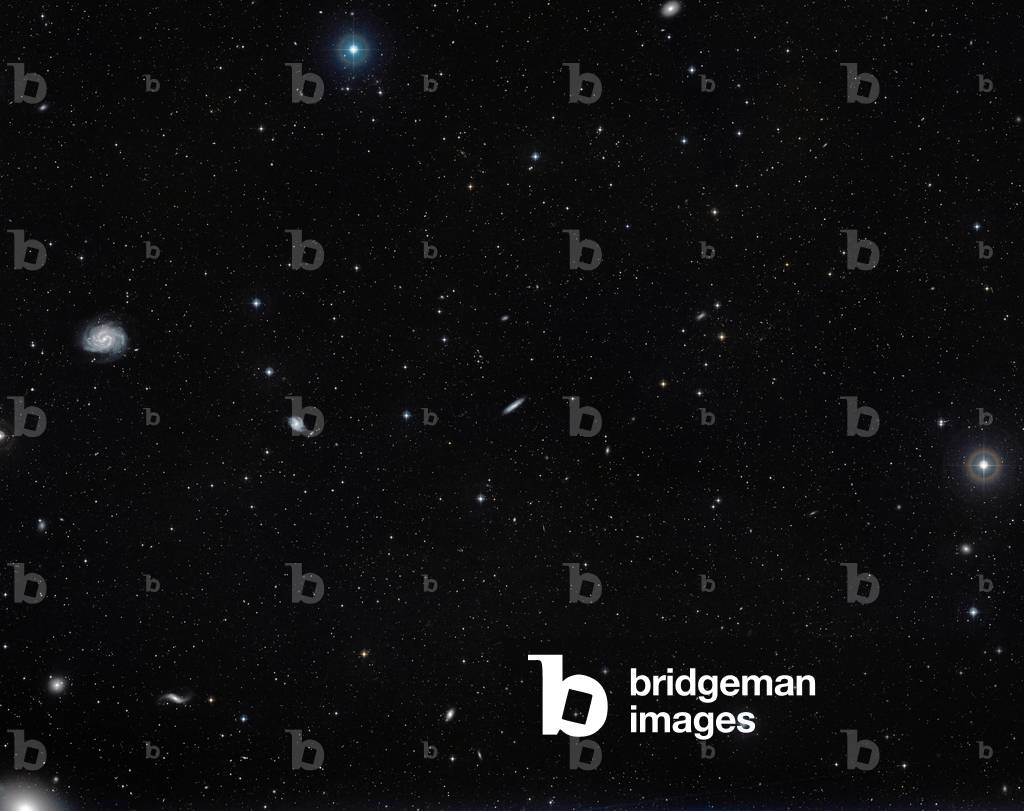
Field around the galaxy NGC 4522 - Wide field around the galaxy NGC 4522 - Field around the galaxy NGC 4522 (center) in the galaxy cluster of the Virgin. On the extreme left, the spiral galaxy NGC 4535. Wide field around the galaxy NGC 4522 (center of the image) in the Virgo galaxy cluster

PIX4611505: Field around the galaxy NGC 4522 - Wide field around the galaxy NGC 4522 - Field around the galaxy NGC 4522 (center) in the galaxy cluster of the Virgin. On the extreme left, the spiral galaxy NGC 4535. Wide field around the galaxy NGC 4522 (center of the image) in the Virgo galaxy cluster / Bridgeman Images

Spiral galaxy NGC 4565 in Berenice's Hair - Spiral galaxy NGC 4565 in Coma Berenices - The galaxy NGC 4565 is located about 30 million years ago - light from Earth. It's a spiral galaxy seen by the slice. This image was obtained by one of the 8.2 m telescopes of the VLT in Chile. NGC 4565 is a very large edge - on spiral galaxy over 100,000 light - years in diameter, located at about 30 million light - years from us

PIX4611520: Spiral galaxy NGC 4565 in Berenice's Hair - Spiral galaxy NGC 4565 in Coma Berenices - The galaxy NGC 4565 is located about 30 million years ago - light from Earth. It's a spiral galaxy seen by the slice. This image was obtained by one of the 8.2 m telescopes of the VLT in Chile. NGC 4565 is a very large edge - on spiral galaxy over 100,000 light - years in diameter, located at about 30 million light - years from us / Bridgeman Images

The Fuller Building, construction 1928-1929, architects Walker Morrisae & Gilette, 41East 57th Street in Manhattan New York (United States). Photography 10/04/03.

TEC4611531: The Fuller Building, construction 1928-1929, architects Walker Morrisae & Gilette, 41East 57th Street in Manhattan New York (United States). Photography 10/04/03. / Bridgeman Images

Spiral Galaxy M58 in Virgo - Spiral galaxy M58 in Virgo - The spiral galaxy M58 (NGC 4579) is located about 60 million years away - light from Earth. It is part of the great cluster of galaxies of the Virgin. M58 is a spiral galaxy of type SBC in the constellation Virgo, although the bar is not prominent and some have classified it as intermediate between normal and barred spirals

PIX4611566: Spiral Galaxy M58 in Virgo - Spiral galaxy M58 in Virgo - The spiral galaxy M58 (NGC 4579) is located about 60 million years away - light from Earth. It is part of the great cluster of galaxies of the Virgin. M58 is a spiral galaxy of type SBC in the constellation Virgo, although the bar is not prominent and some have classified it as intermediate between normal and barred spirals / Bridgeman Images

Spiral galaxy of Sombrero M104 in the Virgin - The Sombrero galaxy (M104) in Virgo - Image of the spiral galaxy M104 or NGC 4594 (Sombrero galaxy), located about 28 million years ago - light. The Sombrero, named after the broad - brimmed Mexican hat it superficially resembles, is probably the most famous galaxy in the sky. The light from this remarkable spiral system is dominated by the billions of old, faint stars that form the vast 'bulge' around its tiny hidden nucleus. Most spirals, including the Milky Way, have clouds of old, faint stars around their nuclei, but in M104 the galaxy's light is dominated by them. This effect is enhanced because disk of the galaxy is seen nearly edge - on and dust in its outer parts is in silhouette as it crosses the picture. The galaxy is about 28 million light years distant

PIX4611629: Spiral galaxy of Sombrero M104 in the Virgin - The Sombrero galaxy (M104) in Virgo - Image of the spiral galaxy M104 or NGC 4594 (Sombrero galaxy), located about 28 million years ago - light. The Sombrero, named after the broad - brimmed Mexican hat it superficially resembles, is probably the most famous galaxy in the sky. The light from this remarkable spiral system is dominated by the billions of old, faint stars that form the vast 'bulge' around its tiny hidden nucleus. Most spirals, including the Milky Way, have clouds of old, faint stars around their nuclei, but in M104 the galaxy's light is dominated by them. This effect is enhanced because disk of the galaxy is seen nearly edge - on and dust in its outer parts is in silhouette as it crosses the picture. The galaxy is about 28 million light years distant / Bridgeman Images

Spiral galaxy of Sombrero M104 in the Virgin - The Sombrero galaxy (M104) in Virgo - The spiral galaxy M104 or NGC 4594 (Sombrero galaxy) is located between 28 and 40 million years - light. Image obtained with a telescope 61 cm in diameter. The Sombrero, named after the broad - brimmed Mexican hat it superficially resembles, is probably the most famous galaxy in the sky. The spiral galaxy is between 28 to 40 million light years distant. Image taken with a 24 - inch telescope

PIX4611664: Spiral galaxy of Sombrero M104 in the Virgin - The Sombrero galaxy (M104) in Virgo - The spiral galaxy M104 or NGC 4594 (Sombrero galaxy) is located between 28 and 40 million years - light. Image obtained with a telescope 61 cm in diameter. The Sombrero, named after the broad - brimmed Mexican hat it superficially resembles, is probably the most famous galaxy in the sky. The spiral galaxy is between 28 to 40 million light years distant. Image taken with a 24 - inch telescope / Bridgeman Images

View of Amsterdam Harbour from Ij Detail, 1666 (oil on canvas)

JLJ4611688: View of Amsterdam Harbour from Ij Detail, 1666 (oil on canvas), Backhuysen, Ludolf, I (1630-1708) / Bridgeman Images

The cathedrale de Rouen, the portal sun morning, blue harmony Detail, 1893 (oil on canvas)

JLJ4611727: The cathedrale de Rouen, the portal sun morning, blue harmony Detail, 1893 (oil on canvas), Monet, Claude (1840-1926) / Bridgeman Images

The elliptical galaxy NGC 4660 - The elliptical galaxy NGC 4660 - The galaxy NGC 4660 is located 49 million years ago - light from Earth, in the Virgin's cluster. Image obtained by the Hubble Space Telescope. The elliptical galaxy NGC 4660 lies at a distance of 49 million light - years from the Sun in the spring constellation Virgo. This image was made from data taken with Hubble space telescope

PIX4611798: The elliptical galaxy NGC 4660 - The elliptical galaxy NGC 4660 - The galaxy NGC 4660 is located 49 million years ago - light from Earth, in the Virgin's cluster. Image obtained by the Hubble Space Telescope. The elliptical galaxy NGC 4660 lies at a distance of 49 million light - years from the Sun in the spring constellation Virgo. This image was made from data taken with Hubble space telescope / Bridgeman Images

Colliding galaxies NGC 4676 in Berenice's Hair - Colliding galaxies NGC 4676 - The galaxy NGC 4676 is located about 300 million years away - light from Earth. It is a system of two spiral galaxies that collide and eventually become one galaxy. This image was obtained by the Hubble Space Telescope in April 2002. Located 300 million light - years away in the constellation Coma Berenices, the colliding galaxies have been nicknamed “” The Mice”” because of the long tails of stars and gas emanating from each galaxy. Otherwise known as NGC 4676, the pair will eventually merge into a single giant galaxy. Image obtained by the Hubble space telescope in April 2002

PIX4611830: Colliding galaxies NGC 4676 in Berenice's Hair - Colliding galaxies NGC 4676 - The galaxy NGC 4676 is located about 300 million years away - light from Earth. It is a system of two spiral galaxies that collide and eventually become one galaxy. This image was obtained by the Hubble Space Telescope in April 2002. Located 300 million light - years away in the constellation Coma Berenices, the colliding galaxies have been nicknamed “” The Mice”” because of the long tails of stars and gas emanating from each galaxy. Otherwise known as NGC 4676, the pair will eventually merge into a single giant galaxy. Image obtained by the Hubble space telescope in April 2002 / Bridgeman Images

Wall Street in Manhattan, New York (United States).

TEC4611915: Wall Street in Manhattan, New York (United States). / Bridgeman Images

Spiral galaxy NGC 4725 in Berenice's Hair - Spiral galaxies NGC 4725 and NGC 4712 on the right. Composite image obtained with Subaru and Hubble telescopes (HST). Spiral galaxies NGC 4725 and NGC 4712 (at right).Composite image from Hubble space telescope and Subaru data sources

PIX4611920: Spiral galaxy NGC 4725 in Berenice's Hair - Spiral galaxies NGC 4725 and NGC 4712 on the right. Composite image obtained with Subaru and Hubble telescopes (HST). Spiral galaxies NGC 4725 and NGC 4712 (at right).Composite image from Hubble space telescope and Subaru data sources / Bridgeman Images

Centaurus A elliptical galaxy (NGC 5128) in Centaurus - The radio galaxy Centaurus A (NGC 5128) - The galaxy NGC 5128 is located about 13 million years away from Earth in the southern constellation of Centaurus. A broad dark band crosses it in the middle, a probable vestige of a collision with a spiral galaxy. This giant galaxy is a powerful radio source known as Centaurus A. It is an active galaxy whose energy comes from a supermassive black hole. Image obtained with a 35 cm telescope, 11 hours of cumulative poses. NGC 5128 is the nearest large elliptical galaxies to our sun at about 13 million light years. It is also the nearest of the giant radio galaxies, possessing an active galactic nucleus (AGN) and optically one of the most luminous galaxies in the sky. In 1949, NGC 5128 was found to be a loud source of radio energy, in fact the loudest radio source in its region of the sky (second overall to Cygnus A), earning it the designation Centarus A. As a radio galaxy it releases 1000 times the radio energy of the Milky Way in the form of large bi - directional radio lobes that extend some 800,000 light years into intergalactic space. The source of the radio emission is very compact, about 10 light days across and is believed to be a supermassive black hole in the galaxy's center with a total mass of 200 million to possibly one billion suns. As a radio galaxy, NGC 5128 belongs to the subgroup of galaxies called Active Galaxies, which include Quasars, Seyfert galaxies, Blazars and Radio Galaxies. Active galaxies are distinguished by their prodigious energy output which cannot be explained by their stellar populations and must have another source. Active galaxies have in common an “Active Galactic Nucleus (AGN)”” which is believed responsible for their prodigious energy output. Supermassive black holes are almost certainly the central engines of Active Galactic Nuclei, powering the enormous outflows of energy whi

PIX4612271: Centaurus A elliptical galaxy (NGC 5128) in Centaurus - The radio galaxy Centaurus A (NGC 5128) - The galaxy NGC 5128 is located about 13 million years away from Earth in the southern constellation of Centaurus. A broad dark band crosses it in the middle, a probable vestige of a collision with a spiral galaxy. This giant galaxy is a powerful radio source known as Centaurus A. It is an active galaxy whose energy comes from a supermassive black hole. Image obtained with a 35 cm telescope, 11 hours of cumulative poses. NGC 5128 is the nearest large elliptical galaxies to our sun at about 13 million light years. It is also the nearest of the giant radio galaxies, possessing an active galactic nucleus (AGN) and optically one of the most luminous galaxies in the sky. In 1949, NGC 5128 was found to be a loud source of radio energy, in fact the loudest radio source in its region of the sky (second overall to Cygnus A), earning it the designation Centarus A. As a radio galaxy it releases 1000 times the radio energy of the Milky Way in the form of large bi - directional radio lobes that extend some 800,000 light years into intergalactic space. The source of the radio emission is very compact, about 10 light days across and is believed to be a supermassive black hole in the galaxy's center with a total mass of 200 million to possibly one billion suns. As a radio galaxy, NGC 5128 belongs to the subgroup of galaxies called Active Galaxies, which include Quasars, Seyfert galaxies, Blazars and Radio Galaxies. Active galaxies are distinguished by their prodigious energy output which cannot be explained by their stellar populations and must have another source. Active galaxies have in common an “Active Galactic Nucleus (AGN)”” which is believed responsible for their prodigious energy output. Supermassive black holes are almost certainly the central engines of Active Galactic Nuclei, powering the enormous outflows of energy whi / Bridgeman Images

The payment of the dime or the Deombrement has Bethlehem Detail (oil on canvas)

JLJ4612293: The payment of the dime or the Deombrement has Bethlehem Detail (oil on canvas), Brueghel, Pieter the Younger (c.1564-1638) / Bridgeman Images

Portrait of young man (oil on wood, 1475-1480)

LRI4612399: Portrait of young man (oil on wood, 1475-1480), Veneziano, Jacometto (fl.1472-97) (attr. to) / Bridgeman Images

Priest of Sarapis w/ priestly crown, 18th c. copy of 120-130 AD sculpture, 18th century (stone)

JLJ4612418: Priest of Sarapis w/ priestly crown, 18th c. copy of 120-130 AD sculpture, 18th century (stone), Unknown artist, (18th century) / Bridgeman Images

Spiral Galaxy M51 in Hunting Dogs - Spiral galaxy M51 in Canes Venatici - The spiral galaxy M51 (NGC 5194) is located about 31 million years ago - light from Earth. This galaxy is double; two galaxies interact: the largest, NGC 5194, the smallest NGC 5195. M51 (NGC 5194) is located 31 million light - years away in the constellation Canes Venatici (the Hunting Dogs). It was one of the first discoveries made by Charles Messier in 1773, and it was the first galaxy where spiral structure was observed, by Lord Rosse in 1845. A faint companion galaxy, NGC 5195, seen here to the left of M51, is interacting with M51

PIX4612462: Spiral Galaxy M51 in Hunting Dogs - Spiral galaxy M51 in Canes Venatici - The spiral galaxy M51 (NGC 5194) is located about 31 million years ago - light from Earth. This galaxy is double; two galaxies interact: the largest, NGC 5194, the smallest NGC 5195. M51 (NGC 5194) is located 31 million light - years away in the constellation Canes Venatici (the Hunting Dogs). It was one of the first discoveries made by Charles Messier in 1773, and it was the first galaxy where spiral structure was observed, by Lord Rosse in 1845. A faint companion galaxy, NGC 5195, seen here to the left of M51, is interacting with M51 / Bridgeman Images
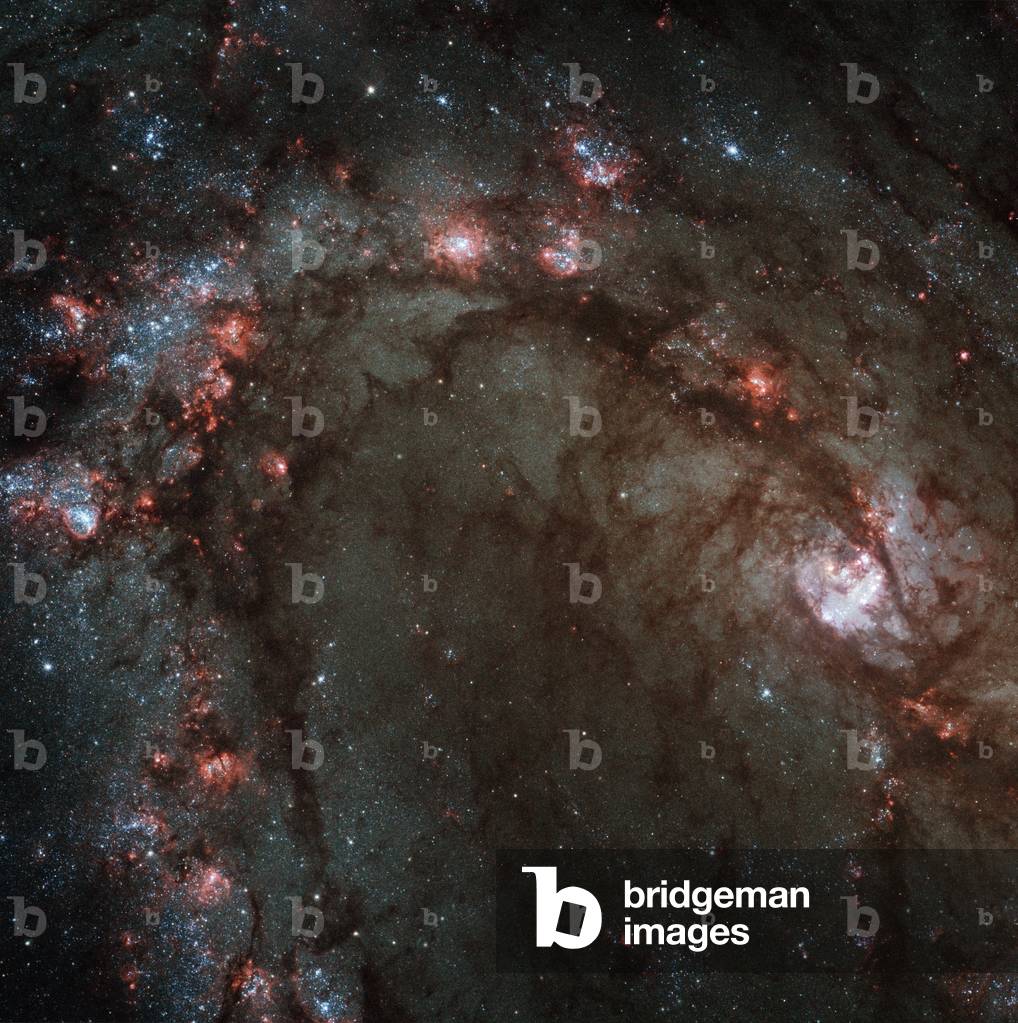
Star Formation in Galaxy M83 - Star Birth in Spiral galaxy M83 - Close-up of star-forming zones in the arms and near the nucleus (white region on the right) of the M83 galaxy. In red appear the hydrogen clouds in which the stars are born. The new stars are concentrated in blue clusters visible by hundreds on this image. The galaxy M83 (NGC 5236) is located about 15 million light years away from Earth in the constellation Hydra. This galaxy is intermediate between a classic spiral and a barree spiral. Image obtained by the Hubble space telescope with its wide field camera 3 (WFC3) in August 2009. Nicknamed the Southern Pinwheel, M83 is undergoing more rapid star formation than our own Milky Way galaxy, especially in its nucleus. The sharp “” eye”” of the Wide Field Camera 3 (WFC3) has captured hundreds of young star clusters, ancient swarms of globular star clusters, and hundreds of thousands of individual stars, mostly blue supergiants and red supergiants. The image, taken in August 2009, provides a close - up view of the myriad stars near the galaxy's core, the bright whitish region at far right. WFC3's broad wavelength range, from ultraviolet to near - infrared, reveals stars at different stages of evolution, allowing astronomers to dissect the galaxy's star - formation history. The newest generations of stars are forming largely in clusters on the edges of the dark dust lanes, the backbone of the spiral arms. These fledgling stars, only a few million years old, are bursting out of their dusty cocoons and producing bubbles of reddish glowing hydrogen gas. The excavated regions give a colorful “” Swiss cheese””” appearance to the spiral arm. Gradually, the young stars' fierce winds (streams of charged particles) blow away the gas, revealing bright blue star clusters. These stars are about 1 million to 10 million years old. The older populations of stars are not as blue. A bar of stars,

PIX4612521: Star Formation in Galaxy M83 - Star Birth in Spiral galaxy M83 - Close-up of star-forming zones in the arms and near the nucleus (white region on the right) of the M83 galaxy. In red appear the hydrogen clouds in which the stars are born. The new stars are concentrated in blue clusters visible by hundreds on this image. The galaxy M83 (NGC 5236) is located about 15 million light years away from Earth in the constellation Hydra. This galaxy is intermediate between a classic spiral and a barree spiral. Image obtained by the Hubble space telescope with its wide field camera 3 (WFC3) in August 2009. Nicknamed the Southern Pinwheel, M83 is undergoing more rapid star formation than our own Milky Way galaxy, especially in its nucleus. The sharp “” eye”” of the Wide Field Camera 3 (WFC3) has captured hundreds of young star clusters, ancient swarms of globular star clusters, and hundreds of thousands of individual stars, mostly blue supergiants and red supergiants. The image, taken in August 2009, provides a close - up view of the myriad stars near the galaxy's core, the bright whitish region at far right. WFC3's broad wavelength range, from ultraviolet to near - infrared, reveals stars at different stages of evolution, allowing astronomers to dissect the galaxy's star - formation history. The newest generations of stars are forming largely in clusters on the edges of the dark dust lanes, the backbone of the spiral arms. These fledgling stars, only a few million years old, are bursting out of their dusty cocoons and producing bubbles of reddish glowing hydrogen gas. The excavated regions give a colorful “” Swiss cheese””” appearance to the spiral arm. Gradually, the young stars' fierce winds (streams of charged particles) blow away the gas, revealing bright blue star clusters. These stars are about 1 million to 10 million years old. The older populations of stars are not as blue. A bar of stars, / Bridgeman Images

Construction of a building in Chelsea, New York, United States.

TEC4611998: Construction of a building in Chelsea, New York, United States. / Bridgeman Images

Central Park in Manhattan, New York, United States.

TEC4612040: Central Park in Manhattan, New York, United States. / Bridgeman Images

Spiral galaxy NGC 5033 in Hunting Dogs - Seyfert galaxy NGC 5033 in Canes Venatici - The spiral galaxy NGC 5033 is located about 43 million years ago - light from Earth. It is a galaxy of Seyfert whose core houses a supermassive black hole. This spiral galaxy is a Seyfert galaxy with a nucleus containing a supermassive black hole. NGC 5033 is located at about 40 million light year away

PIX4612090: Spiral galaxy NGC 5033 in Hunting Dogs - Seyfert galaxy NGC 5033 in Canes Venatici - The spiral galaxy NGC 5033 is located about 43 million years ago - light from Earth. It is a galaxy of Seyfert whose core houses a supermassive black hole. This spiral galaxy is a Seyfert galaxy with a nucleus containing a supermassive black hole. NGC 5033 is located at about 40 million light year away / Bridgeman Images

View of the city of Zaragoza (Zaragoza) in 1646 (oil on canvas)

JLJ4612536: View of the city of Zaragoza (Zaragoza) in 1646 (oil on canvas), Mazo, Juan Bautista Martinez del (1612-67) / Bridgeman Images

Spiral galaxy NGC 5364 in Virgo - Spiral galaxy NGC 5364 in Virgo - Spiral galaxy located in the constellation Virgo. At the bottom of the picture, the galaxy NGC 5360. Image obtained with a telescope 61 cm in diameter. Spiral galaxy located in Virgo constellation. Below, the edge - on galaxy NGC 5360. Image taken with a 24 - inch telescope

PIX4612577: Spiral galaxy NGC 5364 in Virgo - Spiral galaxy NGC 5364 in Virgo - Spiral galaxy located in the constellation Virgo. At the bottom of the picture, the galaxy NGC 5360. Image obtained with a telescope 61 cm in diameter. Spiral galaxy located in Virgo constellation. Below, the edge - on galaxy NGC 5360. Image taken with a 24 - inch telescope / Bridgeman Images

Oriental antique art: Electrum cup, c.1200 BC (gold and silver)

JLJ4612596: Oriental antique art: Electrum cup, c.1200 BC (gold and silver), Iranian School / Bridgeman Images

Center of the Spiral Galaxy M101 - Spiral galaxy M101 in constellation Ursa Major - The galaxy M101 (NGC 5457) is located about 27 million years - light from Earth. Composite image obtained by the Hubble Space Telescope. The spiral galaxy M101 is about 27 million light - years away in the constellation Ursa Major. Image of the core of M101 taken by the Hubble space telescope (HST)

PIX4612732: Center of the Spiral Galaxy M101 - Spiral galaxy M101 in constellation Ursa Major - The galaxy M101 (NGC 5457) is located about 27 million years - light from Earth. Composite image obtained by the Hubble Space Telescope. The spiral galaxy M101 is about 27 million light - years away in the constellation Ursa Major. Image of the core of M101 taken by the Hubble space telescope (HST) / Bridgeman Images

Project for a hotel room, 1967 (Acrylic on canvas)

LRI4612746: Project for a hotel room, 1967 (Acrylic on canvas), Adami, Valerio (b.1935) / Bridgeman Images

Homage to the Square: slale and late sky, 1961 (painting)

LRI4612782: Homage to the Square: slale and late sky, 1961 (painting), Albers, Josef (1888-1976) / Bridgeman Images


Back to top