2502127 Search Results

JLJ4610136: Unter vier Augen. illustration of the book "Entre quatre yeux" by Reznicek: couple in evening clothes, c.1908 (engraving), Reznicek, Ferdinand von (1868-1909) / Bridgeman Images

PIX4610145: Spiral Galaxy NGC 2775 - Spiral galaxy NGC 2775 - NGC 2775 (or Caldwell 48) is a spiral galaxy located 55 million light years ago in the constellation Cancer. The spiral galaxy NGC 2775 (or Caldwell 48) lies 55 million light - years away in the constellation of Cancer / Bridgeman Images

JLJ4610387: A fish tree, in "New assembly of the manouvries habilles", 18th century (engraving), Engelbrecht, Martin (1684-1756) / Bridgeman Images

TEC4611044: The UN, United Nations headquarters, (construction 1951, architect Wallace K.Harrison) along the Hudson River in New York (United States). Photography 10/04/03. / Bridgeman Images

JLJ4611097: Asanuma's boat. Japanese Print, Ukiyo-e style, c.1768 (print), Harunobu, Suzuki (1725-70) / Bridgeman Images
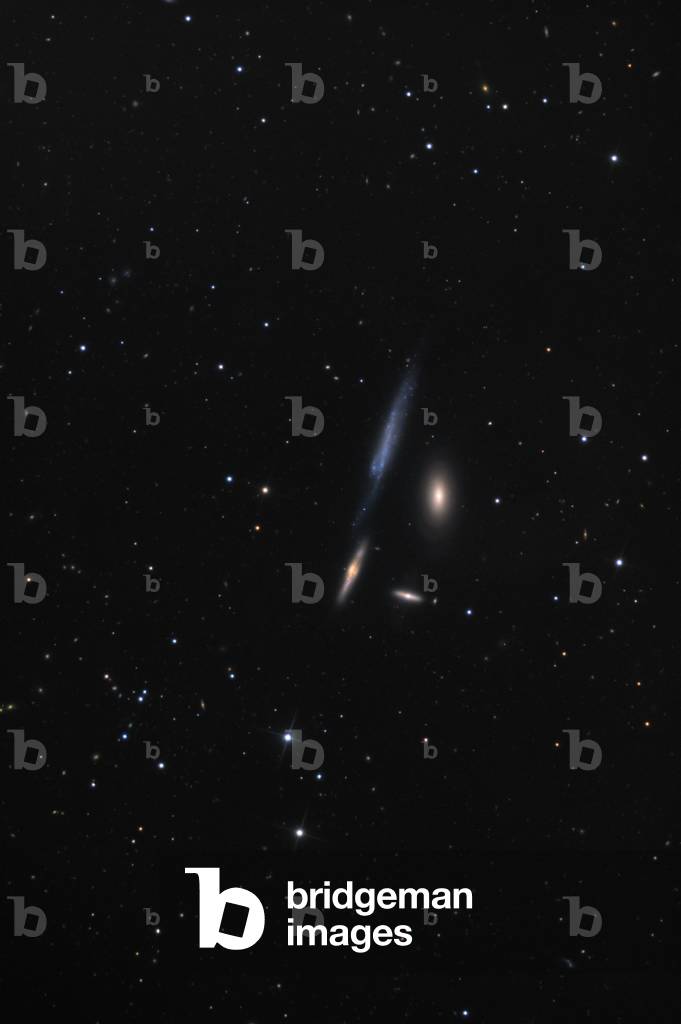
PIX4611136: Group of galaxies HCG 61 in Berenice's Hair - Hickson 61 - The Box - The group of galaxies HCG 61 (Hickson 61, the box) consists of three interacting galaxies, and one forward galaxy (NGC 4173, the largest in the image) that is not physically associated. From the top and then clockwise, we find the spiral galaxy NGC 4173, the lenticular galaxy NGC 4169, and the spiral galaxies NGC 4174 and NGC 4175. Hickson 61 (HCG 61) is a group of four galaxies located in Coma Berenices. In foreground is NGC 4173 (top left, the largest spiral galaxy) which is closer than the three other galaxies and not associated to them. At right is the brightest galaxy, NGC 4169, a lenticular galaxy. Bottom right is the spiral galaxy NGC 4174 and bottom left, NGC 4175 / Bridgeman Images

TEC4611177: Park Avenue in Manhattan (New York) (United States). photograph 10/04/03. / Bridgeman Images

TEC4611228: The Empire State building, 350 5th street in Manhattan, New York (United States). Art Deco skyscraper designed by Shreve, Lamb & Harmon Associates and whose construction was completed in 1930. Until the construction of the three towers of the World Trade Center, this skyscraper was the highest in New York. Since the 9/11 attack, the Empire State Building is once again the tallest building in the city. Photography 10/04/03. / Bridgeman Images
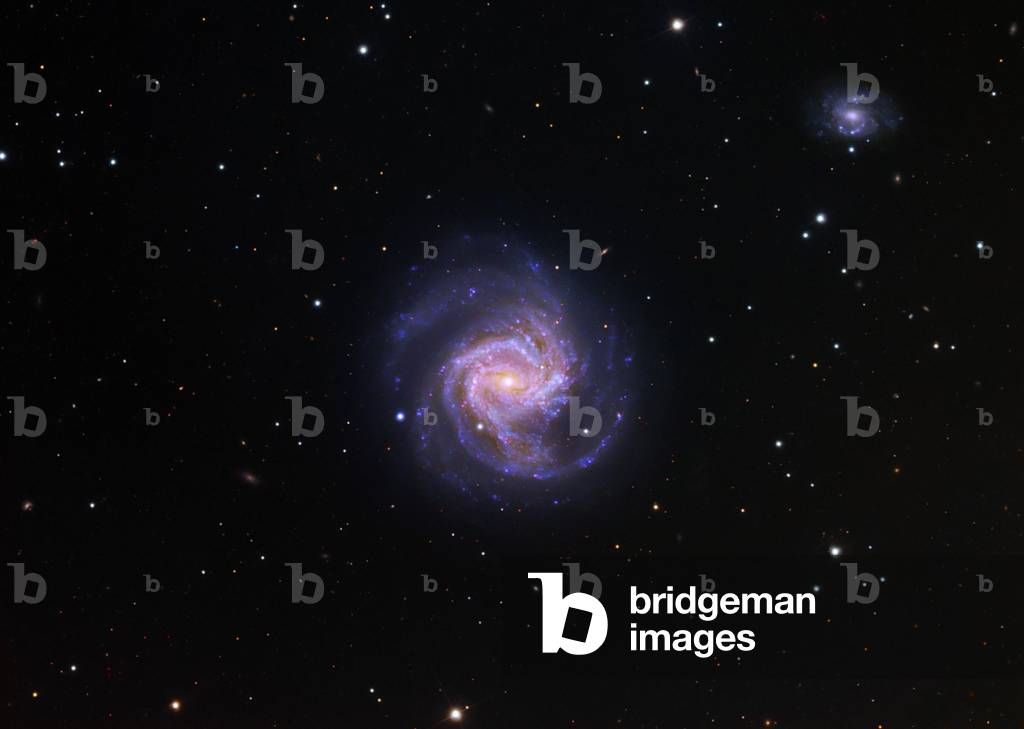
PIX4611251: Spiral Galaxy M61 in Virgo - Spiral galaxy M61 in Virgo - The spiral galaxy M61 (NGC 4303) is located about 60 million years away - light from Earth. It is one of the largest galaxies in the Virgin's cluster, measuring 100,000 years - light. The SabBC spiral galaxy M61 is one of the larger galaxies in the Virgo cluster, with a dimension some 100 000 light - years (6 arc minutes) across, comparable to the size of our own Galaxy / Bridgeman Images

JLJ4611272: Parisian fashion: evening dress, Draw, 20th century (litho), Lepape, Georges (1887-1971) / Bridgeman Images

JLJ4611289: Intermission. Parisian Fashion: Evening Dress by Charles Frederic Worth (1825-1895), 1913 (drawing), Taquoy, Maurice (1878-1952) / Bridgeman Images

PIX4610556: Spiral Galaxy NGC 3310 - Spiral galaxy NGC 3310 - NGC 3310 (or Arp 217) is a spiral galaxy located 59 million light years ago in the constellation Ursae. The spiral galaxy NGC 3310 (or Arp 217) lies 59 million light - years away in the constellation of Ursa Major / Bridgeman Images

LRI4610578: Woman with a straw hat. 1879 (Oil on canvas), Renoir, Pierre Auguste (1841-1919) / Bridgeman Images

JLJ4610638: The feast of the lodges in 1850 (oil on canvas), Prieur, Georges (19th century) / Bridgeman Images
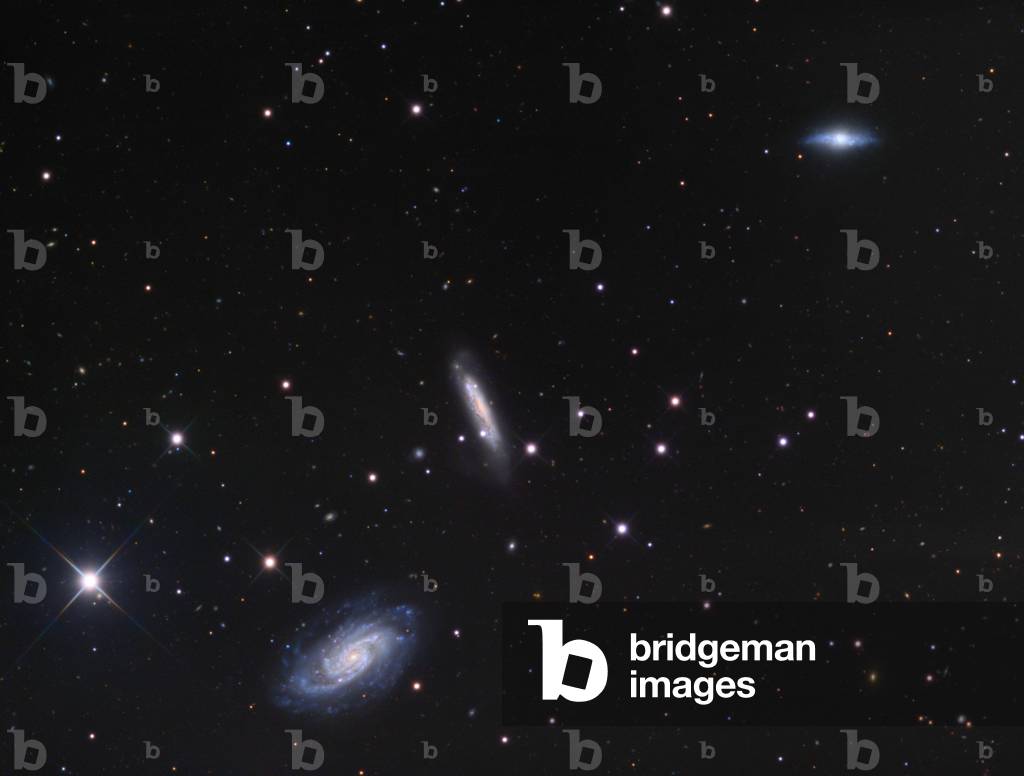
PIX4610706: Galaxies NGC 3430 and NGC 3424 in the Little Lion - Galaxies NGC 3430 and NGC 3424 in Leo Minor - Galaxy NGC 3430 (bottom) and NGC 3424 (middle). Image obtained with a telescope 61 cm in diameter. Galaxy NGC 3430 (bottom), and NGC 3424 (middle) / Bridgeman Images
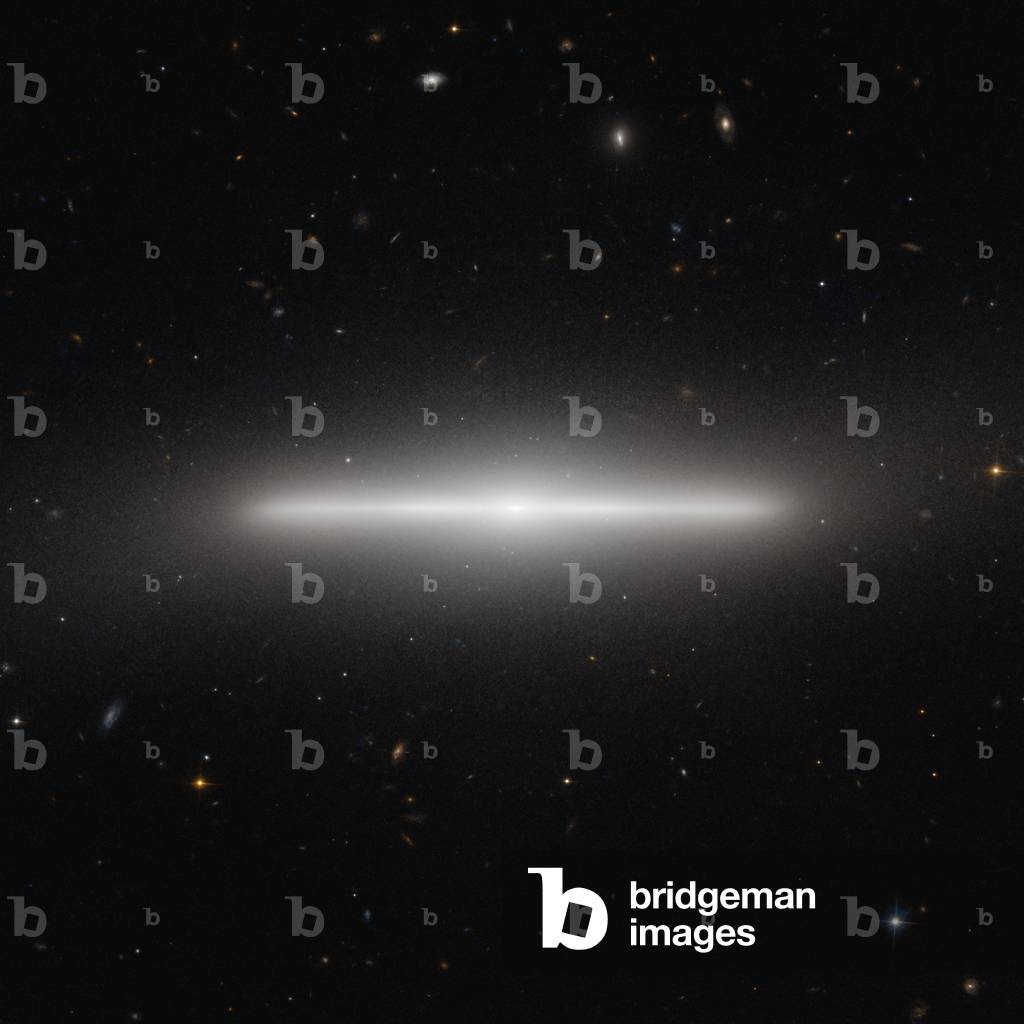
PIX4611380: Spiral Galaxy NGC 4452 - Galaxy Spiral NGC 4452 - NGC 4452 is located about 60 million light years away from Earth in the galaxy cluster of Our Lady. Seen from the Earth, this spiral galaxy is presented by the slice, leaving only the thickness of its disc visible. Image obtained by the Hubble Space Telescope. The NASA/ESA Hubble Space Telescope has imaged a striking galaxy called NGC 4452, which appears to lie exactly edge - on as seen from Earth. The bright nucleus can be seen at the centre, along with the very thin disc that looks like a straight line from our unusual viewing position. To complete the picture, a hazy halo of stars on the periphery of the galaxy makes it seem to glow. NGC 4452 was first seen by William Herschel in 1784 with his 47 cm telescope in England. He described the object as a bright nebula, small and very much elongated. The new Hubble image shows just how elongated this unusual object really is. NGC 4452 is part of the Virgo Cluster, so - called because many of its members appear in the constellation of Virgo (the Maiden). This enormous grouping is approximately 60 million light - years distant and contains around 2000 galaxies. Large numbers of much more remote, faint galaxies, far beyond NGC 4452 and the Virgo Cluster, appear in the background of this image. This picture of NGC 4452 was created from images taken using the Wide Field Channel on Hubble's Advanced Camera for Surveys. This picture was made from images through blue (F475W, colored blue) and near - infrared (F850LP, colored red) filters. The exposures times were 750 s and 1210 s respectively. The field of view extends over 2.6 arcminutes / Bridgeman Images

TEC4611404: The Sony headquarters formerly AT & T building (construction 1984, architects Philip Johnson and John Burgee), 550 Madison Avenue, ÆMidtown in Manhattan, New York (USA). The Pritzker Prize was created in 1979 by Jay A. Pritzker and his wife. Decerne by the Hyat Foundation and endowed $100,000, it was awarded for the first year to American architect Philip Johnson. Photography 10/04/03. / Bridgeman Images

PIX4611569: Spiral galaxy NGC 4565 in Berenice's Hair - Spiral galaxy NGC 4565 in Coma Berenices - The galaxy NGC 4565 is located about 30 million years ago - light from Earth. It's a spiral galaxy seen by the slice. Image obtained with a 40 cm telescope, composite of several poses. Edge - on galaxy located at about 30 million light years away. Composite image obtained with a RC 16”” telescope / Bridgeman Images

TEC4611446: Hudson Hotel, 356 West 58th Street in Manhattan, architect Philippe Starck, New York (United States). Photography 10/04/03., Starck, Philippe (b.1949) / Bridgeman Images

TEC4611515: The Whitney Museum, 945 Madison Avenue at 75th Street in Manhattan, architect Marcel Breuer, 1966. New York, United States. Photography 10/04/03., Breuer, Marcel (1902-81) / Bridgeman Images

TEC4611570: Tower LVMH 57th Street/Madison Avenue, construction 1999-2001, architect Christian de Protzamparc. New York, United States. Photocopy 15/10/01., Portzamparc, de Christian (b.1944) / Bridgeman Images

TEC4611582: Tower LVMH 57th Street/Madison Avenue, construction 1999-2001, architect Christian de Protzamparc. New York, United States. Photography 15/10/03., Portzamparc, de Christian (b.1944) / Bridgeman Images

JLJ4610767: A garden for floor, in "New assembly of the manouvries habilles", 18th century (engraving), Engelbrecht, Martin (1684-1756) / Bridgeman Images

PIX4610790: Spiral galaxies M65 and M66 in the Lion - M65 and M66 spiral galaxy in Leo - M65 (NGC3623), on the right, with its neighbors M66 (NGC 3627), on the left, and NGC 3628 (off-field), forms a triplet of galaxies, called the Lion Triplet or the Group of M66, located at a distance of approximately 35 million light. Image obtained with a 400 mm telescope and CCD camera, more than three hours of combined installation. From right to left are M65 (NGC 3623) and M66 (NGC 3627). They both form the remarkable Leo triplet (or M66 group) with their neighbor NGC 3628 (out of frame) / Bridgeman Images
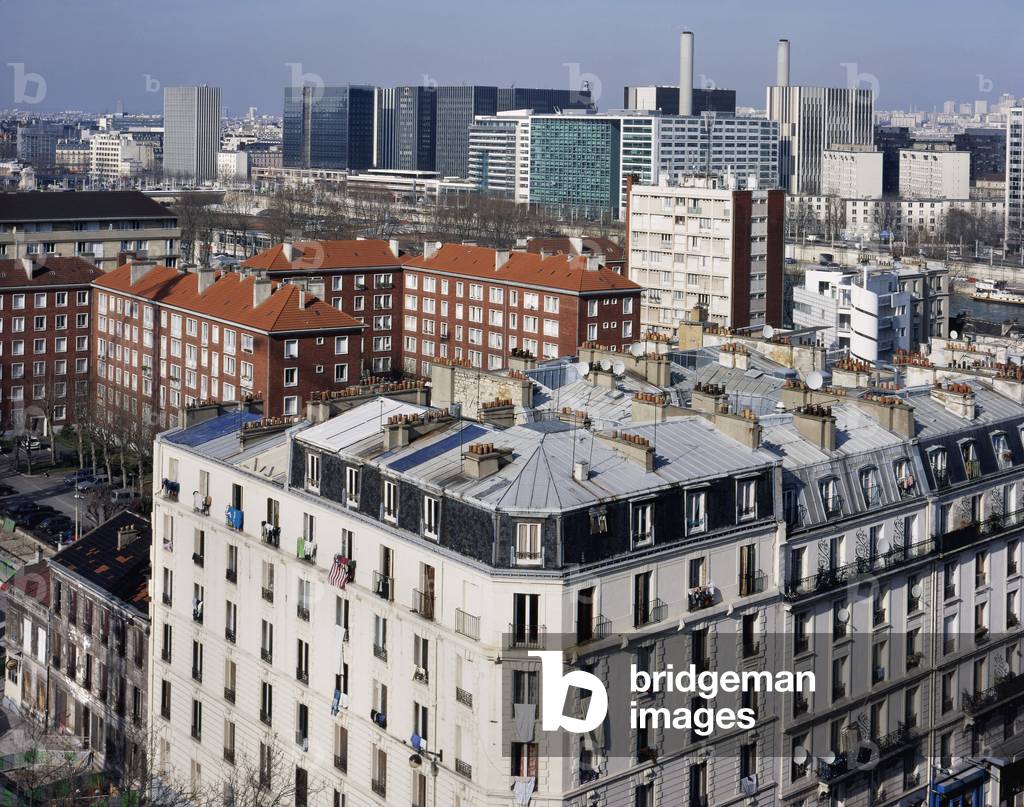
MDA4610799: Parisian residential buildings. Panoramic view from boulevard Vincent Auriol, Paris. / Bridgeman Images

PIX4610836: Spiral Galaxy M66 in the Lion - Spiral galaxy M66 in Leo - M66 (NGC 3627) is a spiral galaxy located at a distance of about 35 million years - light. M66, with its neighbors M65 and NGC 3628, forms a remarkable triplet of galaxies, called the Lion Triplet or the M66 Group. Image obtained by the Hubble Space Telescope. The unusual spiral galaxy, Messier 66, is located at a distance of about 35 million light - years in the constellation of Leo. Together with Messier 65 and NGC 3628, Messier 66 is one third of the Leo Triplet, a trio of interacting spiral galaxies, part of the larger Messier 66 group. Messier 66 wins out in size over its fellow triplets - - it is about 100 000 light - years across. Messier 66 is the proud owner of exclusive asymmetric spiral arms which seem to climb above the galaxy's main disc and an apparently displaced nucleus. This asymmetry is unusual; most often, dense waves of gas, dust and newly born stars wind about the galaxy's centre in a symmetric way. Astronomers believe that Messier 66's once orderly shape has most likely been distorted by the gravitational pull of its two neighbours. Hubble has imaged Messier 66's striking dust lanes and bright star clusters along the spiral arms in fine detail with the Advanced Camera for Surveys. Star clusters - - pictured in the blue and pinkish regions of the image - - are key tools for astronomers since they are used as indicators of how the parent galaxies assembled over time. Messier 66 boasts a remarkable record of supernovae explosions. The spiral galaxy has hosted three supernovae since 1989, the latest one occurring in 2009. A supernova is a stellar explosion that may momentarily outshine its entire host galaxy. It then fades away over a period lasting several weeks or months. During its very short life the supernova radiates as much energy as the Sun would radiate over a period of about 10 billion years / Bridgeman Images
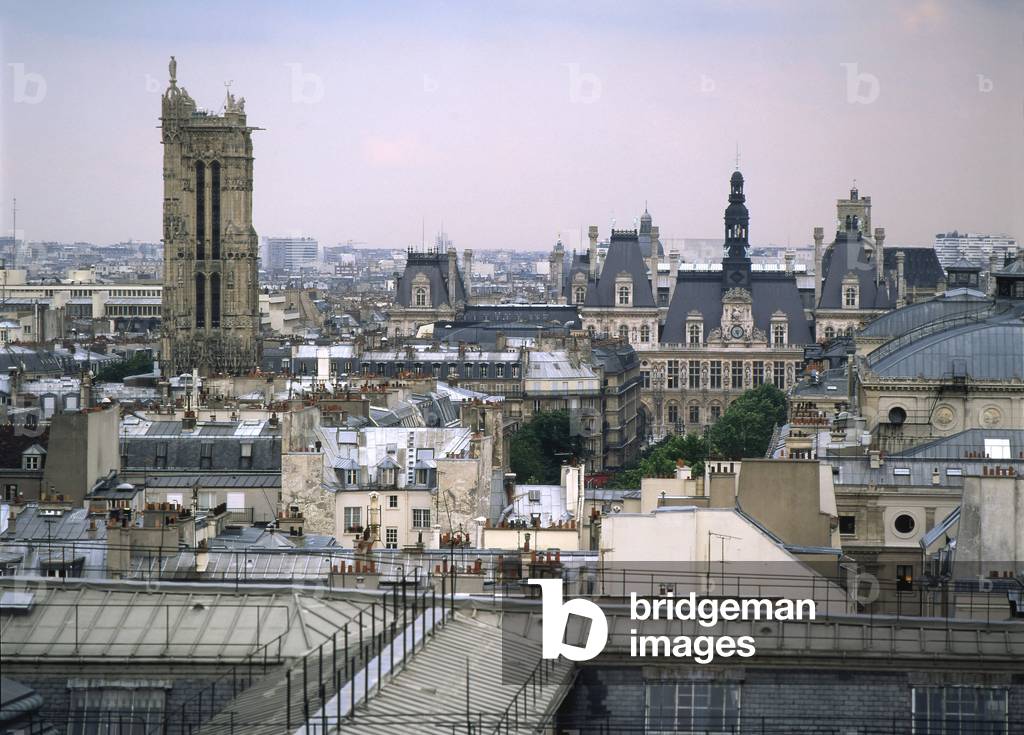
MDA4610873: The Saint Jacques Tower, panoramic view from the Opera Bastille on Paris. / Bridgeman Images
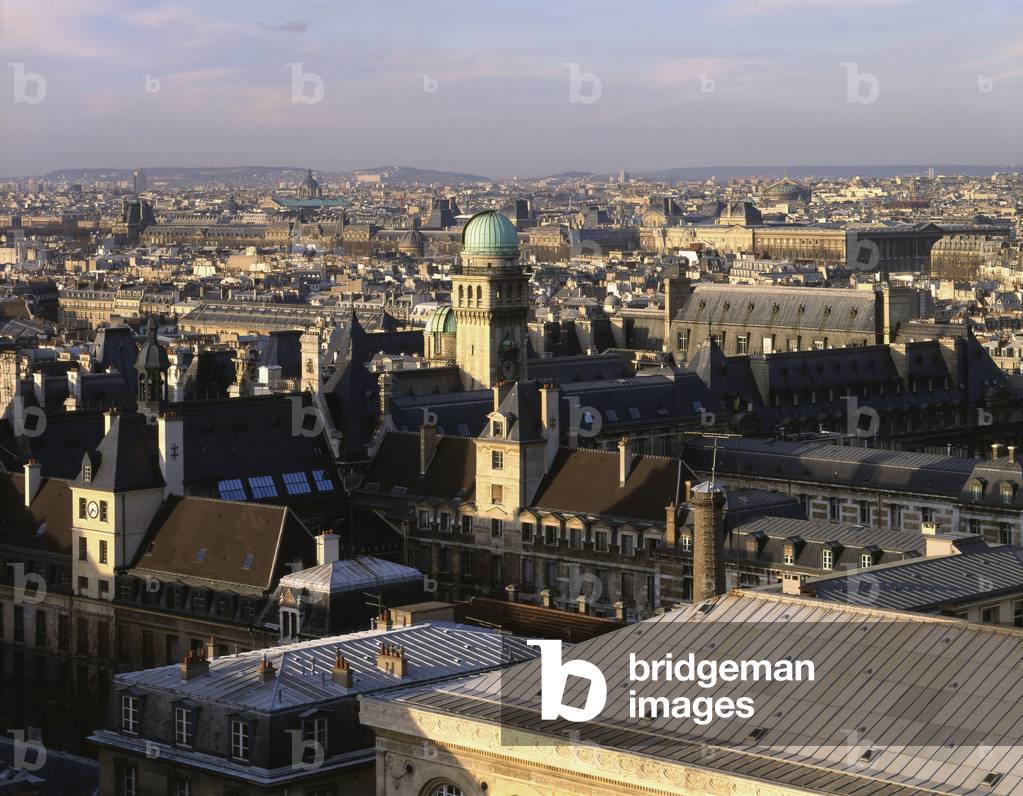
MDA4610905: Panoramic view of Paris from the Pantheon. / Bridgeman Images
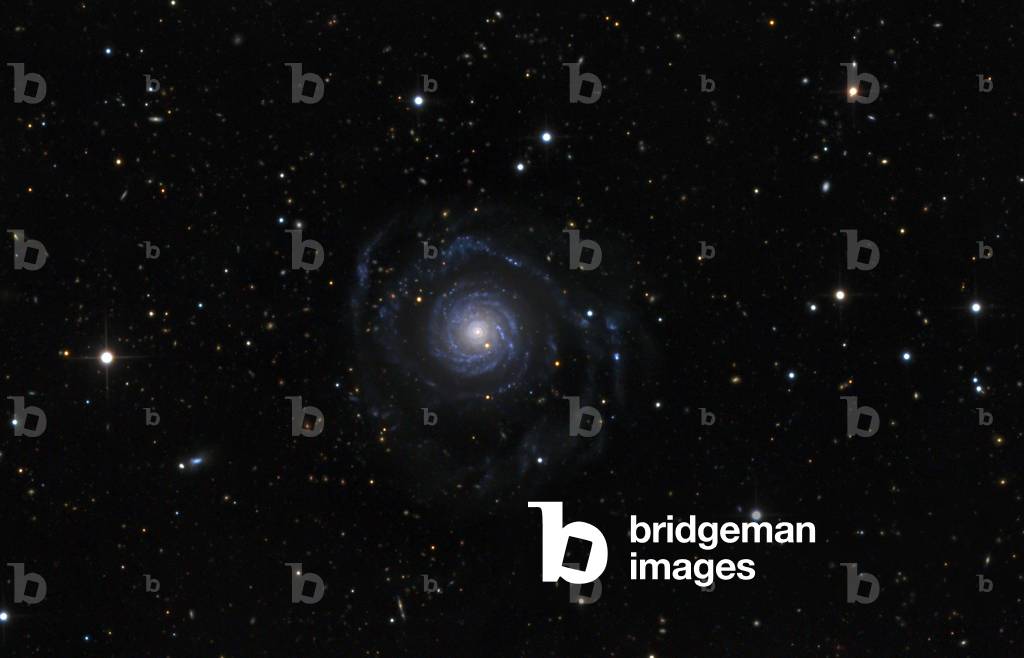
PIX4610917: Spiral galaxy NGC 3642 - NGC 3642 spiral galaxy in Ursa Major - Spiral galaxy NGC 3642 in the constellation Ursae Majoris. Image made with a telescope of 61 cm. NGC 3642 is located in the constellation of Ursa Major. Image obtained with a 24 - inch telescope / Bridgeman Images

PIX4610926: Interacting Galaxies Arp 299 - Interacting galaxies Arp 299 - The particular galaxy Arp 299 is located about 150 million light years away from Earth in the constellation of the Great Bear. Composed of galaxies IC 694 and NGC 3690, this interacting system presents important star formations. Astronomers also observed the appearance of several supernovae. Arp 299 is an ultra-aluminous infrared galaxy. Image obtained by the Hubble Space Telescope on 18 March 2002. This system consists of a pair of galaxies, dubbed IC 694 and NGC 3690, which made a close pass some 700 million years ago. As a result of this interaction, the system underwent a fierce burst of star formation. In the last fifteen years or so six supernovae have popped off in the outer reaches of the galaxy, making this system a distinguished supernova factory. Arp 299 belongs to the family of ultra - luminous infrared galaxies and is located in the constellation of Ursa Major, the Great Bear, approximately 150 million light - years away. It is the 299th galaxy in ARP's Atlas of Peculiar Galaxies. Despite its enormous amount of absorbing dust, enough violet and near - ultraviolet light leaks out for it to be number 171 in B.E. Markarian's catalog of galaxies with excess ultraviolet emission. Image taken by the Hubble space telescope on march 18, 2002 / Bridgeman Images

PIX4611005: Galaxies NGC 3718 and NGC 3729 in the Great Bear / Bridgeman Images

JLJ4611698: View of Paris, taken from the Quai de la Rapee in 1716 Detail of boats on the Seine and activities, 1716 (painting), Martin, Pierre-Denis (1663-1742) / Bridgeman Images

TEC4611739: Times Square in New York (United States). / Bridgeman Images

TEC4611792: Stock market indices on a building facade in Times Square in New York, USA. Photography 20/10/08. / Bridgeman Images

LRI4611822: Cocyte in The Beautiful Helene, 1900 (Watercolour on paper), Toulouse-Lautrec, Henri de (1864-1901) / Bridgeman Images

TEC4611874: LeNew York Stock Exchange in Manhattan, New Yorkæ (USA). / Bridgeman Images
