Search options

Orientation
Colour

Display options

View

Print

To print search results, use print friendly version of this page.

2497527 Search Results
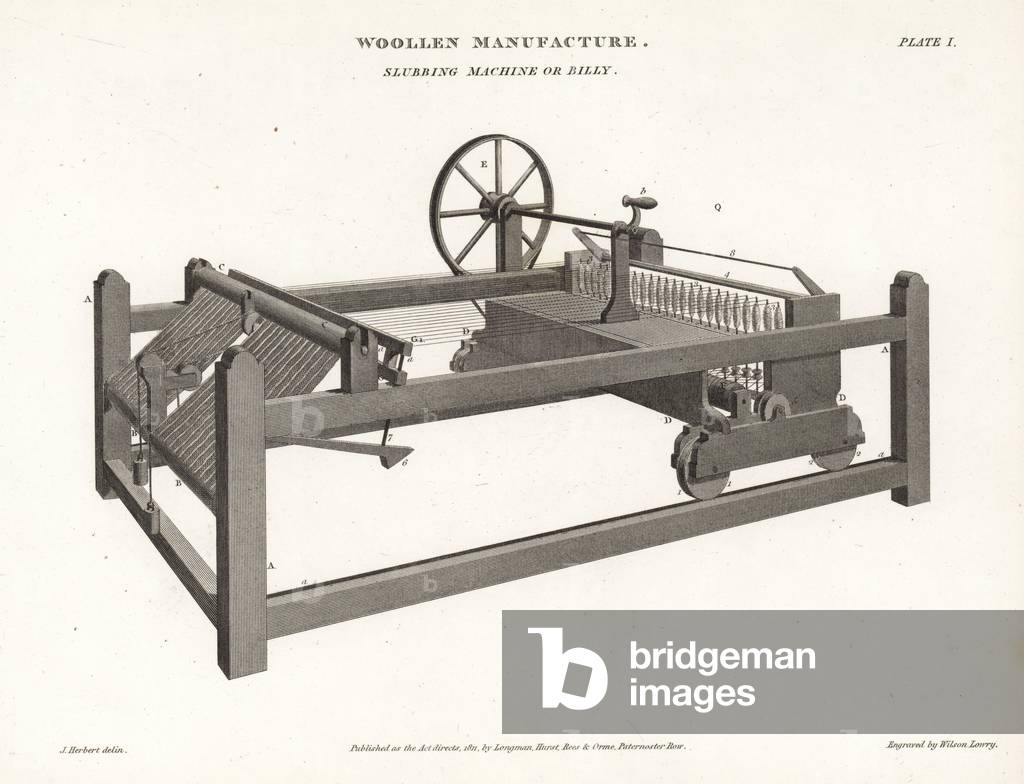
Slubbing machine or billy, used to twist carded thread in woollen manufacture, 19th century. Copperplate engraving by Wilson Lowry after an Illustration by J. Herbert from Abraham Rees' “” Cyclopedia or Universal Dictionary,” London, 1817.

FLO4593159: Slubbing machine or billy, used to twist carded thread in woollen manufacture, 19th century. Copperplate engraving by Wilson Lowry after an Illustration by J. Herbert from Abraham Rees' “” Cyclopedia or Universal Dictionary,” London, 1817. / Bridgeman Images

Persee Constellation - Constellation of Perseus - Persee Constellation. The bright star at the bottom left is Capella in the Coach. Lower right is the Pleiades cluster. At the top of the picture is the constellation Cassiopee. Perseus constellation. The bright star on the left is Capella in Auriga. At the top of the image, Cassiopeia

PIX4593230: Persee Constellation - Constellation of Perseus - Persee Constellation. The bright star at the bottom left is Capella in the Coach. Lower right is the Pleiades cluster. At the top of the picture is the constellation Cassiopee. Perseus constellation. The bright star on the left is Capella in Auriga. At the top of the image, Cassiopeia / Bridgeman Images

Etruscan Art: the god of war Laran, Detail - Bronze sculpture, 475-450 BC - Florence, archeological museum - Laran, etruscan god of war (detail) - Bronze sculpture, 475-450 BC - Archeological Museum, Florence, Italy

LRI4593315: Etruscan Art: the god of war Laran, Detail - Bronze sculpture, 475-450 BC - Florence, archeological museum - Laran, etruscan god of war (detail) - Bronze sculpture, 475-450 BC - Archeological Museum, Florence, Italy, Etruscan, (5th century BC) / Bridgeman Images

Rigging plans for sailing ships, 18th century. Copperplate engraving by Milton after an illustration by Glover from Abraham Rees' “” Cyclopedia or Universal Dictionary,”” London, 1820.

FLO4593332: Rigging plans for sailing ships, 18th century. Copperplate engraving by Milton after an illustration by Glover from Abraham Rees' “” Cyclopedia or Universal Dictionary,”” London, 1820. / Bridgeman Images

Matthew Boulton and James Watt's steam engine, elevation and plan of the beam floor, 1776. Copperplate engraving by Wilson Lowry after an Illustration by J. Farey from Abraham Rees' “” Cyclopedia or Universal Dictionary,” London, 1813.

FLO4593374: Matthew Boulton and James Watt's steam engine, elevation and plan of the beam floor, 1776. Copperplate engraving by Wilson Lowry after an Illustration by J. Farey from Abraham Rees' “” Cyclopedia or Universal Dictionary,” London, 1813. / Bridgeman Images

Terracotta bucket representing a predator attacking a snake and deers running, 520-510 BC

LRI4593397: Terracotta bucket representing a predator attacking a snake and deers running, 520-510 BC, Etruscan, (6th century BC) / Bridgeman Images

Joseph Bramah's hydrostatic (hydraulic) press, sections of the pump and cylinder, 18th century. Copperplate engraving by Wilson Lowry after an illustration by J. Farey from Abraham Rees' “” Cyclopedia or Universal Dictionary,” London, 1812.

FLO4593413: Joseph Bramah's hydrostatic (hydraulic) press, sections of the pump and cylinder, 18th century. Copperplate engraving by Wilson Lowry after an illustration by J. Farey from Abraham Rees' “” Cyclopedia or Universal Dictionary,” London, 1812. / Bridgeman Images
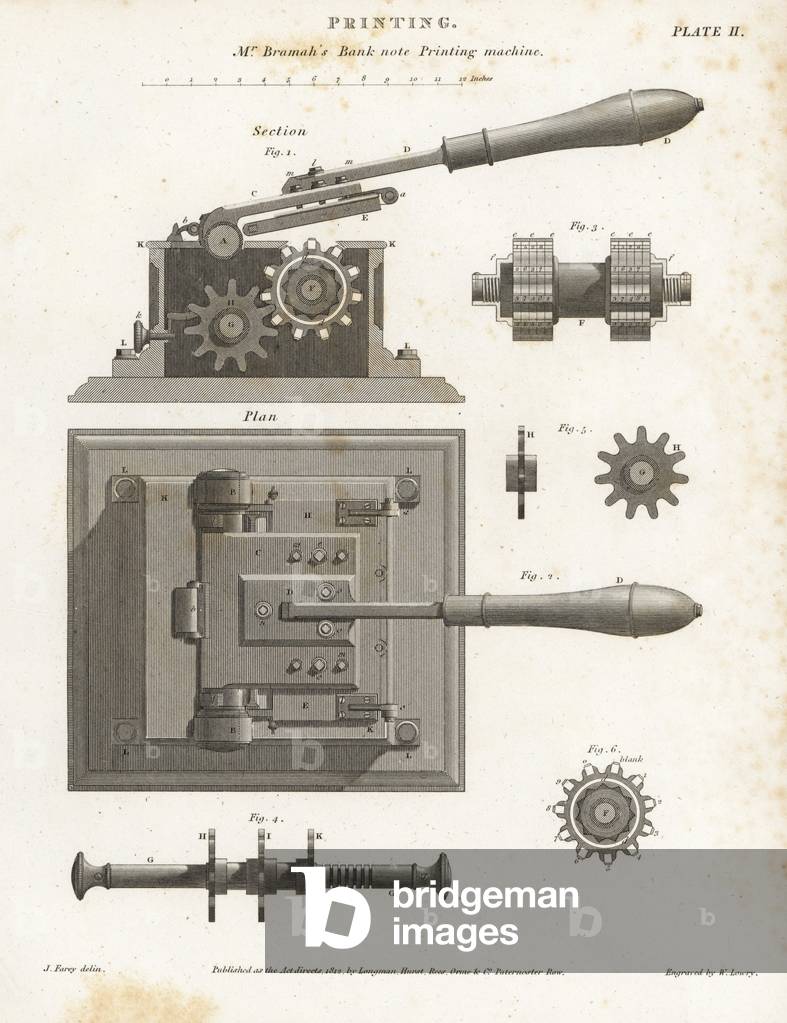
John Bramah's banknote printing press for printing sequential serial numbers, 1806. Copperplate engraving by Wilson Lowry after an illustration by J. Farey from Abraham Rees' “” Cyclopedia or Universal Dictionary,” London, 1812.

FLO4593440: John Bramah's banknote printing press for printing sequential serial numbers, 1806. Copperplate engraving by Wilson Lowry after an illustration by J. Farey from Abraham Rees' “” Cyclopedia or Universal Dictionary,” London, 1812. / Bridgeman Images

Painted terracotta krater, 590-570 BC

LRI4593455: Painted terracotta krater, 590-570 BC, Etruscan, (6th century BC) / Bridgeman Images

First rotary press printing machine patented by printer Richard Bacon and engineer Bryan Donkin, 1813. Copperplate engraving by Wilson Lowry after an illustration by J. Farey from Abraham Rees' “” Cyclopedia or Universal Dictionary,” London, 1816.

FLO4593470: First rotary press printing machine patented by printer Richard Bacon and engineer Bryan Donkin, 1813. Copperplate engraving by Wilson Lowry after an illustration by J. Farey from Abraham Rees' “” Cyclopedia or Universal Dictionary,” London, 1816. / Bridgeman Images

Pottery kiln, vertical and horizontal sections, 18th century. Copperplate engraving by Wilson Lowry after an illustration by J. Farey from Abraham Rees' “” Cyclopedia or Universal Dictionary,” London, 1815.

FLO4593602: Pottery kiln, vertical and horizontal sections, 18th century. Copperplate engraving by Wilson Lowry after an illustration by J. Farey from Abraham Rees' “” Cyclopedia or Universal Dictionary,” London, 1815. / Bridgeman Images

Ancient musical instruments and masks. A Greek barbiton or harp (1), a mask of Hercules furens of Euripides (2), a mask of Thai from Terence's play of the Eunochs (3), lyre player from volume 4, plate 42 of the Herculaneum paintings (4) and lyres from Sir William Hamilton's collection (5,6). Copperplate engraving from Abraham Rees' Cyclopedia or Universal Dictionary of Arts, Sciences and Literature, Longman, Hurst, Rees, Orme and Brown, London, 1820.

FLO4593644: Ancient musical instruments and masks. A Greek barbiton or harp (1), a mask of Hercules furens of Euripides (2), a mask of Thai from Terence's play of the Eunochs (3), lyre player from volume 4, plate 42 of the Herculaneum paintings (4) and lyres from Sir William Hamilton's collection (5,6). Copperplate engraving from Abraham Rees' Cyclopedia or Universal Dictionary of Arts, Sciences and Literature, Longman, Hurst, Rees, Orme and Brown, London, 1820. / Bridgeman Images
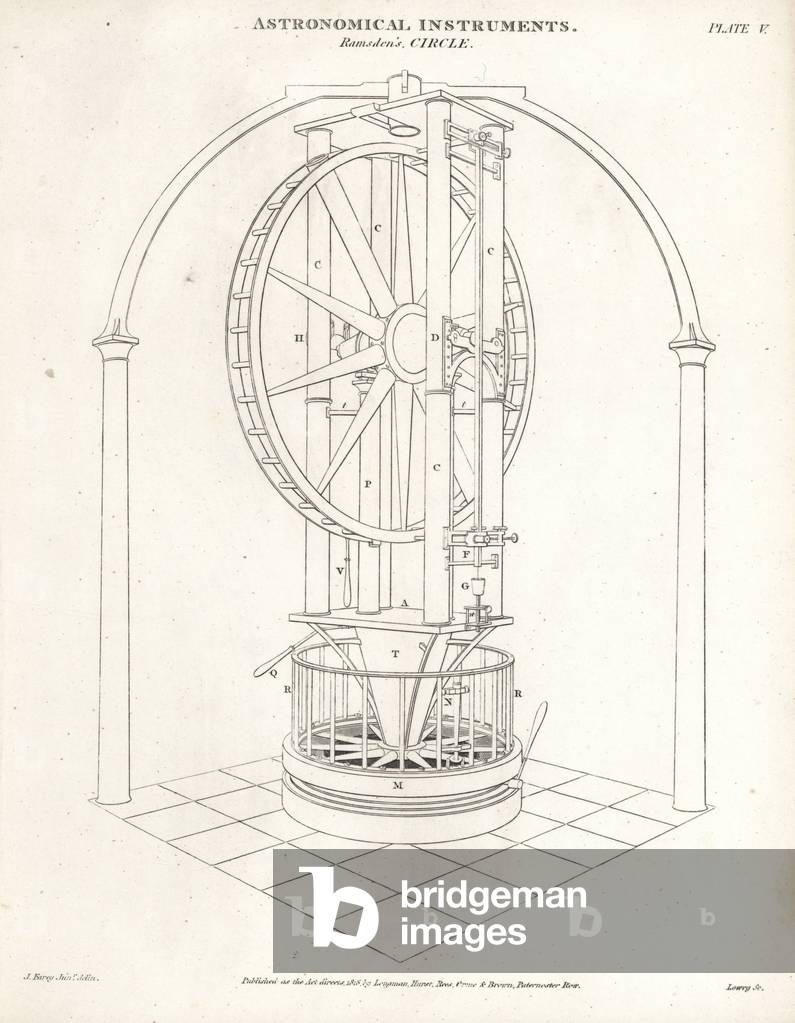
Ramsden's circle, a five-foot high vertical circle finished in 1789 by the English scientific instrument maker Jesse Ramsden. Copperplate engraving by Wilson Lowry after a drawing by J. Farey from Abraham Rees' Cyclopedia or Universal Dictionary of Arts, Sciences and Literature, Longman, Hurst, Rees, Orme and Brown, London, 1820.

FLO4593669: Ramsden's circle, a five-foot high vertical circle finished in 1789 by the English scientific instrument maker Jesse Ramsden. Copperplate engraving by Wilson Lowry after a drawing by J. Farey from Abraham Rees' Cyclopedia or Universal Dictionary of Arts, Sciences and Literature, Longman, Hurst, Rees, Orme and Brown, London, 1820. / Bridgeman Images
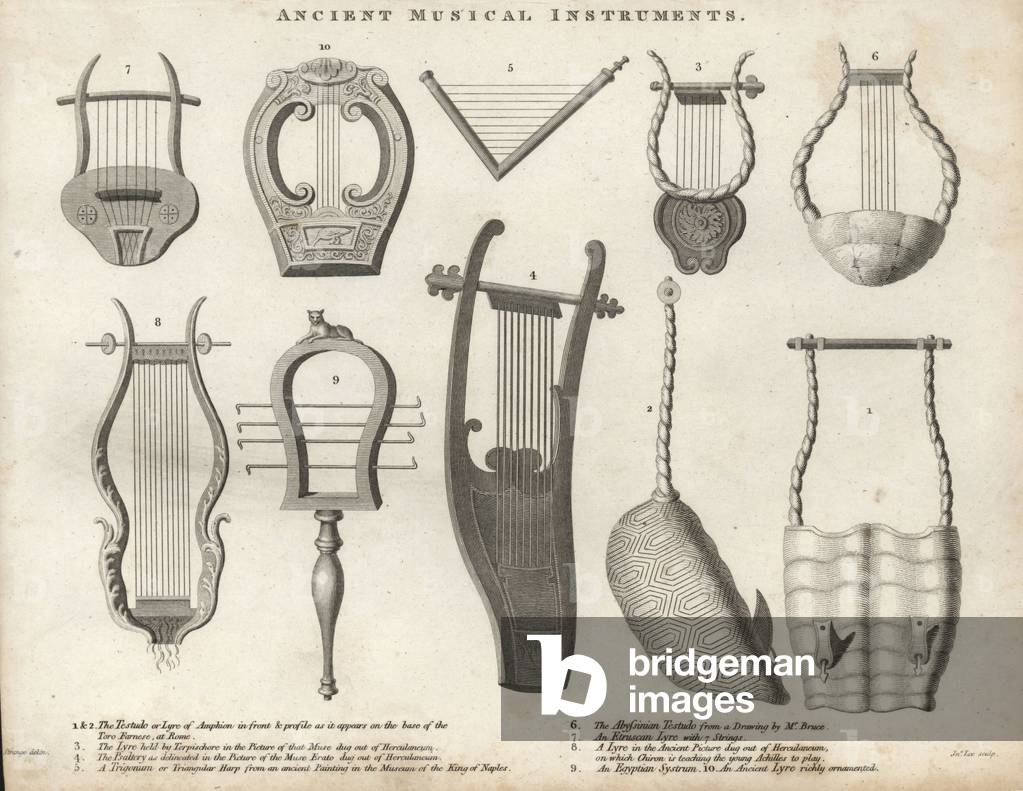
Testudo or lyre of Amphion (1,2), lyre held by Terpsichore (3), psaltery (4), triangular harp or Trigonium (5), Abyssinian testudo (6), Etruscan 6-string lyre (7), lyre (8), Egyptian systrum (9) and richly ornamented lyre. Copperplate engraving by John Lee after an illustration by Strange from Abraham Rees' Cyclopedia or Universal Dictionary of Arts, Sciences and Literature, Longman, Hurst, Rees, Orme and Brown, London, 1820.

FLO4593743: Testudo or lyre of Amphion (1,2), lyre held by Terpsichore (3), psaltery (4), triangular harp or Trigonium (5), Abyssinian testudo (6), Etruscan 6-string lyre (7), lyre (8), Egyptian systrum (9) and richly ornamented lyre. Copperplate engraving by John Lee after an illustration by Strange from Abraham Rees' Cyclopedia or Universal Dictionary of Arts, Sciences and Literature, Longman, Hurst, Rees, Orme and Brown, London, 1820. / Bridgeman Images
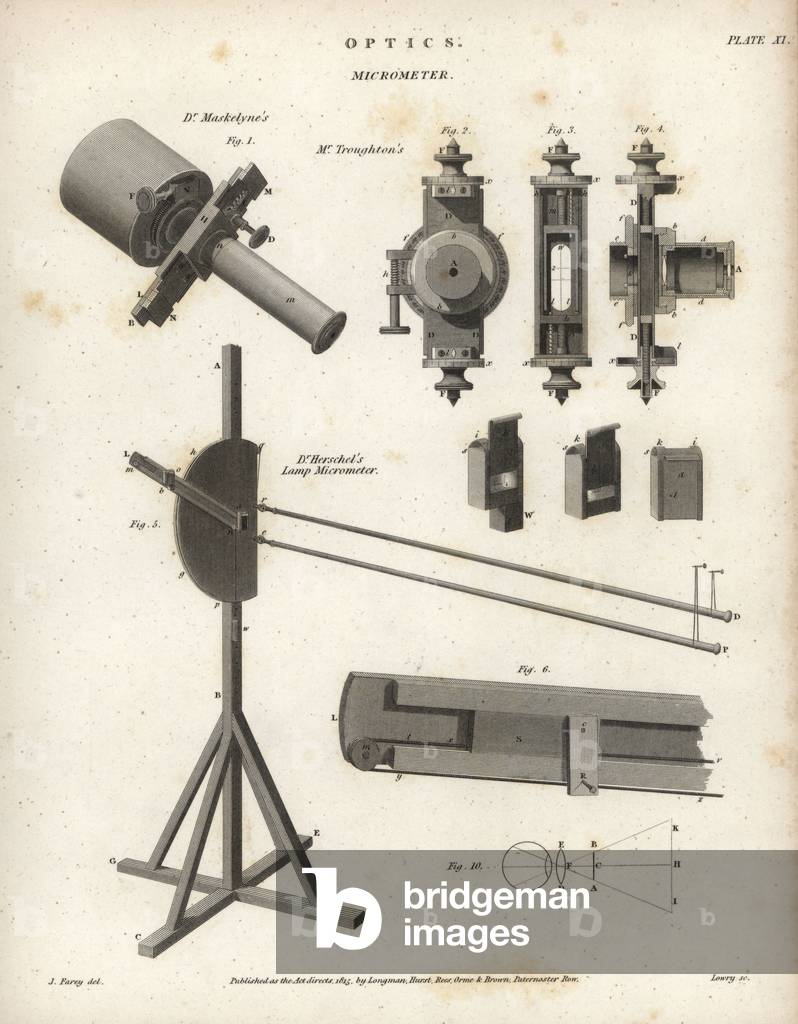
Optical micrometers including Dr. Nevil Maskelyn's, Mr. Edward Troughton's and Dr. William Herschel's lamp micrometer. Copperplate engraving by Wilson Lowry after a drawing by J. Farey Jr. from Abraham Rees' Cyclopedia or Universal Dictionary of Arts, Sciences and Literature, Longman, Hurst, Rees, Orme and Brown, London, 1820.

FLO4593778: Optical micrometers including Dr. Nevil Maskelyn's, Mr. Edward Troughton's and Dr. William Herschel's lamp micrometer. Copperplate engraving by Wilson Lowry after a drawing by J. Farey Jr. from Abraham Rees' Cyclopedia or Universal Dictionary of Arts, Sciences and Literature, Longman, Hurst, Rees, Orme and Brown, London, 1820. / Bridgeman Images

Indian musical instruments (drums, horns and cymbals) from an original painting (1), and the Been or rudra vina, as described by Sir William Jones in Asiatic Researches. Copperplate engraving by John Lee from Abraham Rees' Cyclopedia or Universal Dictionary of Arts, Sciences and Literature, Longman, Hurst, Rees, Orme and Brown, London, 1820.

FLO4593826: Indian musical instruments (drums, horns and cymbals) from an original painting (1), and the Been or rudra vina, as described by Sir William Jones in Asiatic Researches. Copperplate engraving by John Lee from Abraham Rees' Cyclopedia or Universal Dictionary of Arts, Sciences and Literature, Longman, Hurst, Rees, Orme and Brown, London, 1820. / Bridgeman Images

Internal view of the cave of Boboli. Detail. 1583-1588

LRI4594043: Internal view of the cave of Boboli. Detail. 1583-1588, Buontalenti, Bernardo (1536-1608) / Bridgeman Images
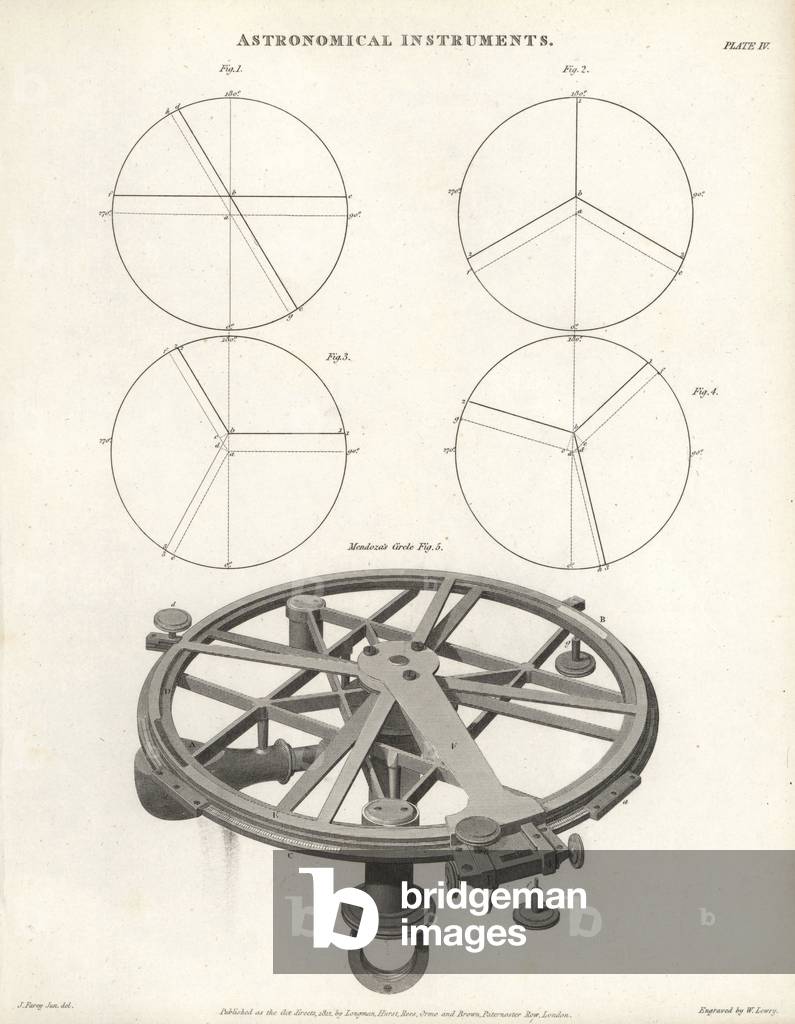
Josef de Mendoza y Rios's refinement to the reflecting circle, an astronomical instrument, 1801. Copperplate engraving by Wilson Lowry after a drawing by J. Farey from Abraham Rees' Cyclopedia or Universal Dictionary of Arts, Sciences and Literature, Longman, Hurst, Rees, Orme and Brown, London, 1820.

FLO4594139: Josef de Mendoza y Rios's refinement to the reflecting circle, an astronomical instrument, 1801. Copperplate engraving by Wilson Lowry after a drawing by J. Farey from Abraham Rees' Cyclopedia or Universal Dictionary of Arts, Sciences and Literature, Longman, Hurst, Rees, Orme and Brown, London, 1820. / Bridgeman Images

Origins of the bow. Medieval paintings, stuatus and objects depicting early violins or fiddles. Copperplate engraving by John Lee from Abraham Rees' Cyclopedia or Universal Dictionary of Arts, Sciences and Literature, Longman, Hurst, Rees, Orme and Brown, London, 1820.

FLO4593956: Origins of the bow. Medieval paintings, stuatus and objects depicting early violins or fiddles. Copperplate engraving by John Lee from Abraham Rees' Cyclopedia or Universal Dictionary of Arts, Sciences and Literature, Longman, Hurst, Rees, Orme and Brown, London, 1820. / Bridgeman Images

The Deposition (Pieta) Jesus Christ and the Virgin Mary surrounded by Saint John and Saint Mary Magdalene before the cross with the inscription INRI (I.N.R.I.). Low relief ceramic by Giovanni della Robbia (1469-1529) Dim. 3x2,28 m Florence, Museo Nazionale del Bargello

LRI4594165: The Deposition (Pieta) Jesus Christ and the Virgin Mary surrounded by Saint John and Saint Mary Magdalene before the cross with the inscription INRI (I.N.R.I.). Low relief ceramic by Giovanni della Robbia (1469-1529) Dim. 3x2,28 m Florence, Museo Nazionale del Bargello, Robbia, Giovanni della (1469-c.1530) / Bridgeman Images

Edward Troughton's wall circle. He was an English maker of astronomical instruments. Copperplate engraving by Wilson Lowry after a drawing by J. Farey Jr. from Abraham Rees' Cyclopedia or Universal Dictionary of Arts, Sciences and Literature, Longman, Hurst, Rees, Orme and Brown, London, 1820.

FLO4594178: Edward Troughton's wall circle. He was an English maker of astronomical instruments. Copperplate engraving by Wilson Lowry after a drawing by J. Farey Jr. from Abraham Rees' Cyclopedia or Universal Dictionary of Arts, Sciences and Literature, Longman, Hurst, Rees, Orme and Brown, London, 1820. / Bridgeman Images

The Virgin of the Apple Sculpture by Luca della Robbia (ca. 1400-1482) Florence, Museo Nazionale del Bargello

LRI4594214: The Virgin of the Apple Sculpture by Luca della Robbia (ca. 1400-1482) Florence, Museo Nazionale del Bargello, Della Robbia, Luca (1400-82) / Bridgeman Images

St. George's Tricholome (Agaricus gambosus 1), Champetre agaric (Agaricus campestris 2) - Chromolithography from a drawing by Mordecai Cubitt Cooke (1825-1914), published in “A Plain and Easy Account of British Fungi””, Robert Hardwicke edition, London, 181818 62

FLO4594396: St. George's Tricholome (Agaricus gambosus 1), Champetre agaric (Agaricus campestris 2) - Chromolithography from a drawing by Mordecai Cubitt Cooke (1825-1914), published in “A Plain and Easy Account of British Fungi””, Robert Hardwicke edition, London, 181818 62 / Bridgeman Images

Astronomical chart of the constellation of Orion. Copperplate engraving by Milton after a drawing by L. Hebert from Abraham Rees' Cyclopedia or Universal Dictionary of Arts, Sciences and Literature, Longman, Hurst, Rees, Orme and Brown, London, 1820.

FLO4594430: Astronomical chart of the constellation of Orion. Copperplate engraving by Milton after a drawing by L. Hebert from Abraham Rees' Cyclopedia or Universal Dictionary of Arts, Sciences and Literature, Longman, Hurst, Rees, Orme and Brown, London, 1820. / Bridgeman Images
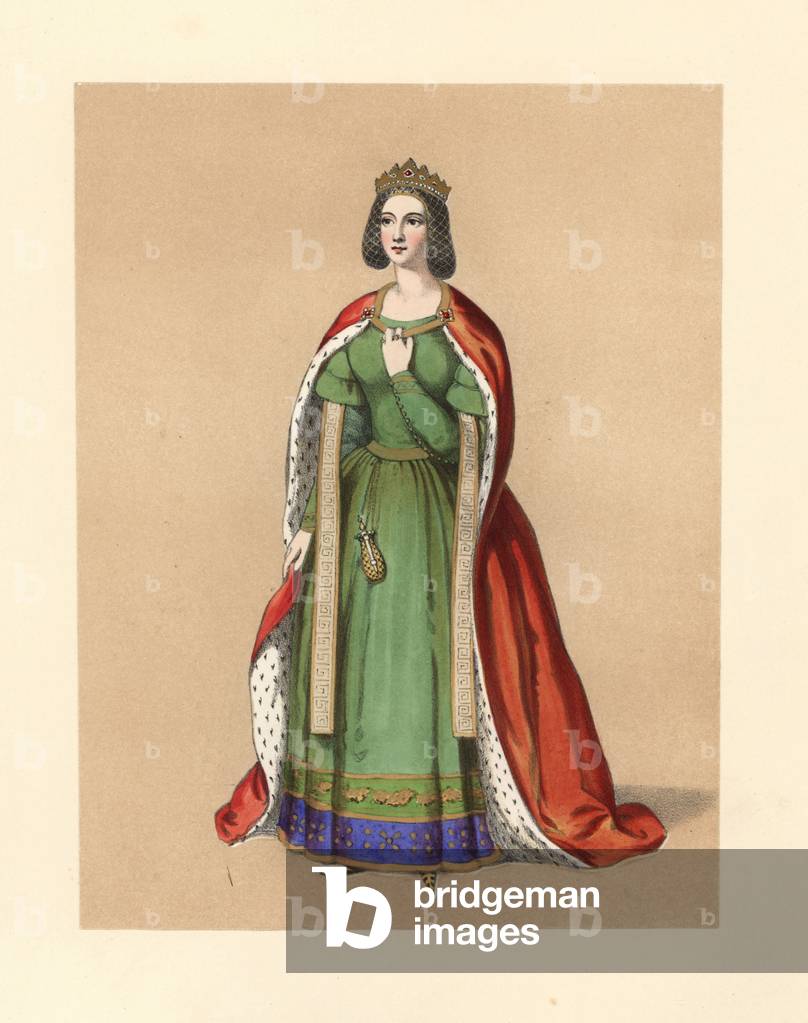
Dress (Dress) of the reign of Edward III, 1327-1377. She wears a gold crown over a hairnet, an ermine-lined mantle over a green dress, with a purse hanging from her belt.Based on a brassed of the wife of William de Wynston, Necton Church, Royal manuscript, “” Vision of Piers Ploughman,”” brassed of Lady Harvick, South Acre Church, Norfolk. Handcoloured lithograph from “” Costumes of British Ladies from the Time of William the First to the Reign of Queen Victoria”, London, Dickinson and Son, 1840.

FLO4594563: Dress (Dress) of the reign of Edward III, 1327-1377. She wears a gold crown over a hairnet, an ermine-lined mantle over a green dress, with a purse hanging from her belt.Based on a brassed of the wife of William de Wynston, Necton Church, Royal manuscript, “” Vision of Piers Ploughman,”” brassed of Lady Harvick, South Acre Church, Norfolk. Handcoloured lithograph from “” Costumes of British Ladies from the Time of William the First to the Reign of Queen Victoria”, London, Dickinson and Son, 1840. / Bridgeman Images

Dress (Dress) of the reign of King Edward I. Longshanks, 1272-1307. She wears a green mantle over a purple dress over a white petticoat, with a jeweled headdress. Based on Sloane manuscript, Lay of Syr Launfal (circa 1300), Royal manuscript, “” Roman de la Rose,”” and Pennant who quotes the lovely Queen of Edward I, Margaret of France, as a model for the dress. Handcoloured lithograph from “” Costumes of British Ladies from the Time of William the First to the Reign of Queen Victoria”, London, Dickinson and Son, 1840.

FLO4594607: Dress (Dress) of the reign of King Edward I. Longshanks, 1272-1307. She wears a green mantle over a purple dress over a white petticoat, with a jeweled headdress. Based on Sloane manuscript, Lay of Syr Launfal (circa 1300), Royal manuscript, “” Roman de la Rose,”” and Pennant who quotes the lovely Queen of Edward I, Margaret of France, as a model for the dress. Handcoloured lithograph from “” Costumes of British Ladies from the Time of William the First to the Reign of Queen Victoria”, London, Dickinson and Son, 1840. / Bridgeman Images
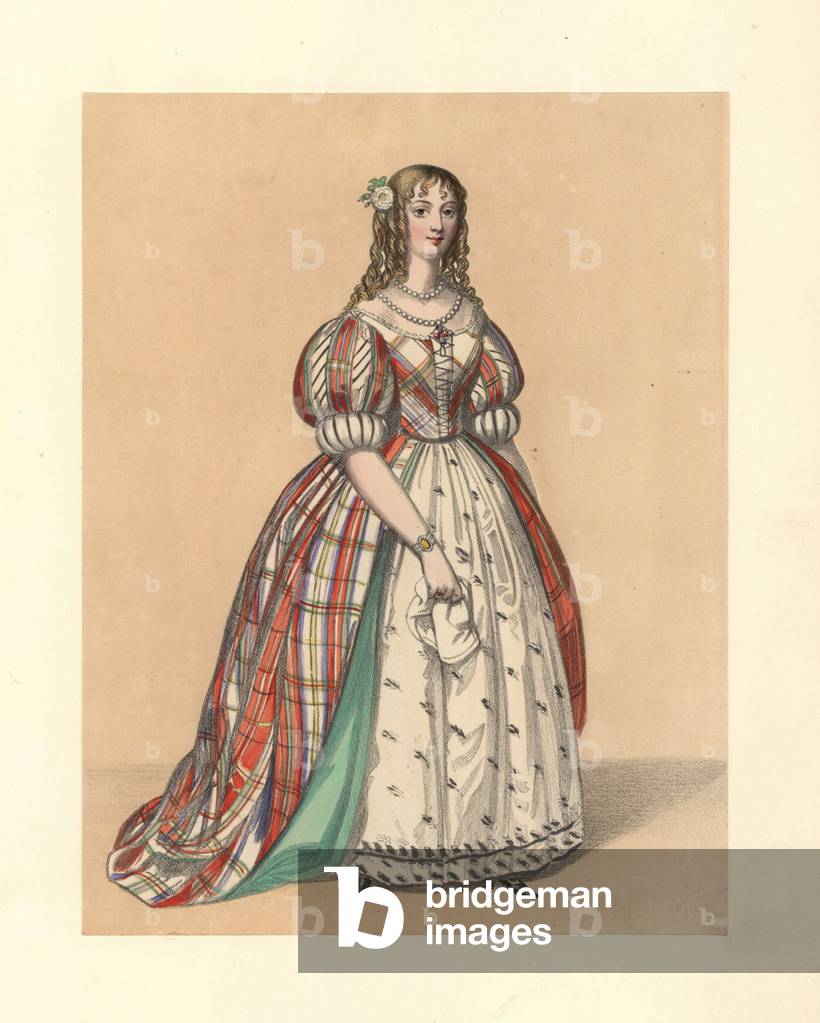
Dress (Dress) of the reign of James II, 1685-1688. She wears her hair in ringlets, a low-cut check dress with bodice and puff sleeves over an embroidered petticoat. Based on Hollar's “” Ornatus Muliebris Anglicanus,”” Heath's “” Chronicle,”” by Grammont, portraits, prints. Handcoloured lithograph from “” Costumes of British Ladies from the Time of William the First to the Reign of Queen Victoria”, London, Dickinson and Son, 1840.

FLO4594708: Dress (Dress) of the reign of James II, 1685-1688. She wears her hair in ringlets, a low-cut check dress with bodice and puff sleeves over an embroidered petticoat. Based on Hollar's “” Ornatus Muliebris Anglicanus,”” Heath's “” Chronicle,”” by Grammont, portraits, prints. Handcoloured lithograph from “” Costumes of British Ladies from the Time of William the First to the Reign of Queen Victoria”, London, Dickinson and Son, 1840. / Bridgeman Images
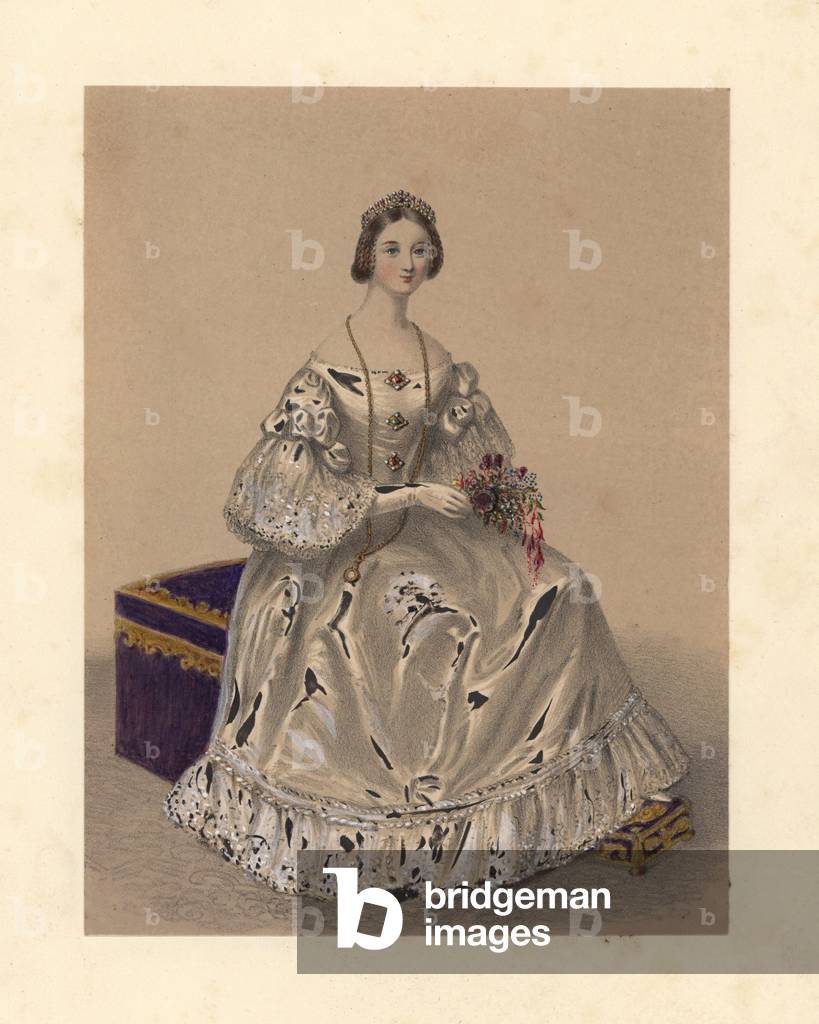
Dress (Robe) of the reign of William IV, 1830-1837. Woman in tiara with low-cut gown with puff sleeves and lace cuffs, holding a garland of flowers. Jewelry copied from actual pieces. Handcoloured lithograph from “” Costumes of British Ladies from the Time of William the First to the Reign of Queen Victoria”, London, Dickinson and Son, 1840.

FLO4594811: Dress (Robe) of the reign of William IV, 1830-1837. Woman in tiara with low-cut gown with puff sleeves and lace cuffs, holding a garland of flowers. Jewelry copied from actual pieces. Handcoloured lithograph from “” Costumes of British Ladies from the Time of William the First to the Reign of Queen Victoria”, London, Dickinson and Son, 1840. / Bridgeman Images
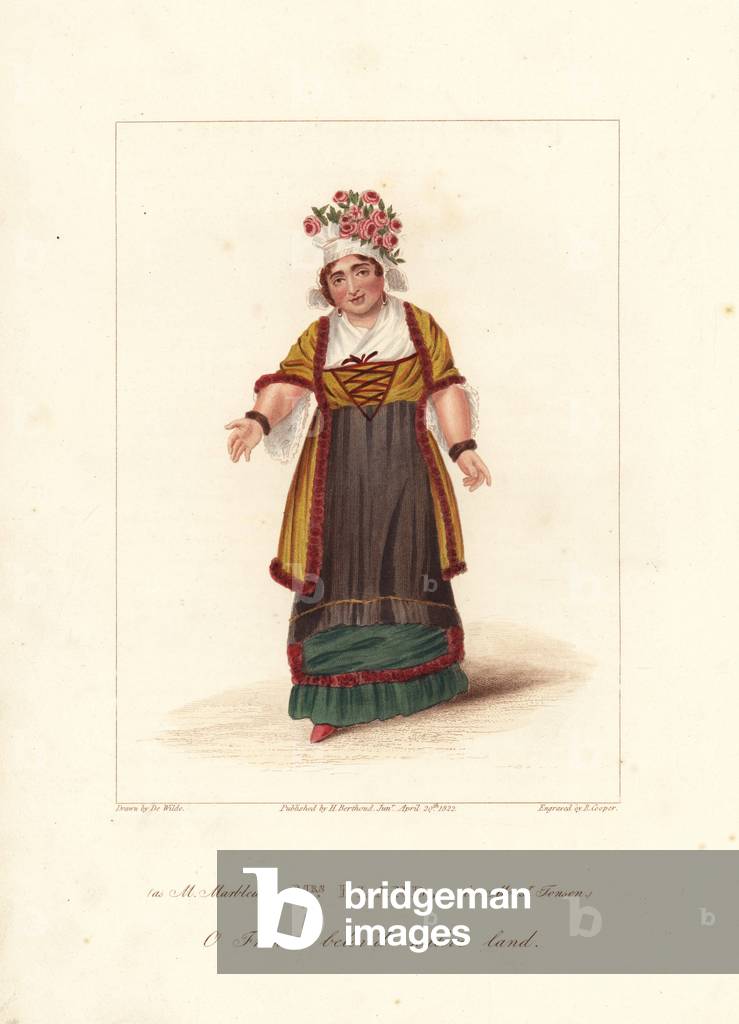
Mrs. Maria Theresa Bland, actress and singer, as Madame Marbleu in “” Monsieur Tonson””” the Theatre Royal Drury Lane. Handcoloured stipple copperplate engraving by Robert Cooper after a painting by Samuel de Wilde. From D. Terry's “” British Theatrical Gallery,” London, Henry Berthoud Jr., 1825.

FLO4594932: Mrs. Maria Theresa Bland, actress and singer, as Madame Marbleu in “” Monsieur Tonson””” the Theatre Royal Drury Lane. Handcoloured stipple copperplate engraving by Robert Cooper after a painting by Samuel de Wilde. From D. Terry's “” British Theatrical Gallery,” London, Henry Berthoud Jr., 1825. / Bridgeman Images
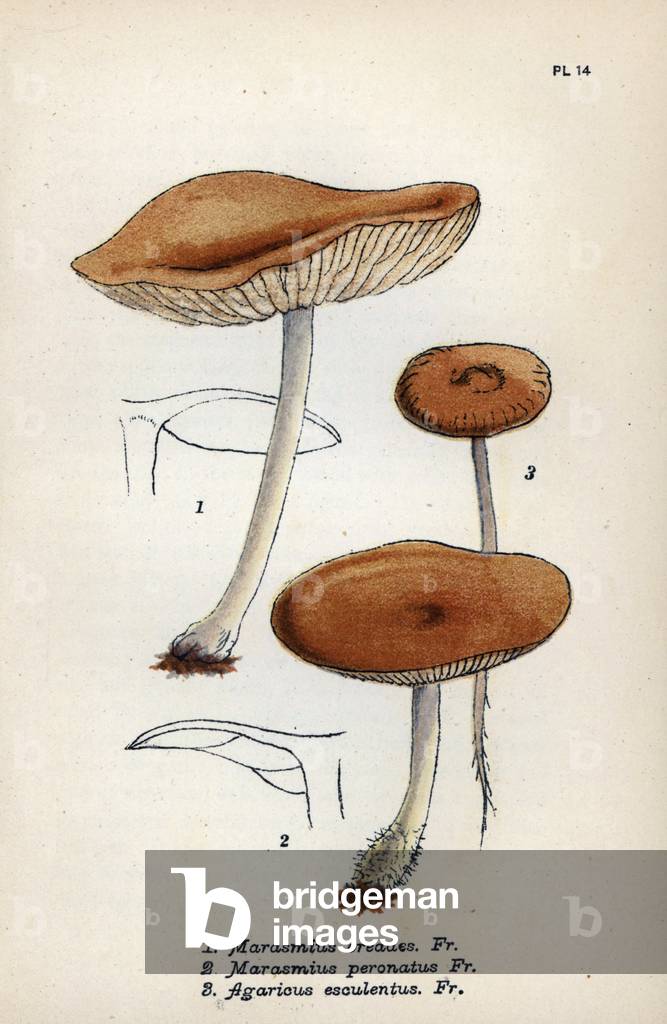
Marasmus of the oreads or false musseron (Marasmius oreades 1), collybia guetree or burlant marasmus (Marasmius peronatus 2), collybia of the epiceas cones (Agaricus esculentus 3) - Chromolithography after a drawing by Mordecai Cubitt Cooke (1825-1914), published in “” A Plain and Easy Account of British Fungi”” English), Robert Hardwicke Edition, London, 1862

FLO4594431: Marasmus of the oreads or false musseron (Marasmius oreades 1), collybia guetree or burlant marasmus (Marasmius peronatus 2), collybia of the epiceas cones (Agaricus esculentus 3) - Chromolithography after a drawing by Mordecai Cubitt Cooke (1825-1914), published in “” A Plain and Easy Account of British Fungi”” English), Robert Hardwicke Edition, London, 1862 / Bridgeman Images

The dwarf Morgante Braccio di Bartolo, court dwarf of Cosimo I of Medici (Cosimo I de Medici). Bronze sculpture by Giambologna (Giovanni da Bologna or Jean de Bologna or Boulogne, 1529-1608) Museo Nazionale del Bargello Florence

LRI4594565: The dwarf Morgante Braccio di Bartolo, court dwarf of Cosimo I of Medici (Cosimo I de Medici). Bronze sculpture by Giambologna (Giovanni da Bologna or Jean de Bologna or Boulogne, 1529-1608) Museo Nazionale del Bargello Florence, Giambologna (Giovanni da Bologna), (1529-1608) / Bridgeman Images

Dress early in the reign of King George III, 1760-1770. Woman with greengrocer's barrow headdress, bouffant hair, tight silk bodice with lace collar, silk muff and white petticoats. “The long side curls are imitated by carrots similarly disposed.”” Based on prints “” The Maiden Aunt””” 1776, “” The Green Stall,”” “” The Macaroni Courtship,””” and Bunbury. Handcoloured lithograph from “” Costumes of British Ladies from the Time of William the First to the Reign of Queen Victoria”, London, Dickinson and Son, 1840.

FLO4594766: Dress early in the reign of King George III, 1760-1770. Woman with greengrocer's barrow headdress, bouffant hair, tight silk bodice with lace collar, silk muff and white petticoats. “The long side curls are imitated by carrots similarly disposed.”” Based on prints “” The Maiden Aunt””” 1776, “” The Green Stall,”” “” The Macaroni Courtship,””” and Bunbury. Handcoloured lithograph from “” Costumes of British Ladies from the Time of William the First to the Reign of Queen Victoria”, London, Dickinson and Son, 1840. / Bridgeman Images
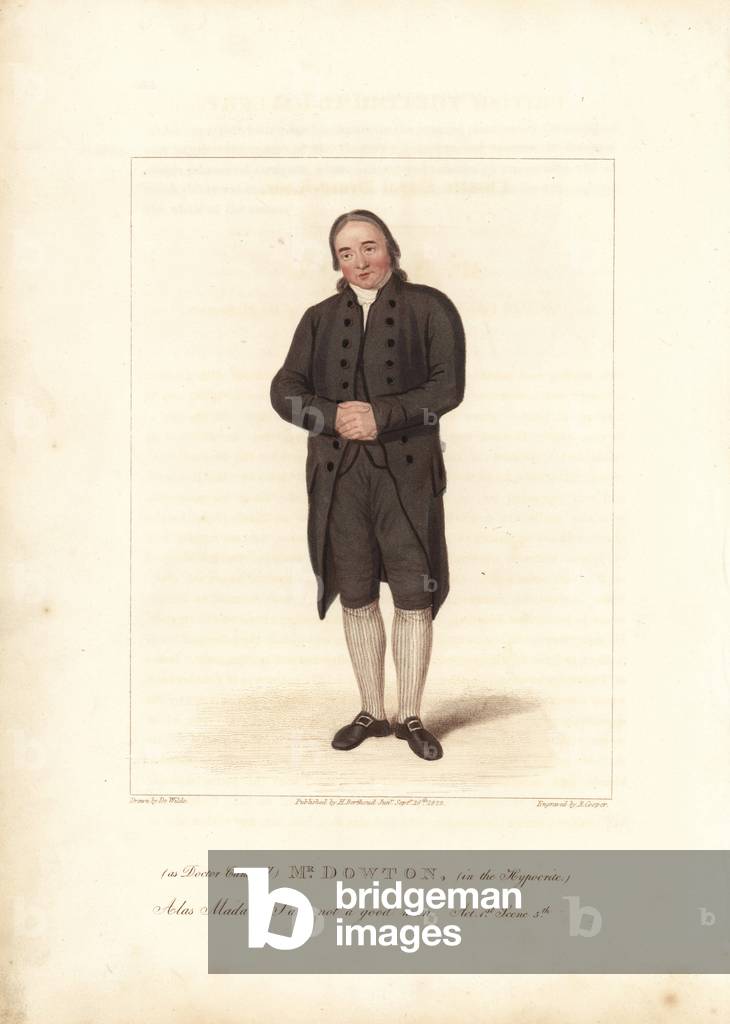
Mr. William Dowton as Doctor Cantwell in “The Hypocrite” at the Theatre Royal Drury Lane. Handcoloured stipple copperplate engraving by Robert Cooper after a painting by Samuel de Wilde. From D. Terry's “” British Theatrical Gallery,” London, Henry Berthoud Jr., 1825.

FLO4594879: Mr. William Dowton as Doctor Cantwell in “The Hypocrite” at the Theatre Royal Drury Lane. Handcoloured stipple copperplate engraving by Robert Cooper after a painting by Samuel de Wilde. From D. Terry's “” British Theatrical Gallery,” London, Henry Berthoud Jr., 1825. / Bridgeman Images

Mr. James Pimbury Wilkinson as Michael in “” Free and Easy”” at the Theatre Royal English Opera House, Strand. Handcoloured stipple copperplate engraving by Robert Cooper after a painting by George Clint. From D. Terry's “” British Theatrical Gallery,” London, Henry Berthoud Jr., 1825.

FLO4594887: Mr. James Pimbury Wilkinson as Michael in “” Free and Easy”” at the Theatre Royal English Opera House, Strand. Handcoloured stipple copperplate engraving by Robert Cooper after a painting by George Clint. From D. Terry's “” British Theatrical Gallery,” London, Henry Berthoud Jr., 1825. / Bridgeman Images
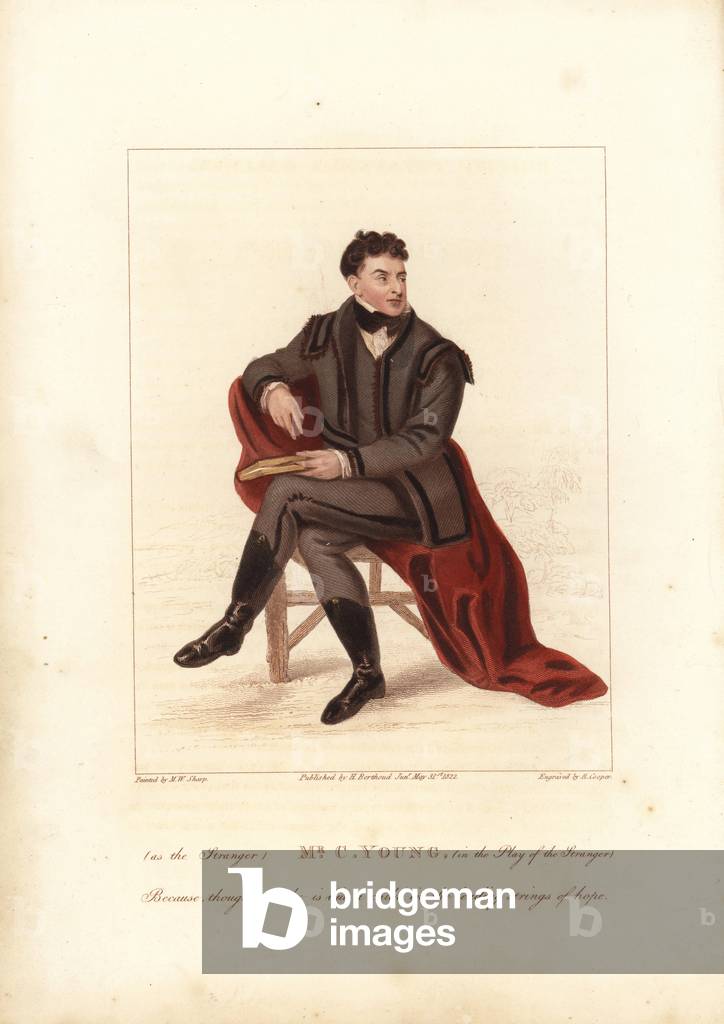
Mr. Charles Young in “The Stranger” at the Theatre Royal Covent Garden. Handcoloured stipple copperplate engraving by Robert Cooper after a painting by Michael William Sharp. From D. Terry's “” British Theatrical Gallery,” London, Henry Berthoud Jr., 1825.

FLO4594926: Mr. Charles Young in “The Stranger” at the Theatre Royal Covent Garden. Handcoloured stipple copperplate engraving by Robert Cooper after a painting by Michael William Sharp. From D. Terry's “” British Theatrical Gallery,” London, Henry Berthoud Jr., 1825. / Bridgeman Images
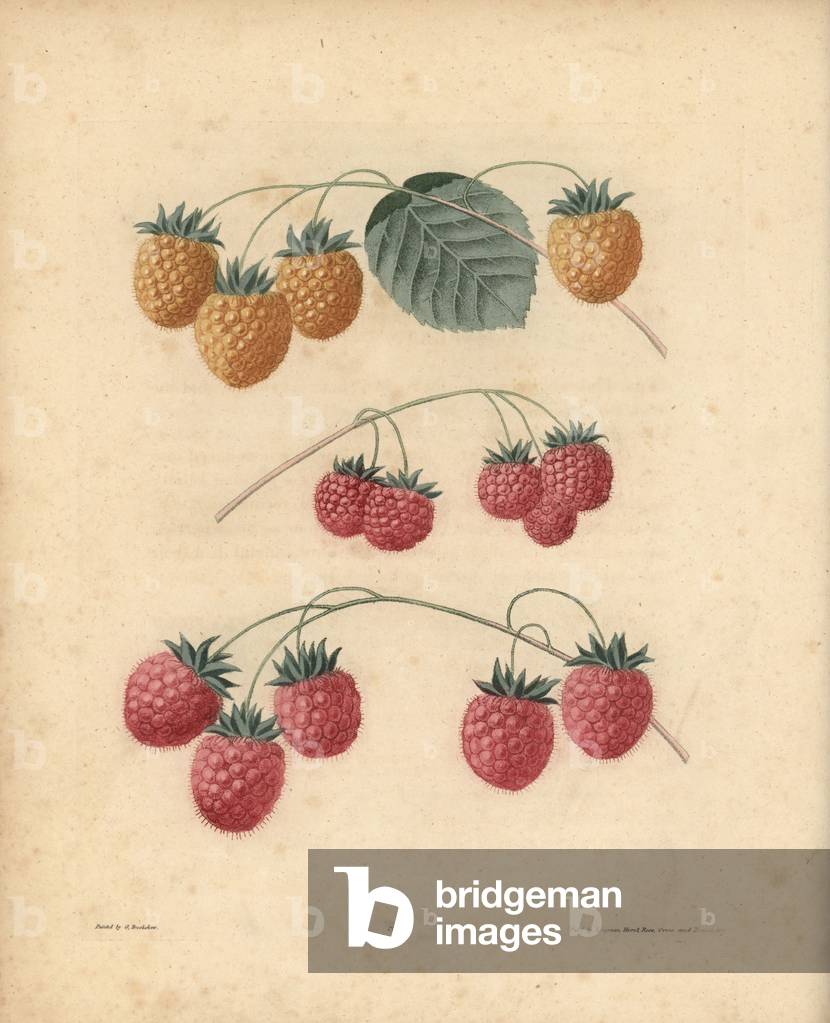
Raspberry varieties: red Antwerp, white Antwerp and common raspberry. Handcoloured stipple engraving of an illustration by George Brookshaw from his own “” Pomona Britannica,”” London, Longman, Hurst, etc., 1817. The quarto edition of the original folio edition published from 1804-1812. Brookshaw (1751-1823) was a successful cabinet maker who disappeared in the 1790s before returning as a flower painter with the anonymous “” New Treatise on Flower Painting,””” 1797.

FLO4595046: Raspberry varieties: red Antwerp, white Antwerp and common raspberry. Handcoloured stipple engraving of an illustration by George Brookshaw from his own “” Pomona Britannica,”” London, Longman, Hurst, etc., 1817. The quarto edition of the original folio edition published from 1804-1812. Brookshaw (1751-1823) was a successful cabinet maker who disappeared in the 1790s before returning as a flower painter with the anonymous “” New Treatise on Flower Painting,””” 1797. / Bridgeman Images


Back to top