
Print this page or go back to standard view.

JLJ4607047: The Danish court in front of the Reale casino, 1821 (oil on canvas), Dahl, Johan Christian (1788-1857) / Bridgeman Images

FLO4608331: Medievale Great Britain: a Hibernian couple, 5th century, in front of a tower of ancient Ireland - Forte Water by Robert Havell (1793-1878), based on an illustration by Charles Hamilton Smith (1776-1859), from Samuel Meyrick's Original Costume of British Islanders (1783-1848), 1821 - female Hibernian male and costume, post-Roman era. Man in fallin shirt, trousers, brogues (shoes), and fringed plaid coat holding a short lance. Woman in large piece of cloth trimmed with fringe. In the background, an Irish cloghad, tower or belfry. Handcoloured aquatint by R. Havell from an illustration by Charles Hamilton Smith from Samuel Meyrick's Costume of the Original Inhabitants of the British Islands, London, 1821. / Bridgeman Images

LRI4608368: Fantastic Landscape with Monks, 1720 (painting), Magnasco, Alessandro (1667-1749) / Bridgeman Images

FLO4608413: Napoleon blowing up his comrades. Handcoloured copperplate engraving by George Cruikshank from The Life of Napoleon a Hudibrastic Poem by Doctor Syntax, T. Tegg, London, 1815. / Bridgeman Images

LRI4608500: Drawing by Marino Marini (1901-1980, 20th century. Milano, Collezione Jesi, Marini, Marino (1901-80) / Bridgeman Images

FLO4608541: Napoleon working the gun at the Siege of Toulon, 1793. Handcoloured copperplate engraving by George Cruikshank from The Life of Napoleon a Hudibrastic Poem by Doctor Syntax, T. Tegg, London, 1815. / Bridgeman Images

FLO4607143: Madame Bras as Dame Catherine in La Dame les Belles Cousines by Louis Charles Achille d'Artois, Theatre du Vaudeville, 1823. Handcoloured lithograph by F. Noel after an illustration by Alexandre-Marie Colin from Portraits d'Acteurs et d'Actrices dans different roles, F. Noel, Paris, 1825. / Bridgeman Images

PIX4607179: Artist's view of the probe Hayabusa - Hayabusa spacecraft near the asteroid Itokawa. - Artist's view of the probe Hayabusa near the asteroid Itokawa. His Minerva lander is representative. The Japanese probe Hayabusa (MUSES - C) was launched on 9 May 2003 to reach Asteroid 25143 Itokawa in September 2005 and to take samples from it. His return to Earth is scheduled for 2010. Artwork showing the Hayabusa (MUSES - C) spacecraft with its lander Minerva near the asteroid Itokawa / Bridgeman Images
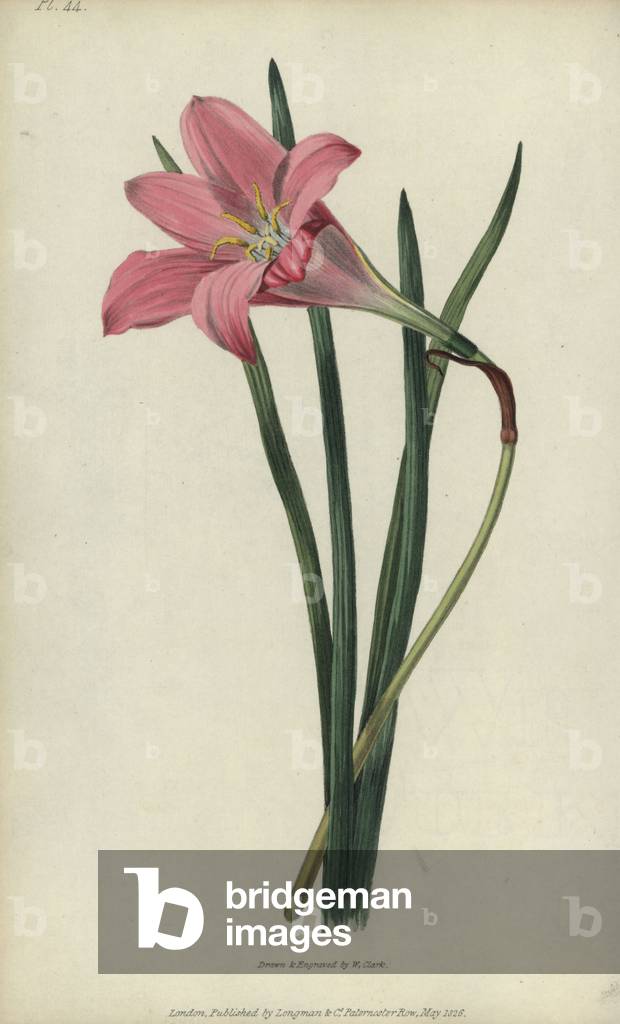
FLO4607479: Rosepink zephyr lily or pink rain lily, Zephyranthes carinata. Handcoloured botanical illustration drawn and engraved by William Clark from Richard Morris's “Flora Conspicua” London, Longman, Rees, 1826. William Clark was former draughtsman to the London Horticultural Society and illustrated many botanical books in the 1820s and 1830s. / Bridgeman Images

FLO4607618: Alfred the Great (846-899) is rebuked by the peasant who entrusted him with the supervision of cakes he let burn - King Alfred burning the cakes in the neat-herd's cottage. Copperplate engraving by J. Hall after an illustration by Edwards from The Copper Plate Magazine or Monthly Treasure, G. Kearsley, London, 1778. / Bridgeman Images

LRI4607828: Election of Nicholas as bishop of Myra. Scenes from the Life of St Nicholas (Tempera on wood, 1330), Lorenzetti, Ambrogio (1285-c.1348) / Bridgeman Images

FLO4608048: Jean Baptiste Colbert, statesman, minister to King Louis XIV. Copperplate engraving by Joshua Collyer after Philippe de Champaigne from The Copper Plate Magazine or Monthly Treasure, G. Kearsley, London, 1778. / Bridgeman Images
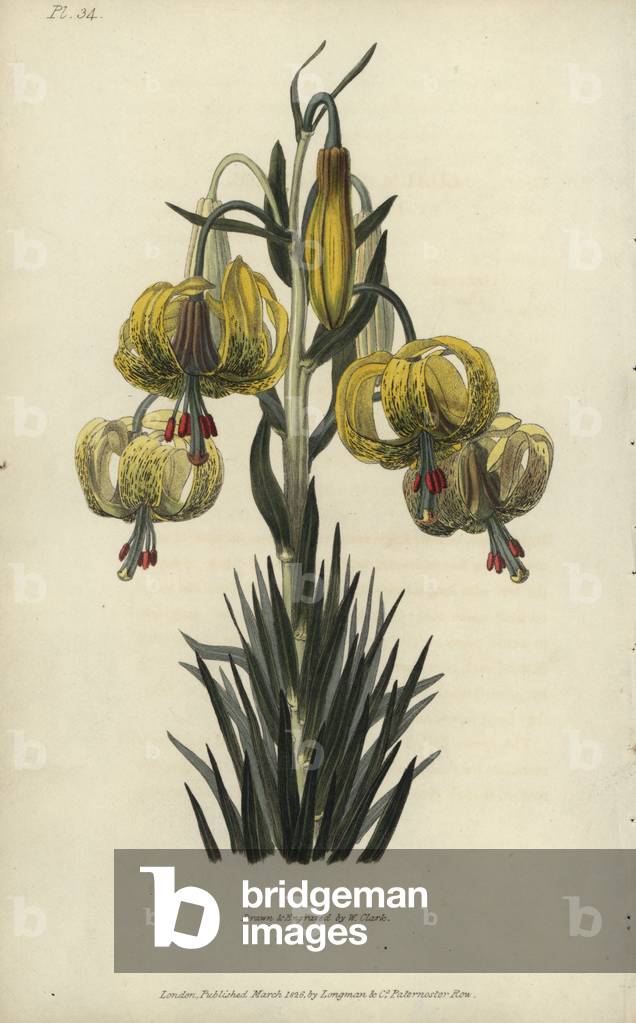
FLO4607365: Turban or pomponian lily, Lilium pomponium. Handcoloured botanical illustration drawn and engraved by William Clark from Richard Morris's “Flora Conspicua” London, Longman, Rees, 1826. William Clark was former draughtsman to the London Horticultural Society and illustrated many botanical books in the 1820s and 1830s. / Bridgeman Images
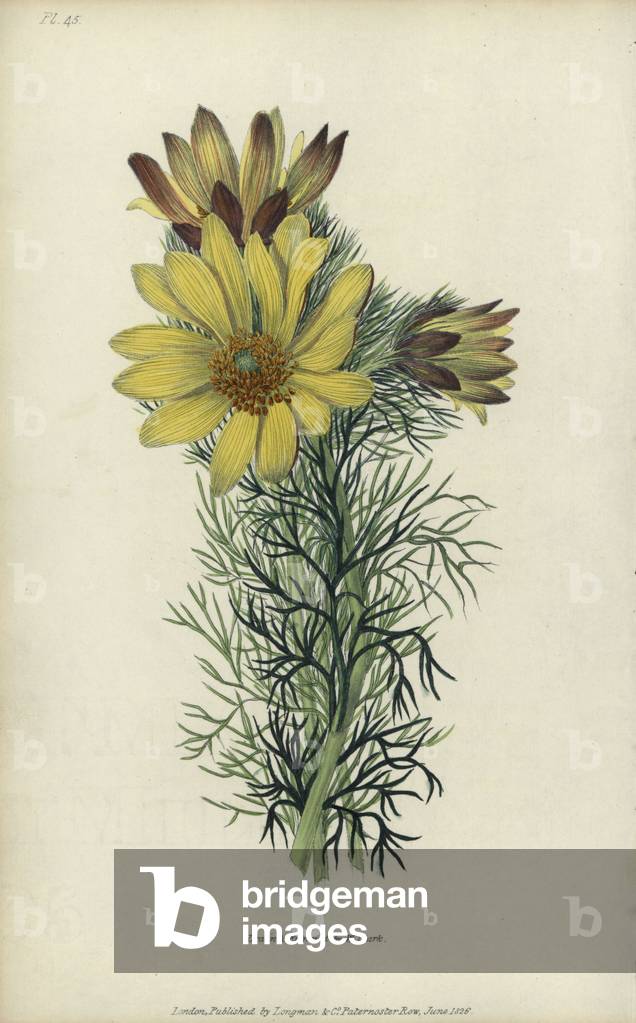
FLO4607485: Spring pheasant's eye, Adonis vernalis. Handcoloured botanical illustration drawn and engraved by William Clark from Richard Morris's “Flora Conspicua” London, Longman, Rees, 1826. William Clark was former draughtsman to the London Horticultural Society and illustrated many botanical books in the 1820s and 1830s. / Bridgeman Images

PIX4607548: Object of Thorne-Zytkow - Artist's view - Thorne-Zytkow object - Artwork: An object of Thorne-Zytkow is a star shaped like a red supergiant star whose heart is occupied by a neutron star. A Thorne- ytkow object is a conjectured type of star wherein a red giant or supergiant contains a neutron star at its core, formed from the collision of the giant with the neutron star. Such objects were hypothesized by Kip Thorne and Anna ytkow in 1977, Dixon, Don (b.1951) / Bridgeman Images
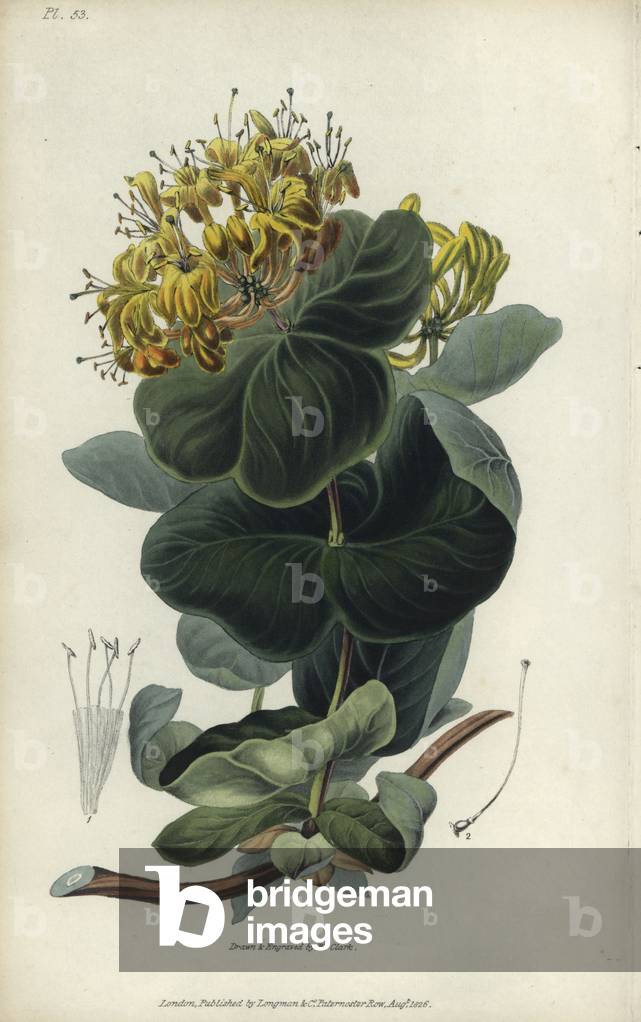
FLO4607553: Native yellow honeysuckle, Lonicera flava. Handcoloured botanical illustration drawn and engraved by William Clark from Richard Morris's “Flora Conspicua” London, Longman, Rees, 1826. William Clark was former draughtsman to the London Horticultural Society and illustrated many botanical books in the 1820s and 1830s. / Bridgeman Images
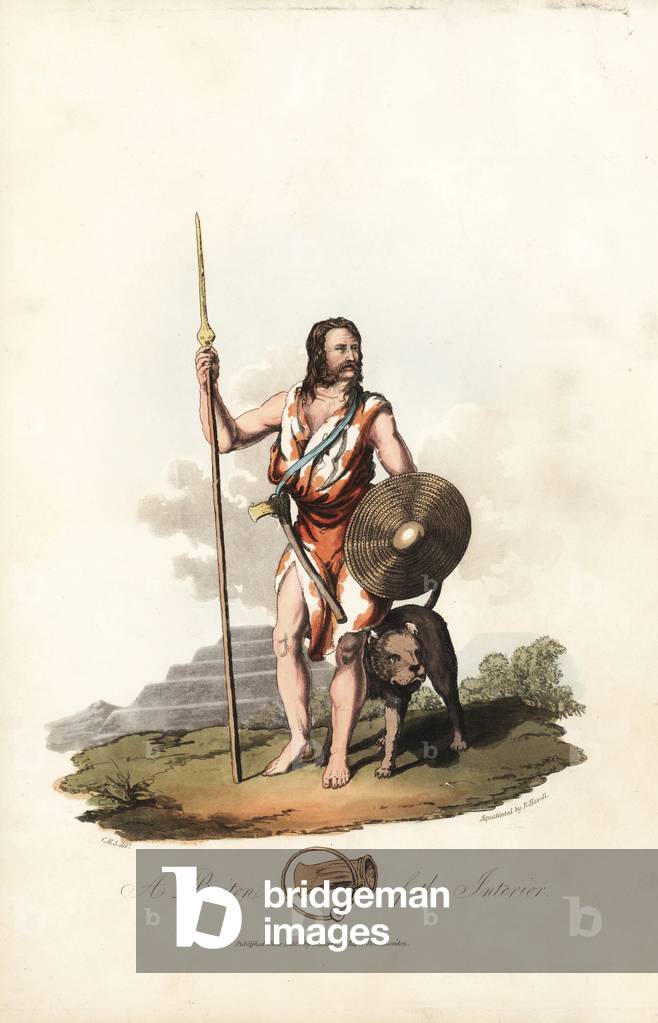
FLO4608193: British Antiquite (pre-Roman period, before 1st century): A British warrior (Scotland), armed with a spear and an axe, holding his shield, in front of a Fortress Caterthun - Fortress of Robert Havell (1793-1878) from an illustration by Charles Hamilton Smith (1776-1859), from the original Costume of the inhabitants of the British Isles, by Samuel Meyrick (1783-1848), 1821 - A Briton of the interior, carrying tarian (shield), fonwayw (spear) and bwyell-arv (battle axe), from the Pre-Roman era - In front of a Catterthun fortress - Handcoloured aquatint by R. Havell from an illustration by Charles Hamilton Smith from Samuel Meyrick's Costume of the Original Inhabitants of the British Islands, London, 1821 / Bridgeman Images

FLO4608205: British Antiquite (pre-Roman period, before 1st century): A Belgian Briton and a Cassiterid from Cornwall (England) - Forte water by Robert Havell (1793-1878) from an illustration by Charles Hamilton Smith (1776-1859), from Samuel Meyrick (1783-1848), 1821 - Belgic Briton and one of the Cassiterides of Cornwall from the Pre-Roman era, in checkered saic (mantle) over a pais (tunic) and llawdyr (pantaloons) and brog (shoes) - The Cassiterides wears a long tunic and carries a staff, they stand in front of the entrenchment of Caer Morus - Handcoloured aquatint by R. Havell from an illustration by Charles Hamilton Smith from Samuel Meyel Rick's Costume of the Original Inhabitants of the British Islands, London, 1821 / Bridgeman Images

FLO4608358: Pabo Post Prydain (ca. 500) (known as the pillar of Brittany), British king of Hen Oggled (England, Scotland) - Forte water by Robert Havell (1793-1878) from an illustration by Charles Hamilton Smith (1776-1859), from Samuel Meyrick's Original Costume of the British Islanders (1783-1848), 1821 - Pabo, the Pillar of Britain son of Arthwys ab Mor, 5th, century, wearing a long Dalmatic tunic bordered with fur, decorated with pearl-studded lace. Handcoloured aquatint by R. Havell from an illustration by Charles Hamilton Smith from Samuel Meyrick's Costume of the Original Inhabitants of the British Islands, London, 1821. / Bridgeman Images
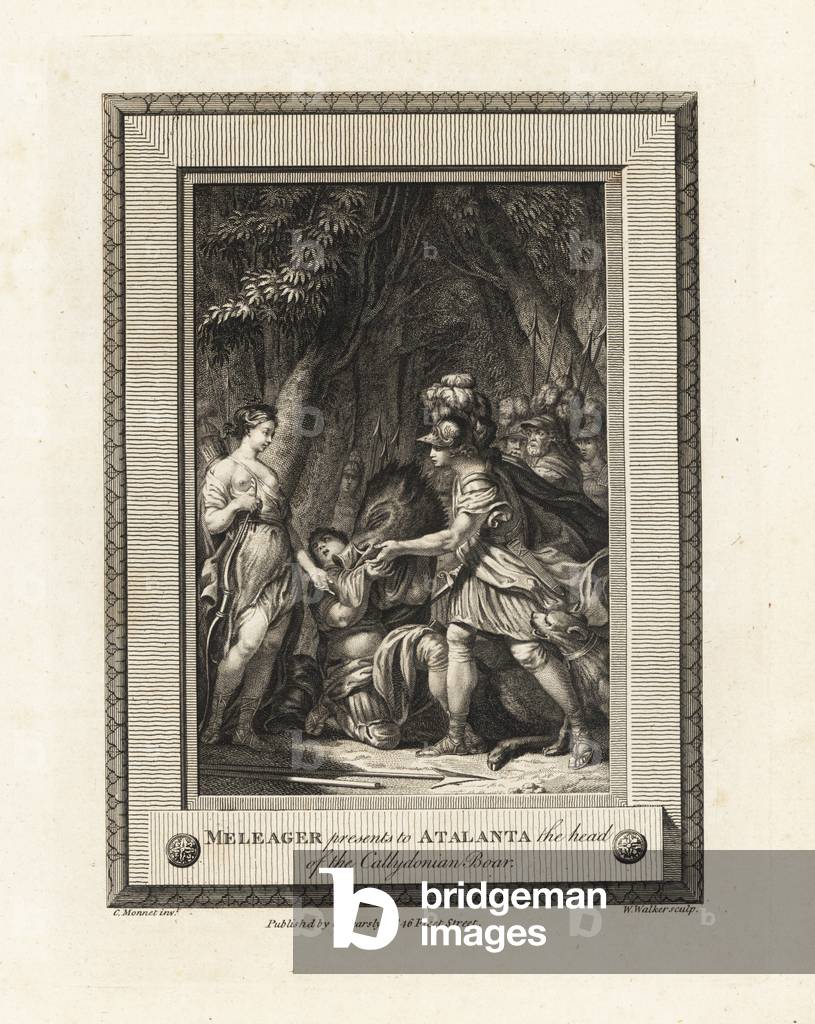
FLO4607684: Meleagre presents to the virgin huntress Atalanta the head of the Calydonian Boar. Copperplate engraving by W. Walker after an illustration by C. Monnet from The Copper Plate Magazine or Monthly Treasure, G. Kearsley, London, 1778. / Bridgeman Images

FLO4607943: Oliver Cromwell, Lord Protector of the Commonwealth, 1599-1658, profile portrait in suit of armour, with vignette below showing him accepting a crown. Copperplate engraving by Thomas Cook after a miniature by Samuel Cooper from The Copper Plate Magazine or Monthly Treasure, G. Kearsley, London, 1778. / Bridgeman Images

FLO4607948: Thomas Wharton, 1st Marquess of Wharton, debauched English nobleman and politician, 1648-1715. With his Copperplate engraving by William Sharp after a painting by Sir Godfrey Kneller from The Copper Plate Magazine or Monthly Treasure, G. Kearsley, London, 1778. / Bridgeman Images

FLO4608005: Moliere, Jean-Baptiste Poquelin, French dramatist and actor. Copperplate engraving by Thomas Cook from The Copper Plate Magazine or Monthly Treasure, G. Kearsley, London, 1778. / Bridgeman Images

FLO4608058: Portrait of William Shakespeare, English poet and dramatist, 1564-1616, within an oval decorated with mask, lyre, horn and ribbon. Copperplate engraving by Thomas Cook from The Copper Plate Magazine or Monthly Treasure, G. Kearsley, London, 1776. / Bridgeman Images

FLO4608674: Napoleon Bonaparte forced to abdicate by Marshal Michel Ney who holds pistols to his head, while a Turk sharpens a scimitar outside. Handcoloured copperplate engraving by George Cruikshank from The Life of Napoleon a Hudibrastic Poem by Doctor Syntax, T. Tegg, London, 1815. / Bridgeman Images

FLO4608759: Imbricated penaea, Penaea imbricata. Handcoloured copperplate engraving by Swan after an illustration by William Jackson Hooker from Samuel Curtis' Botanical Magazine, London, 1828. / Bridgeman Images

FLO4608870: Three-leaved Chinese rose, Rosa sinica. Handcoloured copperplate engraving by Swan after an illustration by William Jackson Hooker from Samuel Curtis' Botanical Magazine, London, 1828. / Bridgeman Images

FLO4608120: Francois de la Mothe le Vayer, English writer and tutor to Louis XIV, 1588-1672, in skullcap and robes within oval, above books, lantern, quill pen and ink well. Copperplate engraving by Thomas Cook from The Copper Plate Magazine or Monthly Treasure, G. Kearsley, London, 1778. / Bridgeman Images

FLO4608125: Prosper Jolyot de Crebillon, French poet and tragedian, 1674-1762. Copperplate engraving by William Walker from The Copper Plate Magazine or Monthly Treasure, G. Kearsley, London, 1778. / Bridgeman Images

LRI4608215: Divine weapons forged in the Volcano's Forge in front of some angels lying in the clouds, Detail (Fresco, 16th century), Luini, Bernardino (c.1480-1532) / Bridgeman Images
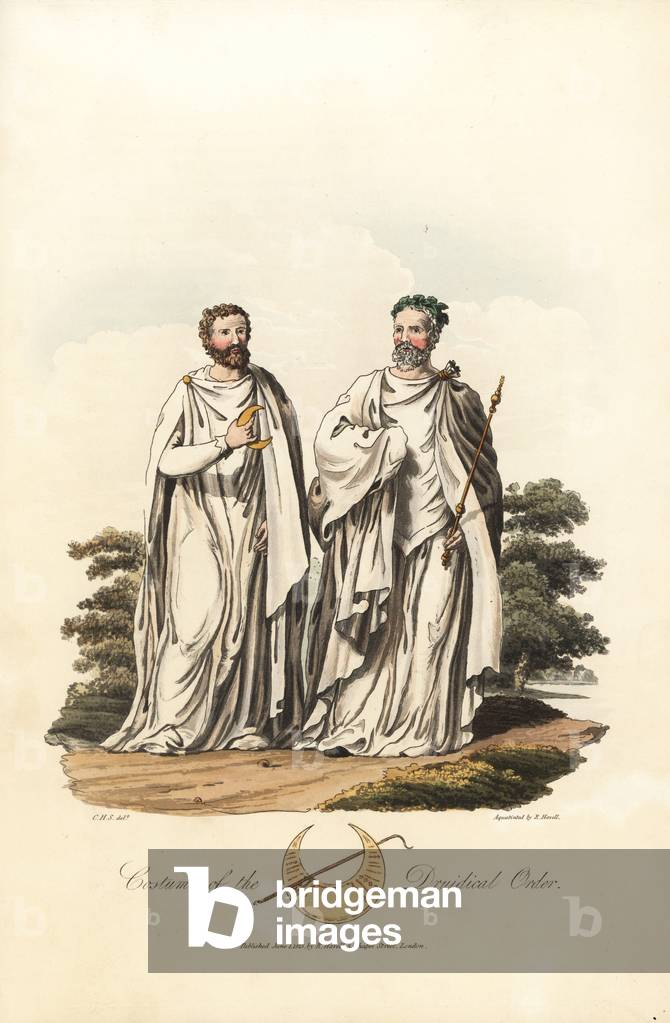
FLO4608220: British antiquite (pre-Roman period, before 1st century): Druid costumes, a Druid archi with its crown of oak leaves and a druid holding a cornan, symbol of celebration - Forte Water by Robert Havell (1793-1878) after an illustration by Charles Hamilton Smith (1776-1859), from original Costume of British Islanders, from Samuel Meyrick (1783-1848), 1821 - Costume of the Druidical Order, Pre-Roman era - Arch-Druid in garland of oak leaves, and Druid holding a Cornan, a symbol of a festival - Handcoloured aquatint by R. Havell from an illustration by Charles Hamilton Smith from Samuel Meyrick's Costume of the Original Inhabitants of the British Islands, London, 1821 / Bridgeman Images
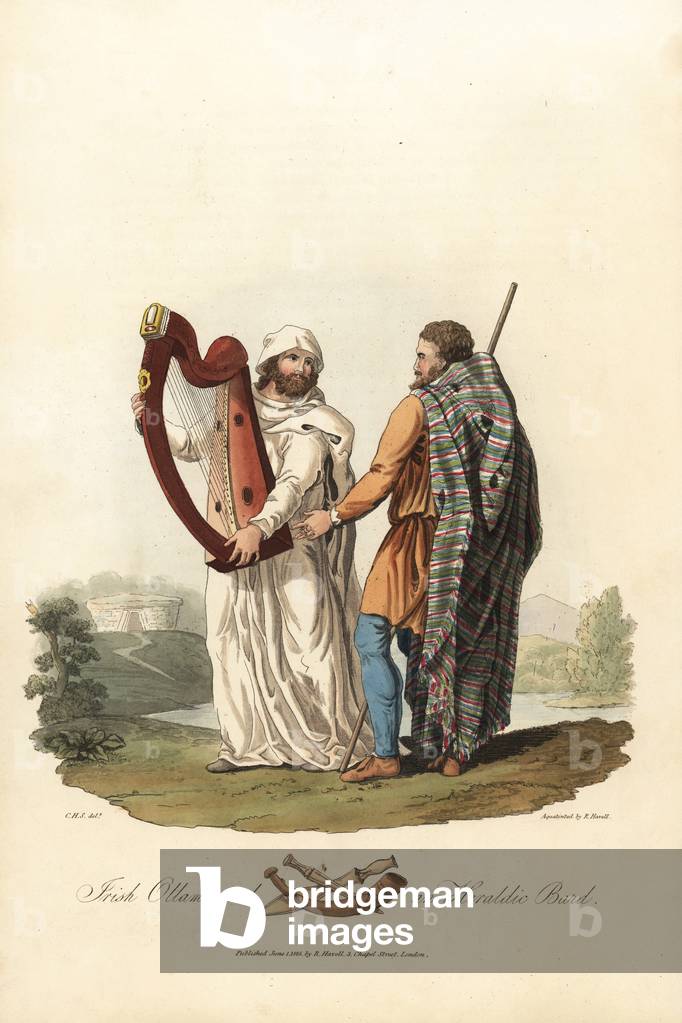
FLO4608234: British antiquite (pre-Roman period, before 1st century): an Irish sage and a heraldic bard wearing his harp - Forte water by Robert Havell (1793-1878) from an illustration by Charles Hamilton Smith (1776-1859), from Samuel Meyrick's original costume of the inhabitants of the British islands, 1821 - Irish ollamh (dignified philosopher) and a filidhe (herald bard), Pre-roman era - The ollamh wears a saffron cota (tunic), cochal (cloak) and trousers, the filidhe wears white robes and hood, and carries a harp - Handcoloured aquatint by R. Havell from an illustration by Charles Hamilton Smith from Samuel Meyrick's Costume of the London Original Inhabitants of the British Islands,, 1821 / Bridgeman Images

LRI4608386: Virginia (oil on canvas, 1914), Magnelli, Alberto (1888-1971) / Bridgeman Images

FLO4608502: The blindfolded Austrian officer (Prince Maurice Liechtenstein) forced to capitulate to Napoleon Bonaparte at the Battle of Ulm, 1805. Handcoloured copperplate engraving by George Cruikshank from The Life of Napoleon a Hudibrastic Poem by Doctor Syntax, T. Tegg, London, 1815. / Bridgeman Images

FLO4609496: Phlox. Copper engraving, painted by John Curtis and grave by Weddell, published in the “Curtis Botanical Magazine”, 1820, by Samuel Curtis, London, England. / Bridgeman Images
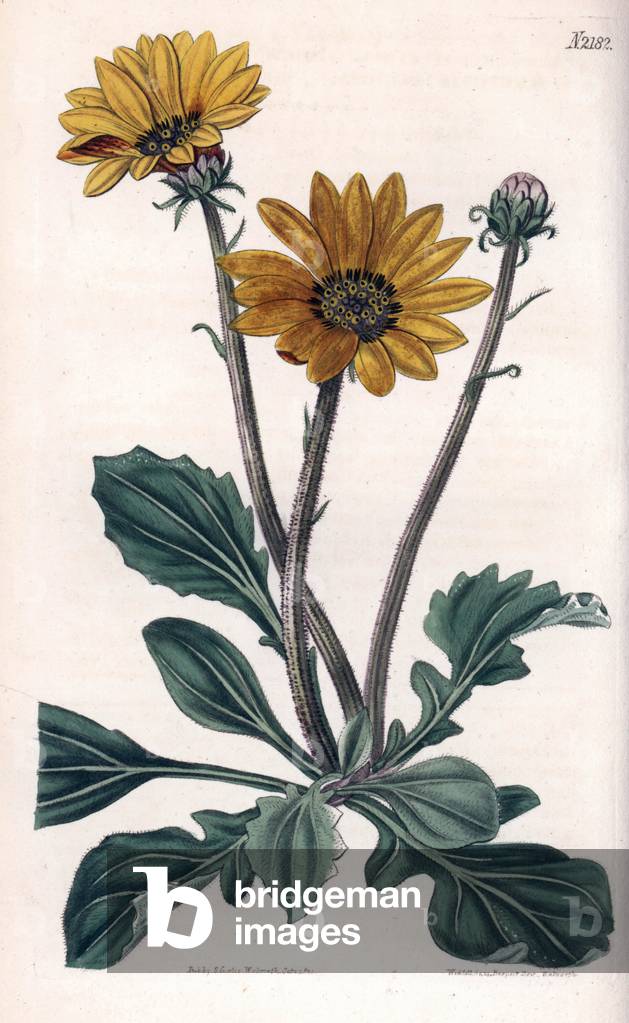
FLO4609593: Variety of arctotis with yellow flowers. Copper engraving, painted by John Curtis and grave by Weddell, published in the “Curtis Botanical Magazine”, 1820, by Samuel Curtis, London, England. / Bridgeman Images