Unknown Artist, (19th century) Assets (17905 in total)

Search options

Orientation
Colour

Display options

View

Print

To print search results, use print friendly version of this page.

Results

Near the cataracts of the Rovuma (Mozambique), the fishing activities of the fish. Engravure to illustrate Dr. Livingstone's first voyages to Southern Africa from 1840 to 1856, in “Le tour du monde, nouveau journal des voyages”” published under the direction of Edouard Charton, 1866, Paris. Selva Collection.

LSE4325735: Near the cataracts of the Rovuma (Mozambique), the fishing activities of the fish. Engravure to illustrate Dr. Livingstone's first voyages to Southern Africa from 1840 to 1856, in “Le tour du monde, nouveau journal des voyages”” published under the direction of Edouard Charton, 1866, Paris. Selva Collection., Unknown Artist, (19th century) / Bridgeman Images

Cauda-yoli (cauda yoli), the annual Turcoman religious feast, to pray for God's protection for the family and the betail, organized by a family, which for the occasion can sacrifice about fifteen sheep, and to which the whole community is invited. Engraving to illustrate the story of Henri de Blocqueville “14 mois de captivite chez les turcomans”” between 1860 and 1861, in “Le tour du monde, nouveau journal des voyages”” published under the direction of Edouard Charton, 1866, Paris. Selva Collection.

LSE4325773: Cauda-yoli (cauda yoli), the annual Turcoman religious feast, to pray for God's protection for the family and the betail, organized by a family, which for the occasion can sacrifice about fifteen sheep, and to which the whole community is invited. Engraving to illustrate the story of Henri de Blocqueville “14 mois de captivite chez les turcomans”” between 1860 and 1861, in “Le tour du monde, nouveau journal des voyages”” published under the direction of Edouard Charton, 1866, Paris. Selva Collection., Unknown Artist, (19th century) / Bridgeman Images

An air ferry, path above the valles, a kind of string basket is suspended from a rope, for the transport of men and materials, its displacement is done by the strength of the arms, pulling the suspension rope. Engraving to illustrate the voyage to Japan in 1863-1864, by Aime Humbert, minister of the Swiss Confederation, in “Le tour du monde, nouveau journal des voyages”, published under the direction of Edouard Charton, 1866, Paris. Selva Collection.

LSE4325834: An air ferry, path above the valles, a kind of string basket is suspended from a rope, for the transport of men and materials, its displacement is done by the strength of the arms, pulling the suspension rope. Engraving to illustrate the voyage to Japan in 1863-1864, by Aime Humbert, minister of the Swiss Confederation, in “Le tour du monde, nouveau journal des voyages”, published under the direction of Edouard Charton, 1866, Paris. Selva Collection., Unknown Artist, (19th century) / Bridgeman Images

A hermit in Kyoto (or Kioto), isolates in a hut nestled in the branches of a tree, on a small island, the hermit can only count on the generosite of the inhabitants of the region who provide him with his food; opposite his tree, a small pavilion welcomes visitors who come to honour him. Engraving to illustrate the voyage to Japan in 1863-1864, by Aime Humbert, minister of the Swiss Confederation, in “Le tour du monde, nouveau journal des voyages”, published under the direction of Edouard Charton, 1866, Paris. Selva Collection.

LSE4325874: A hermit in Kyoto (or Kioto), isolates in a hut nestled in the branches of a tree, on a small island, the hermit can only count on the generosite of the inhabitants of the region who provide him with his food; opposite his tree, a small pavilion welcomes visitors who come to honour him. Engraving to illustrate the voyage to Japan in 1863-1864, by Aime Humbert, minister of the Swiss Confederation, in “Le tour du monde, nouveau journal des voyages”, published under the direction of Edouard Charton, 1866, Paris. Selva Collection., Unknown Artist, (19th century) / Bridgeman Images

A suspended bridge in the Terai (“Wetland”), this area of marecagous meadows forms the base of the Himalayas and borders Nepal south of the Indian border. Engraving to illustrate the exploration of Upper Asia from 1854 to 1857, by Schlagintweit's brothers, in “” Le tour du monde, nouveau journal des voyages””, published under the direction of Edouard Charton, 1866, Paris. Selva Collection.

LSE4325959: A suspended bridge in the Terai (“Wetland”), this area of marecagous meadows forms the base of the Himalayas and borders Nepal south of the Indian border. Engraving to illustrate the exploration of Upper Asia from 1854 to 1857, by Schlagintweit's brothers, in “” Le tour du monde, nouveau journal des voyages””, published under the direction of Edouard Charton, 1866, Paris. Selva Collection., Unknown Artist, (19th century) / Bridgeman Images

High Buddhist priest being adored, surrounded by his disciples rhythming the ritual with gong and cymbals. Engraving to illustrate the voyage to Japan in 1863-1864, by Aime Humbert, minister of the Swiss Confederation, in “Le tour du monde, nouveau journal des voyages”, published under the direction of Edouard Charton, 1866, Paris. Selva Collection.

LSE4326019: High Buddhist priest being adored, surrounded by his disciples rhythming the ritual with gong and cymbals. Engraving to illustrate the voyage to Japan in 1863-1864, by Aime Humbert, minister of the Swiss Confederation, in “Le tour du monde, nouveau journal des voyages”, published under the direction of Edouard Charton, 1866, Paris. Selva Collection., Unknown Artist, (19th century) / Bridgeman Images

Young beggars of the Kychi tribe (located in the Upper Nile region) taking a meal exchange for a few bundles. Engraving to illustrate the voyage to Lake Albert, 1861-64, by Sir Samuel White Baker, in “” Le tour du monde, nouveau journal des voyages”” published under the direction of Edouard Charton, 1867, Paris. Selva Collection.

LSE4326065: Young beggars of the Kychi tribe (located in the Upper Nile region) taking a meal exchange for a few bundles. Engraving to illustrate the voyage to Lake Albert, 1861-64, by Sir Samuel White Baker, in “” Le tour du monde, nouveau journal des voyages”” published under the direction of Edouard Charton, 1867, Paris. Selva Collection., Unknown Artist, (19th century) / Bridgeman Images

The coal sorters, type of Creusot; in the foreground, sitting on the wheelbarrow, the oldest of the sorters, the mother Dion, 36 years of sorting. Engraving to illustrate a voyage to the Creusot and the mines of Saone and Loire, in 1865, by L. Simonin, in “” Le tour du monde, nouveau journal des voyages”” published under the direction of Edouard Charton, 1867, Paris. Selva Collection.

LSE4326120: The coal sorters, type of Creusot; in the foreground, sitting on the wheelbarrow, the oldest of the sorters, the mother Dion, 36 years of sorting. Engraving to illustrate a voyage to the Creusot and the mines of Saone and Loire, in 1865, by L. Simonin, in “” Le tour du monde, nouveau journal des voyages”” published under the direction of Edouard Charton, 1867, Paris. Selva Collection., Unknown Artist, (19th century) / Bridgeman Images

A street in Wales, with locals dressed in traditional costumes, and everyday activities: a first-hand family and women spinning wool with wheels. Engravure pour illustrrer un voyage dans le pays de Wales, en 1862, par Alfred Erny, in “Le tour du monde, nouveau journal des voyages”” published under the direction of Edouard Charton, 1867, Paris. Selva Collection.

LSE4326163: A street in Wales, with locals dressed in traditional costumes, and everyday activities: a first-hand family and women spinning wool with wheels. Engravure pour illustrrer un voyage dans le pays de Wales, en 1862, par Alfred Erny, in “Le tour du monde, nouveau journal des voyages”” published under the direction of Edouard Charton, 1867, Paris. Selva Collection., Unknown Artist, (19th century) / Bridgeman Images

Interior view of a large Buddhist temple, belonging to the Taikoun (temporal ruler of Japan) in Yedo (or Edo, imperial capital, present-day Tokyo). Engraving to illustrate the voyage to Japan, in 1863-1864, by Aime Humbert, minister of the Swiss Confederation, in “” Le tour du monde, nouveau journal des voyages”” published under the direction of Edouard Charton, 1867, Paris. Selva Collection.

LSE4326200: Interior view of a large Buddhist temple, belonging to the Taikoun (temporal ruler of Japan) in Yedo (or Edo, imperial capital, present-day Tokyo). Engraving to illustrate the voyage to Japan, in 1863-1864, by Aime Humbert, minister of the Swiss Confederation, in “” Le tour du monde, nouveau journal des voyages”” published under the direction of Edouard Charton, 1867, Paris. Selva Collection., Unknown Artist, (19th century) / Bridgeman Images

The Artisan Turner Kabyle in his workshop makes a huge wooden flat that is used for all purposes, domestic and agricultural, in Kabylia (Algeria). Engraving to illustrate the excursion to the great Kabilie, between the Mediterranee and the Djurjura, in 1864, by the commander Duhousset, in “” Le tour du monde, nouveau journal des voyages”” published under the direction of Edouard Charton, 1867, Paris. Selva Collection.

LSE4326275: The Artisan Turner Kabyle in his workshop makes a huge wooden flat that is used for all purposes, domestic and agricultural, in Kabylia (Algeria). Engraving to illustrate the excursion to the great Kabilie, between the Mediterranee and the Djurjura, in 1864, by the commander Duhousset, in “” Le tour du monde, nouveau journal des voyages”” published under the direction of Edouard Charton, 1867, Paris. Selva Collection., Unknown Artist, (19th century) / Bridgeman Images

The attack on Sansandig by the army of King Ahmadou (Toucouleur), where fled Bambara took refuge. Engraving to illustrate the voyage to Western Sudan of Lieutenant (Navy) M.Mage, in 1863-1866, published in “Le tour du monde, nouveau journal des voyages”, under the direction of Edouard Charton, 1868, Paris. Selva Collection.

LSE4328080: The attack on Sansandig by the army of King Ahmadou (Toucouleur), where fled Bambara took refuge. Engraving to illustrate the voyage to Western Sudan of Lieutenant (Navy) M.Mage, in 1863-1866, published in “Le tour du monde, nouveau journal des voyages”, under the direction of Edouard Charton, 1868, Paris. Selva Collection., Unknown Artist, (19th century) / Bridgeman Images

A sleigh and his crew lost in the Hummocks, torn blocks of ice that animate the surface of the ice pack. Engraving to illustrate the voyage to the free sea of the Arctic pole, by Doctor Hayes, surgeon of the United States Navy, in 1860-1862, published in “Le tour du monde, nouveau journal des voyages”, edited by Edouard Charton, 1868, Paris. Selva Collection.

LSE4328133: A sleigh and his crew lost in the Hummocks, torn blocks of ice that animate the surface of the ice pack. Engraving to illustrate the voyage to the free sea of the Arctic pole, by Doctor Hayes, surgeon of the United States Navy, in 1860-1862, published in “Le tour du monde, nouveau journal des voyages”, edited by Edouard Charton, 1868, Paris. Selva Collection., Unknown Artist, (19th century) / Bridgeman Images

Lesghinska, a national dance throughout the Caucasus, which consists of very dificile and very eccentric steps that the dancer performs in rhythm with animated but uniform music. It is the same for men and women who form separate groups without ever mixing each other. Engraving to illustrate the voyage in the provinces of the Caucasus, by Basile Vereschaguine, in 1864-1865, published in “” Le tour du monde, nouveau journal des voyages””, edited by Edouard Charton, 1868, Paris. Selva Collection.

LSE4328144: Lesghinska, a national dance throughout the Caucasus, which consists of very dificile and very eccentric steps that the dancer performs in rhythm with animated but uniform music. It is the same for men and women who form separate groups without ever mixing each other. Engraving to illustrate the voyage in the provinces of the Caucasus, by Basile Vereschaguine, in 1864-1865, published in “” Le tour du monde, nouveau journal des voyages””, edited by Edouard Charton, 1868, Paris. Selva Collection., Unknown Artist, (19th century) / Bridgeman Images

Braiders of silk cords, in their workshop in Yedo (or Edo, present-day Tokyo); these braids are very extended since they are used to arrange and maintain military and civilian costumes (the Japanese ignore the button and the clip to tie the clothes). Engraving to illustrate Japan, travel story by Aime Humbert, minister of the Swiss Confederation, in 1863-1864, published in “Le tour du monde, nouveau journal des voyages”, under the direction of Edouard Charton, 1868, Paris. Selva Collection.

LSE4328276: Braiders of silk cords, in their workshop in Yedo (or Edo, present-day Tokyo); these braids are very extended since they are used to arrange and maintain military and civilian costumes (the Japanese ignore the button and the clip to tie the clothes). Engraving to illustrate Japan, travel story by Aime Humbert, minister of the Swiss Confederation, in 1863-1864, published in “Le tour du monde, nouveau journal des voyages”, under the direction of Edouard Charton, 1868, Paris. Selva Collection., Unknown Artist, (19th century) / Bridgeman Images

Bronze shop in Yedo (or Edo, present-day Tokyo), speciality of the city, presenting objects of Buddhist worship: bells, gongs, drums, vases, candelabra, incenses and statues, but also less ritual objects such as a sake cans, lamps, braziers and other household utensils. Engraving to illustrate Japan, travel story by Aime Humbert, minister of the Swiss Confederation, in 1863-1864, published in “Le tour du monde, nouveau journal des voyages”, under the direction of Edouard Charton, 1868, Paris. Selva Collection.

LSE4328297: Bronze shop in Yedo (or Edo, present-day Tokyo), speciality of the city, presenting objects of Buddhist worship: bells, gongs, drums, vases, candelabra, incenses and statues, but also less ritual objects such as a sake cans, lamps, braziers and other household utensils. Engraving to illustrate Japan, travel story by Aime Humbert, minister of the Swiss Confederation, in 1863-1864, published in “Le tour du monde, nouveau journal des voyages”, under the direction of Edouard Charton, 1868, Paris. Selva Collection., Unknown Artist, (19th century) / Bridgeman Images

The matsouri (fair, procession) of tennoo gots, takes place every year on the 6th day of the 6th month, for the fishermen of the beaches of Yedo (or Edo, present-day Tokyo), it is the celebration of the anniversary of their favorite deity: Tengu, the wing god, whom they transport to the sea, source of their subsistence, the most vigorous priests, charge of rites of purification, carry on their shoulder the mikosi (the idol) and undress before entering the water, they are followed by the sinners and begin a simulated struggle to remove the mikosi. Engraving to illustrate Japan, travel story by Aime Humbert, minister of the Swiss Confederation, in 1863-1864, published in “Le tour du monde, nouveau journal des voyages”, under the direction of Edouard Charton, 1868, Paris. Selva Collection.

LSE4328336: The matsouri (fair, procession) of tennoo gots, takes place every year on the 6th day of the 6th month, for the fishermen of the beaches of Yedo (or Edo, present-day Tokyo), it is the celebration of the anniversary of their favorite deity: Tengu, the wing god, whom they transport to the sea, source of their subsistence, the most vigorous priests, charge of rites of purification, carry on their shoulder the mikosi (the idol) and undress before entering the water, they are followed by the sinners and begin a simulated struggle to remove the mikosi. Engraving to illustrate Japan, travel story by Aime Humbert, minister of the Swiss Confederation, in 1863-1864, published in “Le tour du monde, nouveau journal des voyages”, under the direction of Edouard Charton, 1868, Paris. Selva Collection., Unknown Artist, (19th century) / Bridgeman Images

Piazza Navona, built on the ruins of the Stadium of Domitian of the 1st century, is the pride of Baroque Rome, with the fountain of the 4 rivers, built between 1648-1651, according to the design of Bernini (1598-1620) and the Church of St. Agnes, batie between 1652 and 1657, by Francesco Borromini (1599-1667). Engraving to illustrate the voyage to Rome, by Francis Wey, in 1864-1868, published in “Le tour du monde, nouveau journal des voyages”, under the direction of Edouard Charton, 1868, Paris. Selva Collection.

LSE4328455: Piazza Navona, built on the ruins of the Stadium of Domitian of the 1st century, is the pride of Baroque Rome, with the fountain of the 4 rivers, built between 1648-1651, according to the design of Bernini (1598-1620) and the Church of St. Agnes, batie between 1652 and 1657, by Francesco Borromini (1599-1667). Engraving to illustrate the voyage to Rome, by Francis Wey, in 1864-1868, published in “Le tour du monde, nouveau journal des voyages”, under the direction of Edouard Charton, 1868, Paris. Selva Collection., Unknown Artist, (19th century) / Bridgeman Images

A travel tank fired by two white oxen, for ladies or Hindus wealthy. Engraving to illustrate the voyage in the meridional provinces of India, by Alfred Grandidier, in 1862-1864, published in “” le tour du monde””, under the direction of D'Edouard Charton, Hachette, Paris 1869.Selva Collection.

LSE4328483: A travel tank fired by two white oxen, for ladies or Hindus wealthy. Engraving to illustrate the voyage in the meridional provinces of India, by Alfred Grandidier, in 1862-1864, published in “” le tour du monde””, under the direction of D'Edouard Charton, Hachette, Paris 1869.Selva Collection., Unknown Artist, (19th century) / Bridgeman Images

The bison dance performed by the warriors in the Mandans Indians (or noumah ka kie: pheasants) on the left bank of Missouri. Engraving to illustrate an excursion among the Indian tribes of the basins of Colombia and Upper Missouri, by G. Catlin, in 1855, published in “” le tour du monde””, under the direction of D'Edouard Charton, Hachette, Paris 1869.Selva Collection.

LSE4328555: The bison dance performed by the warriors in the Mandans Indians (or noumah ka kie: pheasants) on the left bank of Missouri. Engraving to illustrate an excursion among the Indian tribes of the basins of Colombia and Upper Missouri, by G. Catlin, in 1855, published in “” le tour du monde””, under the direction of D'Edouard Charton, Hachette, Paris 1869.Selva Collection., Unknown Artist, (19th century) / Bridgeman Images

The arcs manufacturer in his workshop, exposes the wood to the flame of a fire of chips, to give them the necessary fold of their curvature. Engraving to illustrate the journey to Japan, by Aime Humbert, minister of the Swiss Confederation, in 1863-1864, published in “” le tour du monde””, under the direction of D'Edouard Charton, Hachette, Paris 1869.Selva Collection.

LSE4328653: The arcs manufacturer in his workshop, exposes the wood to the flame of a fire of chips, to give them the necessary fold of their curvature. Engraving to illustrate the journey to Japan, by Aime Humbert, minister of the Swiss Confederation, in 1863-1864, published in “” le tour du monde””, under the direction of D'Edouard Charton, Hachette, Paris 1869.Selva Collection., Unknown Artist, (19th century) / Bridgeman Images

The troupe of the Saltimbanks the gymnasts of Tokio, they perform under a vast shed or are disposed of bamboo mats, all of them are experienced with these physical exercises but also with the practice of comedy. Engraving to illustrate the journey to Japan, by Aime Humbert, minister of the Swiss Confederation, in 1863-1864, published in “” le tour du monde””, under the direction of Edouard Charton, Hachette, Paris 1869.Selva Collection.

LSE4328686: The troupe of the Saltimbanks the gymnasts of Tokio, they perform under a vast shed or are disposed of bamboo mats, all of them are experienced with these physical exercises but also with the practice of comedy. Engraving to illustrate the journey to Japan, by Aime Humbert, minister of the Swiss Confederation, in 1863-1864, published in “” le tour du monde””, under the direction of Edouard Charton, Hachette, Paris 1869.Selva Collection., Unknown Artist, (19th century) / Bridgeman Images

Traditional costume of women from the borders of Hungary, of Greek religion (Eastern Christian Orthodox Church). Engraving to illustrate the memories of travel among the southern Slavs, by Georges Perrot, in 1868, published in “” Le tour du monde”” 1870-1871, edited by Edouard Charton, edition Hachette, Paris. Selva Collection.

LSE4329017: Traditional costume of women from the borders of Hungary, of Greek religion (Eastern Christian Orthodox Church). Engraving to illustrate the memories of travel among the southern Slavs, by Georges Perrot, in 1868, published in “” Le tour du monde”” 1870-1871, edited by Edouard Charton, edition Hachette, Paris. Selva Collection., Unknown Artist, (19th century) / Bridgeman Images

Portrait of Osceola (1804-1838), leader of seminoles, at the head of the Indian resistance against the United States during the Florida War (1835-1842). Engraving to illustrate the story four months in Florida, by Achille Pousselgue in 1851-1852, published in “” Le tour du monde”” 1870-1871, edited by Edouard Charton, Hachette edition, Paris. Selva Collection.

LSE4329051: Portrait of Osceola (1804-1838), leader of seminoles, at the head of the Indian resistance against the United States during the Florida War (1835-1842). Engraving to illustrate the story four months in Florida, by Achille Pousselgue in 1851-1852, published in “” Le tour du monde”” 1870-1871, edited by Edouard Charton, Hachette edition, Paris. Selva Collection., Unknown Artist, (19th century) / Bridgeman Images

A peaceful interview between the author's expedition and some Siriniris Indians (tribe of Peru, on the Bolivian border), attracted by the opportunity to barter hunting objects for hardware, they turn at themselves, shouting and gestulating. Engravure pour illustrrer le voyage dans les vallees de Quinquinas (Peru), by Paul Marcoy, in 1849-1861, published in “” Le tour du monde””” 1872, edited by Edouard Charton, edition Hachette, Paris. Selva Collection.

LSE4329149: A peaceful interview between the author's expedition and some Siriniris Indians (tribe of Peru, on the Bolivian border), attracted by the opportunity to barter hunting objects for hardware, they turn at themselves, shouting and gestulating. Engravure pour illustrrer le voyage dans les vallees de Quinquinas (Peru), by Paul Marcoy, in 1849-1861, published in “” Le tour du monde””” 1872, edited by Edouard Charton, edition Hachette, Paris. Selva Collection., Unknown Artist, (19th century) / Bridgeman Images

An alluvion gold mine, open air in Colombia, by means of pumps, a stream of water brings the auriferous sludge back to the work site, the tools of the miners are of the utmost simplicity, iron bars and a pool of rocks in which heavy particles and golden pepites accumulate, then are carried away in stretchers. Engraving to illustrate the voyage to New Granada, by Dr. Saffray, in 1869, published in “” Le tour du monde””” 1872, edited by Edouard Charton, edition Hachette, Paris. Selva Collection.

LSE4329244: An alluvion gold mine, open air in Colombia, by means of pumps, a stream of water brings the auriferous sludge back to the work site, the tools of the miners are of the utmost simplicity, iron bars and a pool of rocks in which heavy particles and golden pepites accumulate, then are carried away in stretchers. Engraving to illustrate the voyage to New Granada, by Dr. Saffray, in 1869, published in “” Le tour du monde””” 1872, edited by Edouard Charton, edition Hachette, Paris. Selva Collection., Unknown Artist, (19th century) / Bridgeman Images

A Laotian beating gong in Muong Phang, weapon of several hammers, and striking with double blows on several instruments placed in front of him; the author of the story is represented in the audience, carrying his cardboard drawing under his arm. Engraving to illustrate the voyage of exploration in Indochina, by Francis Garnier, lieutenant of ship, in 1866-1868, published in “” Le tour du monde””” 1872, edited by Edouard Charton, edition Hachette, Paris. Selva Collection.

LSE4329279: A Laotian beating gong in Muong Phang, weapon of several hammers, and striking with double blows on several instruments placed in front of him; the author of the story is represented in the audience, carrying his cardboard drawing under his arm. Engraving to illustrate the voyage of exploration in Indochina, by Francis Garnier, lieutenant of ship, in 1866-1868, published in “” Le tour du monde””” 1872, edited by Edouard Charton, edition Hachette, Paris. Selva Collection., Unknown Artist, (19th century) / Bridgeman Images

The ferry to cross the Cauca River. Engraving to illustrate the voyage to New Granada, by Dr. Saffray, in 1869, published in “” Le tour du monde””” 1873, edited by Edouard Charton, edition Hachette, Paris. Selva Collection.

LSE4329317: The ferry to cross the Cauca River. Engraving to illustrate the voyage to New Granada, by Dr. Saffray, in 1869, published in “” Le tour du monde””” 1873, edited by Edouard Charton, edition Hachette, Paris. Selva Collection., Unknown Artist, (19th century) / Bridgeman Images
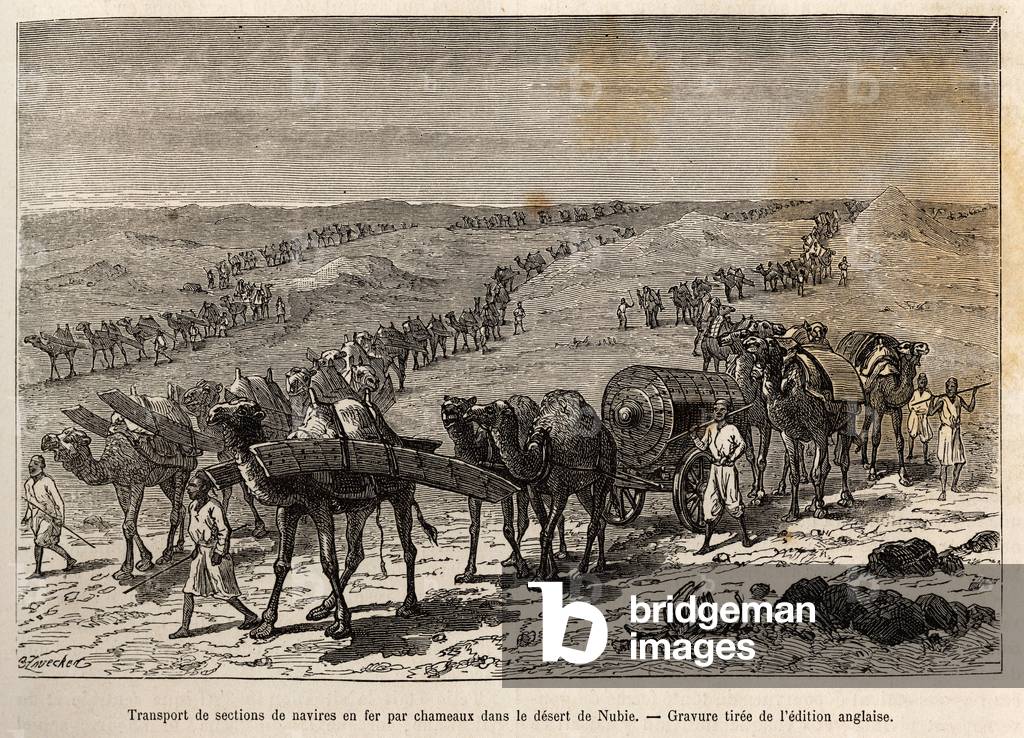
Transport of iron ship sections by camels, in the desert of Nubia (Sudan), engraving illustrating an armed expedition in Central Africa, for the suppression of the black trade, 1869 to 1873, by Sir Samuel White Baker, published in “” Le tour du monde””” 1875, edited by Edouard Charton, Hachette edition, Paris. Selva Collection.

LSE4329933: Transport of iron ship sections by camels, in the desert of Nubia (Sudan), engraving illustrating an armed expedition in Central Africa, for the suppression of the black trade, 1869 to 1873, by Sir Samuel White Baker, published in “” Le tour du monde””” 1875, edited by Edouard Charton, Hachette edition, Paris. Selva Collection., Unknown Artist, (19th century) / Bridgeman Images

Commissioner of Police during the Revolution (1789-1799). Eau forte en couleurs, pour illustration “” Histoire du corps des gardiens de la paix””” book published under the auspices of Louis Lepine (1846-1933) prefet de police de la Seine, by Alfred Rey (1864-?) and Louis Feron (1862-?) , edition Firmin Didot et Cie, 1896, Paris.

LSE4335371: Commissioner of Police during the Revolution (1789-1799). Eau forte en couleurs, pour illustration “” Histoire du corps des gardiens de la paix””” book published under the auspices of Louis Lepine (1846-1933) prefet de police de la Seine, by Alfred Rey (1864-?) and Louis Feron (1862-?) , edition Firmin Didot et Cie, 1896, Paris., Unknown Artist, (19th century) / Bridgeman Images

Prince James, Duke of York (1633-1701) playing palm game, he later returned as James II of England (James II Stuart) - in “” the sports and pastimes of the people of England”” by Joseph Strutt, ed 1801

LSE4401953: Prince James, Duke of York (1633-1701) playing palm game, he later returned as James II of England (James II Stuart) - in “” the sports and pastimes of the people of England”” by Joseph Strutt, ed 1801, Unknown Artist, (19th century) / Bridgeman Images

Découverte des Indes: voyage de Wallis dans le pacifique; Indiens discoverant un miroir - in “Les Voyageurs du 18th et 19th ecle”, by Jules Verne, ed. Hetzel et Cie, Paris.

LSE4402691: Découverte des Indes: voyage de Wallis dans le pacifique; Indiens discoverant un miroir - in “Les Voyageurs du 18th et 19th ecle”, by Jules Verne, ed. Hetzel et Cie, Paris., Unknown Artist, (19th century) / Bridgeman Images

Manufacture of mustard and canned food at Louit freres in bordeaux. Bottles and packaging room. Engraving from 1865.

XEE4404367: Manufacture of mustard and canned food at Louit freres in bordeaux. Bottles and packaging room. Engraving from 1865., Unknown Artist, (19th century) / Bridgeman Images

The Marquis de Carabas pretends to drown while the boot cat calls for help. Illustration of the tale “The cat botte” by Charles Perrault, 1697. In “” Tales from the home for the little ones””. Anonymous engraving of the 19th century.

XEE4404587: The Marquis de Carabas pretends to drown while the boot cat calls for help. Illustration of the tale “The cat botte” by Charles Perrault, 1697. In “” Tales from the home for the little ones””. Anonymous engraving of the 19th century., Unknown Artist, (19th century) / Bridgeman Images

The wolf sits on the chimney. Illustration of the tale “Compere le Loup, Maitre Renard, Comere la Chevre et ses petits biquets”” after a fable by Jean de la Fontaine. In “” Tales from the home for the little ones””. Anonymous engraving of the 19th century.

XEE4404665: The wolf sits on the chimney. Illustration of the tale “Compere le Loup, Maitre Renard, Comere la Chevre et ses petits biquets”” after a fable by Jean de la Fontaine. In “” Tales from the home for the little ones””. Anonymous engraving of the 19th century., Unknown Artist, (19th century) / Bridgeman Images

Portrait of John Law (1671 - 1729), Scottish Financial who caused bankruptcy in 1720 (Event of Quincampoix Street)

XEE4405116: Portrait of John Law (1671 - 1729), Scottish Financial who caused bankruptcy in 1720 (Event of Quincampoix Street), Unknown Artist, (19th century) / Bridgeman Images


Back to top