Assets (809329 in total)

Search options

Orientation
Colour

Display options

View

Print

To print search results, use print friendly version of this page.

Results

Greenwich Millenium Villages in London (England). Realisation 2002, architect Proctor Matthews. Photography 10/04/03.

TEC4649339: Greenwich Millenium Villages in London (England). Realisation 2002, architect Proctor Matthews. Photography 10/04/03. / Bridgeman Images

Tower Bridge to London (England). Construction 1894, architects John Wolfe Barry and Horace Jones. Photography 10/04/03.

TEC4649357: Tower Bridge to London (England). Construction 1894, architects John Wolfe Barry and Horace Jones. Photography 10/04/03. / Bridgeman Images

Tower Bridge in London (architects John Barry Wolfe and Horace Jones, 1864) in London (England). Photography 10/04/03.

TEC4649365: Tower Bridge in London (architects John Barry Wolfe and Horace Jones, 1864) in London (England). Photography 10/04/03. / Bridgeman Images

Thomas Pesquet in the International Space Station (ISS) - Thomas Pesquet in ISS: French astronaut Thomas Pesquet in the International Space Station (ISS). 4 December 2016.

PIX4641123: Thomas Pesquet in the International Space Station (ISS) - Thomas Pesquet in ISS: French astronaut Thomas Pesquet in the International Space Station (ISS). 4 December 2016. / Bridgeman Images

Decolving the shuttle Discovery 02/2011 - Launch of Shuttle Discovery STS - 133. 02/2011 - Decolving the shuttle Discovery (mission STS - 133) with a crew of six astronauts on board as well as Robonaut2. This mission is the 33rd and last mission of the Shuttle Discovery. 24/02/2011. Rising on twin columns of fire and creating rolling clouds of smoke and steam, space shuttle Discovery lifts off Launch Pad 39A at Nasa's Kennedy Space Center in Florida on a picturesque, warm, late February afternoon. Launch of the STS - 133 mission was at 4:53 p.m. EST on Feb. 24. Discovery and its six - member crew are on a mission to deliver the Permanent Multipurpose Module, packed with supplies and critical spare parts, as well as Robonaut 2, the dexterous humanoid astronaut helper, to the International Space Station. Discovery is making its 39th mission and is scheduled to be retired following STS-133. This is the 133rd Space Shuttle Program mission and the 35th shuttle voyage to the space station

PIX4649523: Decolving the shuttle Discovery 02/2011 - Launch of Shuttle Discovery STS - 133. 02/2011 - Decolving the shuttle Discovery (mission STS - 133) with a crew of six astronauts on board as well as Robonaut2. This mission is the 33rd and last mission of the Shuttle Discovery. 24/02/2011. Rising on twin columns of fire and creating rolling clouds of smoke and steam, space shuttle Discovery lifts off Launch Pad 39A at Nasa's Kennedy Space Center in Florida on a picturesque, warm, late February afternoon. Launch of the STS - 133 mission was at 4:53 p.m. EST on Feb. 24. Discovery and its six - member crew are on a mission to deliver the Permanent Multipurpose Module, packed with supplies and critical spare parts, as well as Robonaut 2, the dexterous humanoid astronaut helper, to the International Space Station. Discovery is making its 39th mission and is scheduled to be retired following STS-133. This is the 133rd Space Shuttle Program mission and the 35th shuttle voyage to the space station / Bridgeman Images

La Casa de Pilatos, Santa Cruz Quarter in Seville (Spain). Finish around 1540, this palace, propritete of the Duke of Medinaceli, combines in an astonishing way mudejar art, flamboyant Gothic and Renaissance art. According to popular belief, this palace is the reproduction of Pontius Pilate's palace in Jerusalem. Photography 10/03/97.

TEC4649649: La Casa de Pilatos, Santa Cruz Quarter in Seville (Spain). Finish around 1540, this palace, propritete of the Duke of Medinaceli, combines in an astonishing way mudejar art, flamboyant Gothic and Renaissance art. According to popular belief, this palace is the reproduction of Pontius Pilate's palace in Jerusalem. Photography 10/03/97. / Bridgeman Images

La Casa de Pilatos, Santa Cruz Quarter in Seville (Spain). Finish around 1540, this palace, propritete of the Duke of Medinaceli, combines in an astonishing way mudejar art, flamboyant Gothic and Renaissance art. According to popular belief, this palace is the reproduction of Pontius Pilate's palace in Jerusalem. Photography 10/03/97.

TEC4649690: La Casa de Pilatos, Santa Cruz Quarter in Seville (Spain). Finish around 1540, this palace, propritete of the Duke of Medinaceli, combines in an astonishing way mudejar art, flamboyant Gothic and Renaissance art. According to popular belief, this palace is the reproduction of Pontius Pilate's palace in Jerusalem. Photography 10/03/97. / Bridgeman Images

Atlantis seen from the Space Station 07/2011 - Atlantis seen from the International Space Station 07/2011 - Space Shuttle Atlantis returns to Earth from the International Space Station (ISS) on 21 July 2011. Mission STS-135, the last United States space shuttle mission. This unprecedented view of the space shuttle Atlantis, appearing like a bean sprout against clouds and city lights, on its way home, was photographed by the Expedition 28 crew of the International Space Station. Airglow over Earth can be seen in the background. July 21, 2011

PIX4649851: Atlantis seen from the Space Station 07/2011 - Atlantis seen from the International Space Station 07/2011 - Space Shuttle Atlantis returns to Earth from the International Space Station (ISS) on 21 July 2011. Mission STS-135, the last United States space shuttle mission. This unprecedented view of the space shuttle Atlantis, appearing like a bean sprout against clouds and city lights, on its way home, was photographed by the Expedition 28 crew of the International Space Station. Airglow over Earth can be seen in the background. July 21, 2011 / Bridgeman Images

Gare d'Austerlitz in Paris 75013. Architect Louis Renaud, 1865-1869.

TEC4641429: Gare d'Austerlitz in Paris 75013. Architect Louis Renaud, 1865-1869. / Bridgeman Images

Extra exit - vehicle B.McCandless STS - 41 - B - 02/1984 - Astronaut Bruce McCandless II space walk 02/1984 - Astronaut Bruce McCandless II uses the MMU (Manned Maneuvering Unit), a standalone space chair allowing him to move away from the Challenger space shuttle by several metres without being connected to it. 11 - 02 - 1984. Astronaut Bruce McCandless II, mission specialist, participates in a extravehicular activity (EVA), a few meters away from the cabin of the shuttle Challenger. He is using a nitrogen - propelled hand - controlled manned maneuvering unit. He is performing this EVA without being tethered to the shuttle. Below him can be seen a cloud view of the earth

PIX4649894: Extra exit - vehicle B.McCandless STS - 41 - B - 02/1984 - Astronaut Bruce McCandless II space walk 02/1984 - Astronaut Bruce McCandless II uses the MMU (Manned Maneuvering Unit), a standalone space chair allowing him to move away from the Challenger space shuttle by several metres without being connected to it. 11 - 02 - 1984. Astronaut Bruce McCandless II, mission specialist, participates in a extravehicular activity (EVA), a few meters away from the cabin of the shuttle Challenger. He is using a nitrogen - propelled hand - controlled manned maneuvering unit. He is performing this EVA without being tethered to the shuttle. Below him can be seen a cloud view of the earth / Bridgeman Images

Circumpolar - hemisphere sud - Southern Sky and Milky Way (Lake Titicaca, Bolivia) - Lake Titicaca - 30 minutes on film ISO 800 - 1997 The southern stars gracefully arc over a shore - side cabana at Lake Titicaca. The half hour time exposure demonstrates the rotation of Earth on its axis by revealing the apparent motions of the stars

PIX4581175: Circumpolar - hemisphere sud - Southern Sky and Milky Way (Lake Titicaca, Bolivia) - Lake Titicaca - 30 minutes on film ISO 800 - 1997 The southern stars gracefully arc over a shore - side cabana at Lake Titicaca. The half hour time exposure demonstrates the rotation of Earth on its axis by revealing the apparent motions of the stars / Bridgeman Images

Mauerstrasse, Berlin, Germany. Photograph 15/08/03.

TEC4581201: Mauerstrasse, Berlin, Germany. Photograph 15/08/03. / Bridgeman Images

Friedrichstrasse in Berlin (Germany).

TEC4581205: Friedrichstrasse in Berlin (Germany). / Bridgeman Images

Star Line - Moon, Planets and Orion - Star trails - Moon, Planets and Orion - Photographic pose of several hours on the constellation Orion. Visible also, the Moon, Venus, Mars and a shooting star

PIX4581250: Star Line - Moon, Planets and Orion - Star trails - Moon, Planets and Orion - Photographic pose of several hours on the constellation Orion. Visible also, the Moon, Venus, Mars and a shooting star / Bridgeman Images

Hotel Habana Libre, Vedado District in Havana (Cuba).

TEC4593068: Hotel Habana Libre, Vedado District in Havana (Cuba). / Bridgeman Images

The Pleiades cluster with zodiacal light - The Pleiades cluster with zodiacal light - The zodiacal light that extends here to the Pleiades comes from the reflection of the Sun's light on the countless interplanetary dust; it draws the plane of the Solar System. The faint cone of light extending from the horizon along the ecliptic is known as zodiacal light. It comes from the reflexion of the sun's light off tiny interplanetary dust particles in the plane of the solar system. One can see it here from the bottom right of the image to beyond the Pleiades cluster near the center of the image

PIX4581523: The Pleiades cluster with zodiacal light - The Pleiades cluster with zodiacal light - The zodiacal light that extends here to the Pleiades comes from the reflection of the Sun's light on the countless interplanetary dust; it draws the plane of the Solar System. The faint cone of light extending from the horizon along the ecliptic is known as zodiacal light. It comes from the reflexion of the sun's light off tiny interplanetary dust particles in the plane of the solar system. One can see it here from the bottom right of the image to beyond the Pleiades cluster near the center of the image / Bridgeman Images
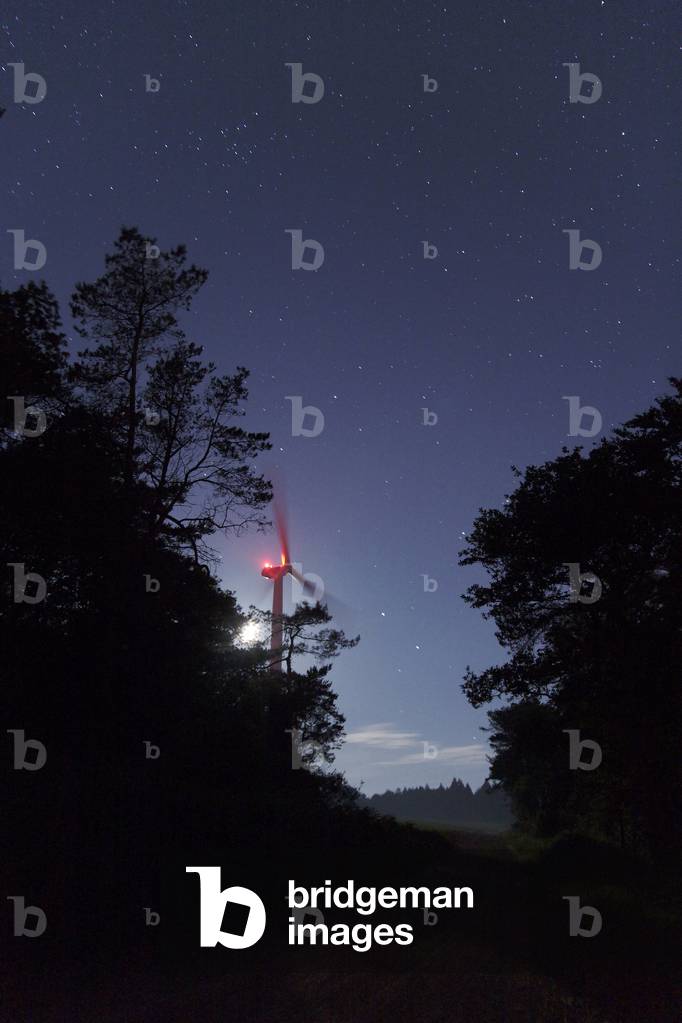
Star sky and wind turbine - Starry sky and wind turbine - A wind turbine is lit by a district of Moon. At the end of the way, the constellation of the Lion that heberge Saturn. June 10, 2008. A Quarter Moon is illuminating the hazy landscape. Brittany, France. June 10 2008

PIX4581736: Star sky and wind turbine - Starry sky and wind turbine - A wind turbine is lit by a district of Moon. At the end of the way, the constellation of the Lion that heberge Saturn. June 10, 2008. A Quarter Moon is illuminating the hazy landscape. Brittany, France. June 10 2008 / Bridgeman Images
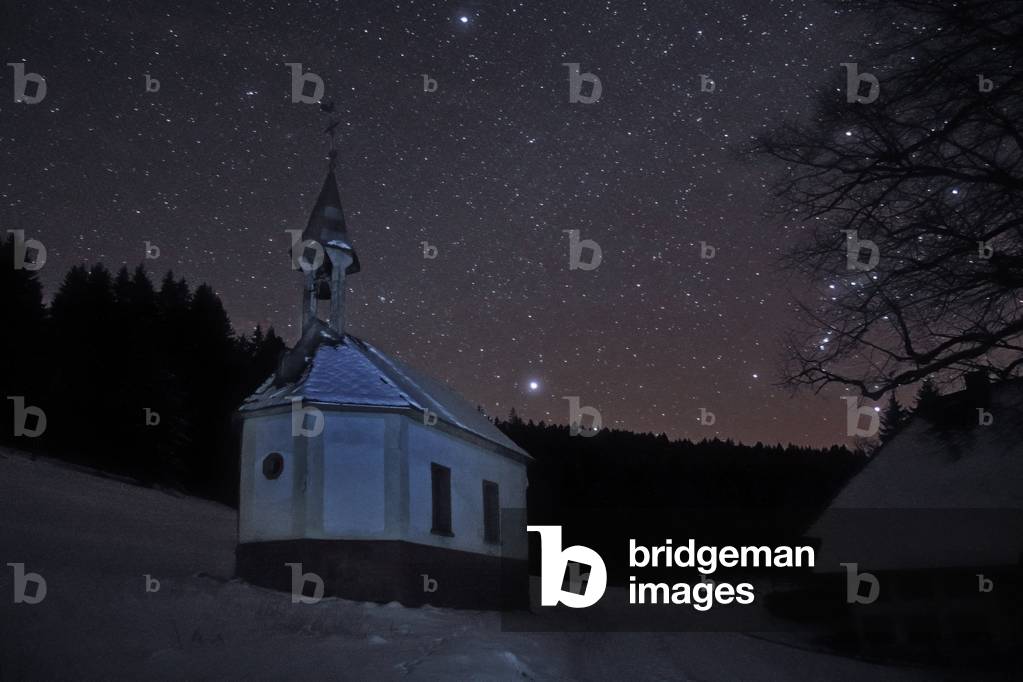
Winter Sky in Black Forest - Winter Sky in Black Forest - The star Sirius and the constellation Orion above a small chapel in Black Forest. The brightest star in the night sky, Sirius, is shining above a small chapel in Black Forest

PIX4581778: Winter Sky in Black Forest - Winter Sky in Black Forest - The star Sirius and the constellation Orion above a small chapel in Black Forest. The brightest star in the night sky, Sirius, is shining above a small chapel in Black Forest / Bridgeman Images

Grenoble (Isere, Rhone Alpes).

TEC4581785: Grenoble (Isere, Rhone Alpes). / Bridgeman Images

Grenoble (Isere, Rhone Alpes).

TEC4581796: Grenoble (Isere, Rhone Alpes). / Bridgeman Images

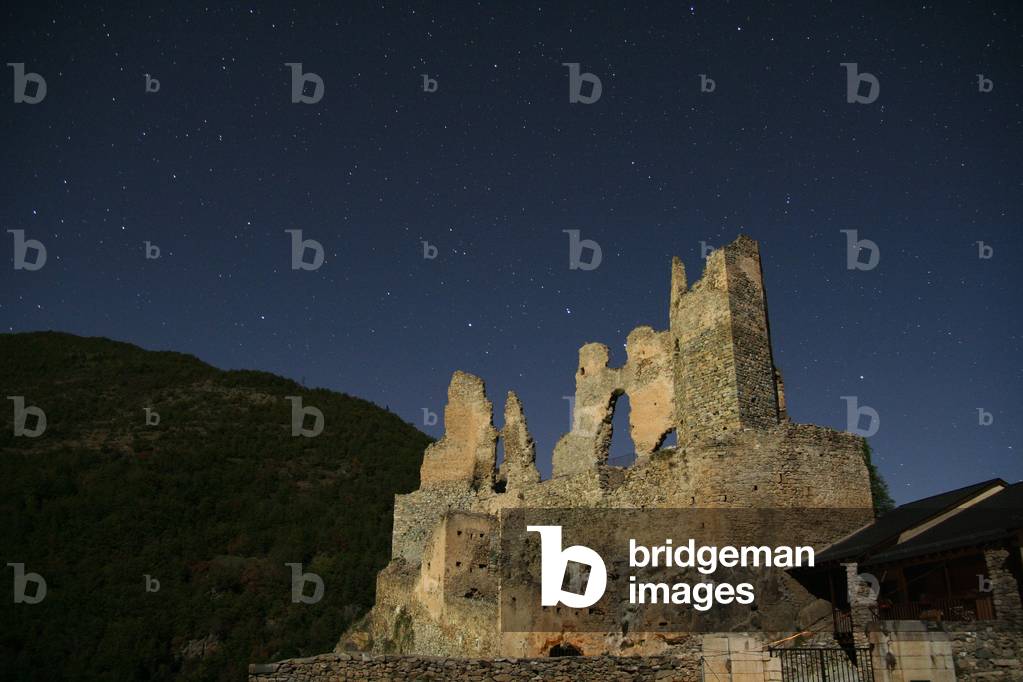
Star sky above the ruins of Usson Castle (09) - Starry sky above the castle of Usson - Star sky above the Cathar castle of Usson in Ariege. Starry sky above the Cathar castle of Uson

PIX4581912: Star sky above the ruins of Usson Castle (09) - Starry sky above the castle of Usson - Star sky above the Cathar castle of Usson in Ariege. Starry sky above the Cathar castle of Uson / Bridgeman Images

The ruins of the dungeon of the castle of Saint Barthelemy in Ariege - Starry sky above the castle of Saint - Barthelemy - Star sky above the ruins of the dungeon of the castle of Saint - Barthelemy in Ariege (Durban - sur - Arize). Starry sky above the castle of Saint - Barthelemy in Ariege (Durban - sur - Arize). 12th - 16th century

PIX4581959: The ruins of the dungeon of the castle of Saint Barthelemy in Ariege - Starry sky above the castle of Saint - Barthelemy - Star sky above the ruins of the dungeon of the castle of Saint - Barthelemy in Ariege (Durban - sur - Arize). Starry sky above the castle of Saint - Barthelemy in Ariege (Durban - sur - Arize). 12th - 16th century / Bridgeman Images

Pont des Arts, Paris 6th arrondissement. The Passerelle des Arts, the first iron bridge in Paris, had the mission of joining the Institut de France and the Louvre, which was then called the Palais des Arts. Reserved for pawns, it was built from 1801 to 1804. It initially consisted of nine arches. Following numerous river accidents, its reconstruction was decided in 1981 but two arches were removed to line them up on the Pont Neuf. Reconstruction in 1981 by Louis Arretche.

TEC4598089: Pont des Arts, Paris 6th arrondissement. The Passerelle des Arts, the first iron bridge in Paris, had the mission of joining the Institut de France and the Louvre, which was then called the Palais des Arts. Reserved for pawns, it was built from 1801 to 1804. It initially consisted of nine arches. Following numerous river accidents, its reconstruction was decided in 1981 but two arches were removed to line them up on the Pont Neuf. Reconstruction in 1981 by Louis Arretche. / Bridgeman Images

Hotel Lutetia in Paris. Architects Louis-Charles (Louis Charles) Boileau (1837-1914) and Henri Tauzin (?) , construction 1911.

TEC4598122: Hotel Lutetia in Paris. Architects Louis-Charles (Louis Charles) Boileau (1837-1914) and Henri Tauzin (?) , construction 1911. / Bridgeman Images

Apollo 17: orange soil on the Moon - Apollo 17: the orange soil - View of orange soil, rich in zinc, probably of volcanic origin. Station 4, near the Shorty Crater. 12/12/1972. A view of the area at Station 4 (Shorty Crater) showing the now highly - publicized orange soil which the Apollo 17 crew members found on the moon during the second Apollo 17 extravehicular activity (EVA) at the Taurus - Littrow landing site. The tripod - like object is the gnomon and photometric chart assembly which is used as a photographic reference to establish local vertical sun angle, scale and lunar color. The gnomon is one of the Apollo lunar geology hand tools. While astronauts Eugene A. Cernan, commander, and Harrison H. Schmitt, lunar module pilot, descended in the Lunar Module (LM) “” Challenger”” to explore the Taurus - Littrow region of the moon, astronaut Ronald E. Evans, command module pilot, remained with the Command and Service Modules (CSM) “” America”” in lunar orbit. Schmitt was the crew man who first spotted the orange soil. 12 Dec 1972

PIX4598153: Apollo 17: orange soil on the Moon - Apollo 17: the orange soil - View of orange soil, rich in zinc, probably of volcanic origin. Station 4, near the Shorty Crater. 12/12/1972. A view of the area at Station 4 (Shorty Crater) showing the now highly - publicized orange soil which the Apollo 17 crew members found on the moon during the second Apollo 17 extravehicular activity (EVA) at the Taurus - Littrow landing site. The tripod - like object is the gnomon and photometric chart assembly which is used as a photographic reference to establish local vertical sun angle, scale and lunar color. The gnomon is one of the Apollo lunar geology hand tools. While astronauts Eugene A. Cernan, commander, and Harrison H. Schmitt, lunar module pilot, descended in the Lunar Module (LM) “” Challenger”” to explore the Taurus - Littrow region of the moon, astronaut Ronald E. Evans, command module pilot, remained with the Command and Service Modules (CSM) “” America”” in lunar orbit. Schmitt was the crew man who first spotted the orange soil. 12 Dec 1972 / Bridgeman Images

Apollo 17: H.Schmitt on the Moon - Apollo 17: Harrison Schmitt and the US flag - Harrison Schmitt near the American flag. Land visible above the flag. 11/12/1972. The photo was taken at the Taurus - Littrow landing site. The highest part of the flag appears to point toward our planet earth in the distant background

PIX4598162: Apollo 17: H.Schmitt on the Moon - Apollo 17: Harrison Schmitt and the US flag - Harrison Schmitt near the American flag. Land visible above the flag. 11/12/1972. The photo was taken at the Taurus - Littrow landing site. The highest part of the flag appears to point toward our planet earth in the distant background / Bridgeman Images

Aerial view of Seven Mile Bridge in the Florida Keys (1988 - Photography)

LRI4598178: Aerial view of Seven Mile Bridge in the Florida Keys (1988 - Photography) / Bridgeman Images

Boat near the Pont des Arts, Paris 6th arrondissement. The Passerelle des Arts, the first iron bridge in Paris, had the mission of joining the Institut de France and the Louvre, which was then called the Palais des Arts. Reserved for pawns, it was built from 1801 to 1804. It initially consisted of nine arches. Following numerous river accidents, its reconstruction was decided in 1981 but two arches were removed to line them up on the Pont Neuf.

TEC4598187: Boat near the Pont des Arts, Paris 6th arrondissement. The Passerelle des Arts, the first iron bridge in Paris, had the mission of joining the Institut de France and the Louvre, which was then called the Palais des Arts. Reserved for pawns, it was built from 1801 to 1804. It initially consisted of nine arches. Following numerous river accidents, its reconstruction was decided in 1981 but two arches were removed to line them up on the Pont Neuf. / Bridgeman Images

Apollo 17: Control Module - Apollo 17: Command Module - The control module Apollo 17 photographs since the LEM. 14/12/1972. Close view of the Command Module from the Lunar Module at rendezvous. Dec 14 1972

PIX4598310: Apollo 17: Control Module - Apollo 17: Command Module - The control module Apollo 17 photographs since the LEM. 14/12/1972. Close view of the Command Module from the Lunar Module at rendezvous. Dec 14 1972 / Bridgeman Images

Mission Andromede - Claudie Haignere - Andromede mission - Claudie Haignere prior to launch - view of the dressing, in view of the launch of the Franco-Russian Andromede mission, this Sunday, October 21 at 14:59 (local time). The Andromede mission took place from 21 to 31 October 2001 on board the ISS (the International Space Station). Claudie Haignere was the first European woman to work aboard the ISS. Date of this shot: Sunday, October 21, 2001 at 10:00 am local time. ESA astronaut Claudie Haignere, from France, and Soyuz TM - 33 mission commander Viktor Afanassiev are donning their Sokol pressure suits prior to transfer to the launch pad for launch of the “Andromede” mission to the International Space Station on October 21, 2001.Claudie Haignere participated as first female European astronaut in a 'taxi light' to the International Space Station as Soyuz Flight Engineer. The “” Andromede”” Mission occured from 21 to 31 October 2001, onboard the International Space Station. Image taken on October 21 2001

PIX4598462: Mission Andromede - Claudie Haignere - Andromede mission - Claudie Haignere prior to launch - view of the dressing, in view of the launch of the Franco-Russian Andromede mission, this Sunday, October 21 at 14:59 (local time). The Andromede mission took place from 21 to 31 October 2001 on board the ISS (the International Space Station). Claudie Haignere was the first European woman to work aboard the ISS. Date of this shot: Sunday, October 21, 2001 at 10:00 am local time. ESA astronaut Claudie Haignere, from France, and Soyuz TM - 33 mission commander Viktor Afanassiev are donning their Sokol pressure suits prior to transfer to the launch pad for launch of the “Andromede” mission to the International Space Station on October 21, 2001.Claudie Haignere participated as first female European astronaut in a 'taxi light' to the International Space Station as Soyuz Flight Engineer. The “” Andromede”” Mission occured from 21 to 31 October 2001, onboard the International Space Station. Image taken on October 21 2001 / Bridgeman Images

Mission Andromede - C. Haignere and V. Afanassiev - Andromede mission - C. Haignere and V. Afanassiev prior to launch - view of the dressing, with a view to launching the Franco-Russian Andromede mission, this Sunday, October 21 at 14:59 (local time). The Andromede mission took place from 21 to 31 October 2001 on board the ISS (the International Space Station). Claudie Haignere was the first European woman to work aboard the ISS. Date of this shot: Sunday, October 21, 2001 at 10:00 am local time. Claudie Haignere participated as first female European astronaut in a taxi flight to the International Space Station as Soyuz Flight Engineer. The “” Andromede”” Mission occured from 21 to 31 October 2001, onboard the International Space Station. Image taken on October 21 2001

PIX4598467: Mission Andromede - C. Haignere and V. Afanassiev - Andromede mission - C. Haignere and V. Afanassiev prior to launch - view of the dressing, with a view to launching the Franco-Russian Andromede mission, this Sunday, October 21 at 14:59 (local time). The Andromede mission took place from 21 to 31 October 2001 on board the ISS (the International Space Station). Claudie Haignere was the first European woman to work aboard the ISS. Date of this shot: Sunday, October 21, 2001 at 10:00 am local time. Claudie Haignere participated as first female European astronaut in a taxi flight to the International Space Station as Soyuz Flight Engineer. The “” Andromede”” Mission occured from 21 to 31 October 2001, onboard the International Space Station. Image taken on October 21 2001 / Bridgeman Images

Mission Andromede - Claudie Haignere - Andromede mission - Claudie Haignere prior to launch - view of the dressing, in view of the launch of the Franco-Russian Andromede mission, this Sunday, October 21 at 14:59 (local time). The Andromede mission took place from 21 to 31 October 2001 on board the ISS (the International Space Station). Claudie Haignere was the first European woman to work aboard the ISS. Date of this shot: Sunday, October 21, 2001 at 10:00 am local time. ESA astronaut Claudie Haignere, from France, is strapped into a launch seat and undergoes a final pressure test of her Sokol pressure suit prior to being transferred to the launch pad and board the Soyuz TM - 33 for launch of the “Andromede” mission to the International Space Station on October 21, 2001. Claudie Haignere participated as first female European astronaut in a taxi flight to the International Space Station as Soyuz Flight Engineer. The “” Andromede”” Mission occured from 21 to 31 October 2001, onboard the International Space Station

PIX4598486: Mission Andromede - Claudie Haignere - Andromede mission - Claudie Haignere prior to launch - view of the dressing, in view of the launch of the Franco-Russian Andromede mission, this Sunday, October 21 at 14:59 (local time). The Andromede mission took place from 21 to 31 October 2001 on board the ISS (the International Space Station). Claudie Haignere was the first European woman to work aboard the ISS. Date of this shot: Sunday, October 21, 2001 at 10:00 am local time. ESA astronaut Claudie Haignere, from France, is strapped into a launch seat and undergoes a final pressure test of her Sokol pressure suit prior to being transferred to the launch pad and board the Soyuz TM - 33 for launch of the “Andromede” mission to the International Space Station on October 21, 2001. Claudie Haignere participated as first female European astronaut in a taxi flight to the International Space Station as Soyuz Flight Engineer. The “” Andromede”” Mission occured from 21 to 31 October 2001, onboard the International Space Station / Bridgeman Images

Constellation of Scorpio - Constellation of Scorpius - Scorpius is one of the constellations of the zodiac. It lies between Libra to the west and Sagittarius to the east

PIX4593697: Constellation of Scorpio - Constellation of Scorpius - Scorpius is one of the constellations of the zodiac. It lies between Libra to the west and Sagittarius to the east / Bridgeman Images

Constellation Scorpio - Constellation of Scorpiu

PIX4593742: Constellation Scorpio - Constellation of Scorpiu / Bridgeman Images

Constellation of Taurus - Constellation of Taurus - Taurus, (the Bull) is one of the most ancient constellations, and appears in artefacts as old as western civilisation itself. The bull is still a figure of strength and fertility in cultures around the world. In the sky the distinctive 'V' shape of his head and long horns tipped by beta (ss) and zeta Tau is easily recognised. If the purpose of the horns was in doubt, the English name for ss Tau is Alnath, meaning 'the butting one'. The bull's glowing red eye of Aldebaran completes the picture, and its location between the delicate Pleiades and the aggressive stance of Orion makes Taurus hard to overlook. Despite its masculine connotations, the constellation is rich in female icons; both the Hyades and Pleiades star clusters are daughters of Atlas and both are important astronomically. The Pleiades (or the Seven Sisters) are a group of young stars at a distance of about 440 light years and on long exposure photographs are seen to be embedded in dust which reflects their light as a blue haze. The Hyades is much closer, and at 150 light years distant is the nearest open cluster to the Sun. However the bright star Aldebaran is much closer (65 ly) and is a chance alignment. Without it there would be no bull in Taurus. Probably the most interesting object in Taurus is M1, the Crab nebula, the remains of a star that exploded in the year 1054BCE

PIX4594065: Constellation of Taurus - Constellation of Taurus - Taurus, (the Bull) is one of the most ancient constellations, and appears in artefacts as old as western civilisation itself. The bull is still a figure of strength and fertility in cultures around the world. In the sky the distinctive 'V' shape of his head and long horns tipped by beta (ss) and zeta Tau is easily recognised. If the purpose of the horns was in doubt, the English name for ss Tau is Alnath, meaning 'the butting one'. The bull's glowing red eye of Aldebaran completes the picture, and its location between the delicate Pleiades and the aggressive stance of Orion makes Taurus hard to overlook. Despite its masculine connotations, the constellation is rich in female icons; both the Hyades and Pleiades star clusters are daughters of Atlas and both are important astronomically. The Pleiades (or the Seven Sisters) are a group of young stars at a distance of about 440 light years and on long exposure photographs are seen to be embedded in dust which reflects their light as a blue haze. The Hyades is much closer, and at 150 light years distant is the nearest open cluster to the Sun. However the bright star Aldebaran is much closer (65 ly) and is a chance alignment. Without it there would be no bull in Taurus. Probably the most interesting object in Taurus is M1, the Crab nebula, the remains of a star that exploded in the year 1054BCE / Bridgeman Images

La Chapelle des Arts et Metiers, 60 rue de Reaumur, Paris 3rd arrondissement. Construction 12th century.

TEC4594121: La Chapelle des Arts et Metiers, 60 rue de Reaumur, Paris 3rd arrondissement. Construction 12th century. / Bridgeman Images


Back to top