Egyptian 18th Dynasty (c.1567-1320 BC) Assets (907 in total)

Search options

Orientation
Colour

Display options

View

Print

To print search results, use print friendly version of this page.

Results

Egyptian antiquite: representation of Roy and his wife Nebtawy facing a high priest. Painting of the Tomb of Roy (TT255). 18th dynasty. From the West Bank of Luxor, Egypt

LRI4681505: Egyptian antiquite: representation of Roy and his wife Nebtawy facing a high priest. Painting of the Tomb of Roy (TT255). 18th dynasty. From the West Bank of Luxor, Egypt, Egyptian 18th Dynasty (c.1567-1320 BC) / Bridgeman Images

Egyptian antiquite: cup of the Immortalite of the benefactors of Thebes. Lotus shaped albaster chalice. From the treasor of Tutankhamun (all-Ankh-amun or Tutankhamun) (1345-1327 BC) 18th dynasty. found in the Valley of kings, Thebes. 1342 BC. Cairo, Egyptian Museum - Egyptian Antiquities: cup of Immortality of the benefactors of Thebes. Alabaster chalice in the shape of a lotus flower. From the treasure of Tutankhamun (All-Ankh-amun or Tutankhamun) (1345-1327 BC), 18th Dynasty. Found in the Valley of the Kings, Thebes. 1342 BC. Egyptian Museum, Cairo, Egypt

LRI4639806: Egyptian antiquite: cup of the Immortalite of the benefactors of Thebes. Lotus shaped albaster chalice. From the treasor of Tutankhamun (all-Ankh-amun or Tutankhamun) (1345-1327 BC) 18th dynasty. found in the Valley of kings, Thebes. 1342 BC. Cairo, Egyptian Museum - Egyptian Antiquities: cup of Immortality of the benefactors of Thebes. Alabaster chalice in the shape of a lotus flower. From the treasure of Tutankhamun (All-Ankh-amun or Tutankhamun) (1345-1327 BC), 18th Dynasty. Found in the Valley of the Kings, Thebes. 1342 BC. Egyptian Museum, Cairo, Egypt, Egyptian 18th Dynasty (c.1567-1320 BC) / Bridgeman Images

View of the Tomb Chapel of Meryre, New Kingdom (photo)

XIR226162: View of the Tomb Chapel of Meryre, New Kingdom (photo), Egyptian 18th Dynasty (c.1567-1320 BC) / Bridgeman Images

Objects removed from the tomb of an Egyptian lady, from tomb group 1723, from Sidmant el-Gebel, New Kingdom, 1479-25 BC (wood, stone and bronze)

FIT76536: Objects removed from the tomb of an Egyptian lady, from tomb group 1723, from Sidmant el-Gebel, New Kingdom, 1479-25 BC (wood, stone and bronze), Egyptian 18th Dynasty (c.1567-1320 BC) / Bridgeman Images

Drinking cup in the form of a half-opened lotus flower, found at the entrance to the tomb of Tutankhamun (c.1370-52 BC) New Kingdom (alabaster) (see also 149480 & 228555)

XIR162302: Drinking cup in the form of a half-opened lotus flower, found at the entrance to the tomb of Tutankhamun (c.1370-52 BC) New Kingdom (alabaster) (see also 149480 & 228555), Egyptian 18th Dynasty (c.1567-1320 BC) / Bridgeman Images

Coffer from the treasury of the tomb of Tutankhamun (c.1370-52 BC) New Kingdom (wood & ivory with applied gold & silver)

XZL149423: Coffer from the treasury of the tomb of Tutankhamun (c.1370-52 BC) New Kingdom (wood & ivory with applied gold & silver), Egyptian 18th Dynasty (c.1567-1320 BC) / Bridgeman Images

Footstool used by the child-king at the beginning of his reign, from the tomb of Tutankhamun (c.1370-52 BC) New Kingdom (painted and gilded wood) (see also 391015)

XZL149411: Footstool used by the child-king at the beginning of his reign, from the tomb of Tutankhamun (c.1370-52 BC) New Kingdom (painted and gilded wood) (see also 391015), Egyptian 18th Dynasty (c.1567-1320 BC) / Bridgeman Images

Egyptian antiquitis: earring with the effigy of Tutankhamun being part of the Tresor of the Pharaoh. Around 1340 BC. From the tomb of All-Ankh-Amon (Tutankhamun or Tutankhamun), Valley of the Kings, Deir el Bahari (Dayr al-Bahri). 18th dynasty. Cairo. Egyptian Museum

LRI4639745: Egyptian antiquitis: earring with the effigy of Tutankhamun being part of the Tresor of the Pharaoh. Around 1340 BC. From the tomb of All-Ankh-Amon (Tutankhamun or Tutankhamun), Valley of the Kings, Deir el Bahari (Dayr al-Bahri). 18th dynasty. Cairo. Egyptian Museum, Egyptian 18th Dynasty (c.1567-1320 BC) / Bridgeman Images

Painting decorating the tomb of Rekhmire, represented surrounded by his servants (fresco)

LRI4682720: Painting decorating the tomb of Rekhmire, represented surrounded by his servants (fresco), Egyptian 18th Dynasty (c.1567-1320 BC) / Bridgeman Images

Egyptian antiquite: representation of Nebtawy (Nebtaoui), wife of the scribe Roy and his sister. Painting of the Tomb of Roy (TT255). 18th dynasty. From the West Bank of Luxor, Egypt

LRI4681506: Egyptian antiquite: representation of Nebtawy (Nebtaoui), wife of the scribe Roy and his sister. Painting of the Tomb of Roy (TT255). 18th dynasty. From the West Bank of Luxor, Egypt, Egyptian 18th Dynasty (c.1567-1320 BC) / Bridgeman Images

Ostrich-feather fan, from the Tomb of Tutankhamun (c.1370-1352 BC) New Kingdom (wood covered with sheet gold) (see also 3975)

XBP324497: Ostrich-feather fan, from the Tomb of Tutankhamun (c.1370-1352 BC) New Kingdom (wood covered with sheet gold) (see also 3975), Egyptian 18th Dynasty (c.1567-1320 BC) / Bridgeman Images

Head of Hatshepsut (c.1473-c.1458 BC) or Tuthmosis II (c.1491-c.1479) New Kingdom, c.1479-1425 BC (granite)

XIR219690: Head of Hatshepsut (c.1473-c.1458 BC) or Tuthmosis II (c.1491-c.1479) New Kingdom, c.1479-1425 BC (granite), Egyptian 18th Dynasty (c.1567-1320 BC) / Bridgeman Images

Flexible bead bracelet, from the Tomb of Tutankhamun, New Kingdom (gold and carnelian with gold, faience & glass beads) (see also 391011 & 391013)

XBP391012: Flexible bead bracelet, from the Tomb of Tutankhamun, New Kingdom (gold and carnelian with gold, faience & glass beads) (see also 391011 & 391013), Egyptian 18th Dynasty (c.1567-1320 BC) / Bridgeman Images

The golden mask of Tutankhamun. Around 1340 BC From the tomb of All-Ankh-Amon (Tutankhamun or Tutankhamun), Valley of Kings, Deir el Bahari (Dayr al-Bahri). Cairo. Egyptian museum.

IBE5357465: The golden mask of Tutankhamun. Around 1340 BC From the tomb of All-Ankh-Amon (Tutankhamun or Tutankhamun), Valley of Kings, Deir el Bahari (Dayr al-Bahri). Cairo. Egyptian museum., Egyptian 18th Dynasty (c.1567-1320 BC) / Bridgeman Images

Relief depicing a princess eating a roasted duck, from the North Palace at Tell El-Amarna, New Kingdom, c.1353-1337 BC (limestone)

XIR230169: Relief depicing a princess eating a roasted duck, from the North Palace at Tell El-Amarna, New Kingdom, c.1353-1337 BC (limestone), Egyptian 18th Dynasty (c.1567-1320 BC) / Bridgeman Images

Queen Hatshepsut (c.1503-1482 BC) drinking from the udder of Hathor, relief from the Chapel of Hathor in the Mortuary Temple of Hatshepsut, New Kingdom (photo)

ANC146330: Queen Hatshepsut (c.1503-1482 BC) drinking from the udder of Hathor, relief from the Chapel of Hathor in the Mortuary Temple of Hatshepsut, New Kingdom (photo), Egyptian 18th Dynasty (c.1567-1320 BC) / Bridgeman Images

Funerary bedhead in the form of the goddess Tueris, from the tomb of Tutankhamun (c.1370-52 BC) New Kingdom (gilded wood)

XZL149484: Funerary bedhead in the form of the goddess Tueris, from the tomb of Tutankhamun (c.1370-52 BC) New Kingdom (gilded wood), Egyptian 18th Dynasty (c.1567-1320 BC) / Bridgeman Images

Pair of Sandals, c.1390-52 (Grass, reed, papyrus)

XOS3472283: Pair of Sandals, c.1390-52 (Grass, reed, papyrus), Egyptian 18th Dynasty (c.1567-1320 BC) / Bridgeman Images

Head of a Princess from the family of Akhenaten, New Kingdom (painted limestone)

XIR370211: Head of a Princess from the family of Akhenaten, New Kingdom (painted limestone), Egyptian 18th Dynasty (c.1567-1320 BC) / Bridgeman Images

Wild Bull Hunt Scarab of Amenhotep III, c.1391-1353 BC (steatite)

XCL500020: Wild Bull Hunt Scarab of Amenhotep III, c.1391-1353 BC (steatite) , Egyptian 18th Dynasty (c.1567-1320 BC) / Bridgeman Images

Pectoral with a bird-scarab, from the tomb of Tutankhamun, New Kingdom (gold cloisonne decorated with semi-precious stones & glass paste)

XBP391035: Pectoral with a bird-scarab, from the tomb of Tutankhamun, New Kingdom (gold cloisonne decorated with semi-precious stones & glass paste), Egyptian 18th Dynasty (c.1567-1320 BC) / Bridgeman Images

Cosmetic vessel in the form of a fish, from Tell el-Amarna, New Kingdom, c.1390-1336 BC (polychrome glass) (see also 348552)

BAL85713: Cosmetic vessel in the form of a fish, from Tell el-Amarna, New Kingdom, c.1390-1336 BC (polychrome glass) (see also 348552), Egyptian 18th Dynasty (c.1567-1320 BC) / Bridgeman Images

Statuette of a sphinx of King Tuthmosis III, New Kingdom, c.1490-1439 BC (bronze inlaid with gold)

PWI107956: Statuette of a sphinx of King Tuthmosis III, New Kingdom, c.1490-1439 BC (bronze inlaid with gold), Egyptian 18th Dynasty (c.1567-1320 BC) / Bridgeman Images

Painted chest with a banquet scene from the tomb of Kha (d.c.1390-52 BC) found at Deir el-Medina, New Kingdom (wood)

XZL148112: Painted chest with a banquet scene from the tomb of Kha (d.c.1390-52 BC) found at Deir el-Medina, New Kingdom (wood), Egyptian 18th Dynasty (c.1567-1320 BC) / Bridgeman Images

Lid of an unguent jar in the form of an ibex, from the tomb of Tutankhamun (c.1370-52 BC) New Kingdom (painted alabaster)

XZL148195: Lid of an unguent jar in the form of an ibex, from the tomb of Tutankhamun (c.1370-52 BC) New Kingdom (painted alabaster), Egyptian 18th Dynasty (c.1567-1320 BC) / Bridgeman Images

Seated statue of the god Amon protecting Tutankhamun, New Kingdom, c.1336-1327 BC (granite)

XIR113553: Seated statue of the god Amon protecting Tutankhamun, New Kingdom, c.1336-1327 BC (granite), Egyptian 18th Dynasty (c.1567-1320 BC) / Bridgeman Images

Egyptian antiquitis: golden wooden statue of the Ka of Tutankhamun which is part of the Tresor of the Pharaoh. It was placed at the entrance of the sarcophagus room to protect the deceased. Around 1340 BC. From the tomb of All-Ankh-Amon (Tutankhamun or Tutankhamun), Valley of the Kings, Deir el Bahari (Dayr al-Bahri). 18th dynasty. Sun. 54 cm Cairo. Egyptian Museum

LRI4639712: Egyptian antiquitis: golden wooden statue of the Ka of Tutankhamun which is part of the Tresor of the Pharaoh. It was placed at the entrance of the sarcophagus room to protect the deceased. Around 1340 BC. From the tomb of All-Ankh-Amon (Tutankhamun or Tutankhamun), Valley of the Kings, Deir el Bahari (Dayr al-Bahri). 18th dynasty. Sun. 54 cm Cairo. Egyptian Museum, Egyptian 18th Dynasty (c.1567-1320 BC) / Bridgeman Images

Shabti figure of the king from the Tomb of Tutankhamun (c.1370-1352 BC) New Kingdom (painted wood)

XIR197874: Shabti figure of the king from the Tomb of Tutankhamun (c.1370-1352 BC) New Kingdom (painted wood), Egyptian 18th Dynasty (c.1567-1320 BC) / Bridgeman Images

Base of a marriage scarab of Amenhotep III (c.1417-1379 BC) and Queen Tiye, New Kingdom, c.1391-1353 BC (stone)

XIR209576: Base of a marriage scarab of Amenhotep III (c.1417-1379 BC) and Queen Tiye, New Kingdom, c.1391-1353 BC (stone), Egyptian 18th Dynasty (c.1567-1320 BC) / Bridgeman Images

Leopard's head, from the Tomb of Tutankhamun, New Kingdom (wood covered with gesso overlaid with gold)

XBP391007: Leopard's head, from the Tomb of Tutankhamun, New Kingdom (wood covered with gesso overlaid with gold), Egyptian 18th Dynasty (c.1567-1320 BC) / Bridgeman Images

Falcon pectoral, from the Tomb of Tutankhamun, New Kingdom (gold inlaid with lapis lazuli, turquoise, carnelian & glass)

XBP391010: Falcon pectoral, from the Tomb of Tutankhamun, New Kingdom (gold inlaid with lapis lazuli, turquoise, carnelian & glass), Egyptian 18th Dynasty (c.1567-1320 BC) / Bridgeman Images
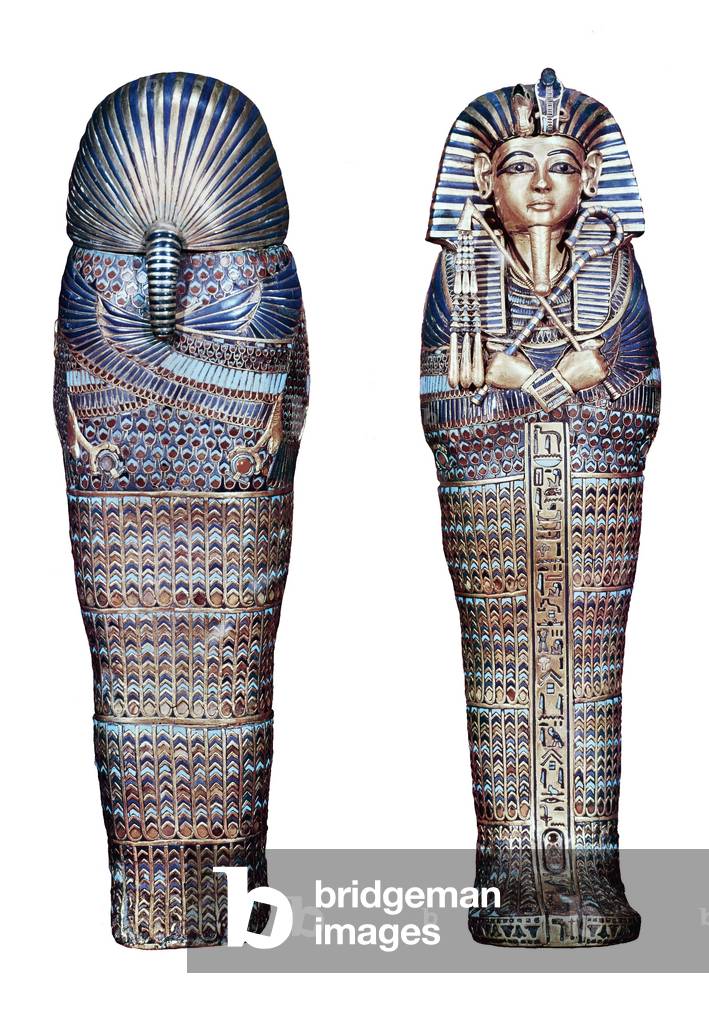
Front and rear view of one of the canopic coffins, from the Tomb of Tutankhamun (c.1370-1352 BC) New Kingdom (beaten gold inlaid with coloured glass & cornelian)

IBE290179: Front and rear view of one of the canopic coffins, from the Tomb of Tutankhamun (c.1370-1352 BC) New Kingdom (beaten gold inlaid with coloured glass & cornelian), Egyptian 18th Dynasty (c.1567-1320 BC) / Bridgeman Images

Detail of a Tutankhamun Chest, New Kingdom, c.1340 BC (painted wood)

XBP483278: Detail of a Tutankhamun Chest, New Kingdom, c.1340 BC (painted wood), Egyptian 18th Dynasty (c.1567-1320 BC) / Bridgeman Images

Statue of Thutmosis III, Pharaoh, 1490-1439 BC (stone)

JLJ4679221: Statue of Thutmosis III, Pharaoh, 1490-1439 BC (stone), Egyptian 18th Dynasty (c.1567-1320 BC) / Bridgeman Images

Five rings, from the Tomb of Tutankhamun, New Kingdom (gold)

XBP391014: Five rings, from the Tomb of Tutankhamun, New Kingdom (gold), Egyptian 18th Dynasty (c.1567-1320 BC) / Bridgeman Images

Egyptian servant girl, carrying an unguent jar, New Kingdom (boxwood, ivory and gold) (for front view see 63075)

ORM65426: Egyptian servant girl, carrying an unguent jar, New Kingdom (boxwood, ivory and gold) (for front view see 63075), Egyptian 18th Dynasty (c.1567-1320 BC) / Bridgeman Images


Back to top