Egyptian 18th Dynasty (c.1567-1320 BC) Assets (907 in total)

Search options

Orientation
Colour

Display options

View

Print

To print search results, use print friendly version of this page.

Results

Amenhotep II (c.1427-1392 BC) with an ankh being raised to his lips, from the sarcophagus chamber of his tomb, New Kingdom (painted limestone)

XIR226539: Amenhotep II (c.1427-1392 BC) with an ankh being raised to his lips, from the sarcophagus chamber of his tomb, New Kingdom (painted limestone), Egyptian 18th Dynasty (c.1567-1320 BC) / Bridgeman Images

The Harpooner, from the Tomb of Tutankhamun (c.1370-1352 BC) New Kingdom (bronze & gilded wood)

BAL3977: The Harpooner, from the Tomb of Tutankhamun (c.1370-1352 BC) New Kingdom (bronze & gilded wood), Egyptian 18th Dynasty (c.1567-1320 BC) / Bridgeman Images

Loading grain, from the Tomb of Unsou, East Thebes, New Kingdom (wall painting)

XIR50798: Loading grain, from the Tomb of Unsou, East Thebes, New Kingdom (wall painting), Egyptian 18th Dynasty (c.1567-1320 BC) / Bridgeman Images

Detail of the goddess Selket from the canopic shrine, from the Tomb of Tutankhamun, New Kingdom (gilded wood)

XBP391042: Detail of the goddess Selket from the canopic shrine, from the Tomb of Tutankhamun, New Kingdom (gilded wood), Egyptian 18th Dynasty (c.1567-1320 BC) / Bridgeman Images

Preparation of two mummies for the purification ceremony, from the tomb of Merymaat, New Kingdom (wall painting)

XIR311559: Preparation of two mummies for the purification ceremony, from the tomb of Merymaat, New Kingdom (wall painting), Egyptian 18th Dynasty (c.1567-1320 BC) / Bridgeman Images

The two mystical eyes, from the Tomb of Tuthmosis III (c.1504-1450 BC) New Kingdom (mural)

XIR155567: The two mystical eyes, from the Tomb of Tuthmosis III (c.1504-1450 BC) New Kingdom (mural), Egyptian 18th Dynasty (c.1567-1320 BC) / Bridgeman Images

Chair, from the Tomb of Tutankhamun (c.1370-1352 BC) depicting the spirit of 'millions of years', New Kingdom (cedarwood) (see also 148192)

XBP227983: Chair, from the Tomb of Tutankhamun (c.1370-1352 BC) depicting the spirit of 'millions of years', New Kingdom (cedarwood) (see also 148192), Egyptian 18th Dynasty (c.1567-1320 BC) / Bridgeman Images

The pharaoh's ecclesiastical throne, from the tomb of Tutankhamun (c.1370-52 BC) New Kingdom (inlaid wood) (see also 59232)

XZL149419: The pharaoh's ecclesiastical throne, from the tomb of Tutankhamun (c.1370-52 BC) New Kingdom (inlaid wood) (see also 59232), Egyptian 18th Dynasty (c.1567-1320 BC) / Bridgeman Images

Tutankhamun (C.1370-1352 BC) the Harpooner, from the Tomb of Tutankhamun, New Kingdom (gilded wood) (see also 3977 & 120779)

XBP341820: Tutankhamun (C.1370-1352 BC) the Harpooner, from the Tomb of Tutankhamun, New Kingdom (gilded wood) (see also 3977 & 120779), Egyptian 18th Dynasty (c.1567-1320 BC) / Bridgeman Images

Head of a woman, believed to be Princess Kiya, New Kingdom (alabaster)

XBP341822: Head of a woman, believed to be Princess Kiya, New Kingdom (alabaster), Egyptian 18th Dynasty (c.1567-1320 BC) / Bridgeman Images

Drinking cup in the form of a half-opened lotus flower, found at the entrance to the tomb of Tutankhamun (c.1370-1352 BC) New Kingdom (alabaster) (see also 162302 & 149480)

XBP341819: Drinking cup in the form of a half-opened lotus flower, found at the entrance to the tomb of Tutankhamun (c.1370-1352 BC) New Kingdom (alabaster) (see also 162302 & 149480), Egyptian 18th Dynasty (c.1567-1320 BC) / Bridgeman Images

Interior of the tomb of Tuthmosis III (c.1490-39 BC) New Kingdom (photo)

XIR153790: Interior of the tomb of Tuthmosis III (c.1490-39 BC) New Kingdom (photo), Egyptian 18th Dynasty (c.1567-1320 BC) / Bridgeman Images

Bust of the Royal Scribe, Meniou, New Kingdom, c.1391-53 BC (limestone)

XIR153793: Bust of the Royal Scribe, Meniou, New Kingdom, c.1391-53 BC (limestone), Egyptian 18th Dynasty (c.1567-1320 BC) / Bridgeman Images

Descent of the sarcophagus into the tomb, from the Tomb of Tuthmosis III (c.1504-1450 BC) New Kingdom (wall painting)

XIR187071: Descent of the sarcophagus into the tomb, from the Tomb of Tuthmosis III (c.1504-1450 BC) New Kingdom (wall painting), Egyptian 18th Dynasty (c.1567-1320 BC) / Bridgeman Images

Detail from the Golden Shrine of Tutankhamun (c.1370-52 BC) depicting the Queen anointing him with scented unguent, New Kingdom (wood overlaid with gesso covered with sheet gold) (detail of 148191)

XZL328362: Detail from the Golden Shrine of Tutankhamun (c.1370-52 BC) depicting the Queen anointing him with scented unguent, New Kingdom (wood overlaid with gesso covered with sheet gold) (detail of 148191), Egyptian 18th Dynasty (c.1567-1320 BC) / Bridgeman Images

Unguent jar with a figure of a the king as a lion, from the tomb of Tutankhamun (c.1370-52 BC) New Kingdom (painted alabaster) (see also 391016)

XZL148194: Unguent jar with a figure of a the king as a lion, from the tomb of Tutankhamun (c.1370-52 BC) New Kingdom (painted alabaster) (see also 391016), Egyptian 18th Dynasty (c.1567-1320 BC) / Bridgeman Images

Bust of King Amenophis IV (Akhenaten) from Tell el-Amarna, New Kingdom, c.1353-1337 BC (limestone)

XIR107947: Bust of King Amenophis IV (Akhenaten) from Tell el-Amarna, New Kingdom, c.1353-1337 BC (limestone), Egyptian 18th Dynasty (c.1567-1320 BC) / Bridgeman Images

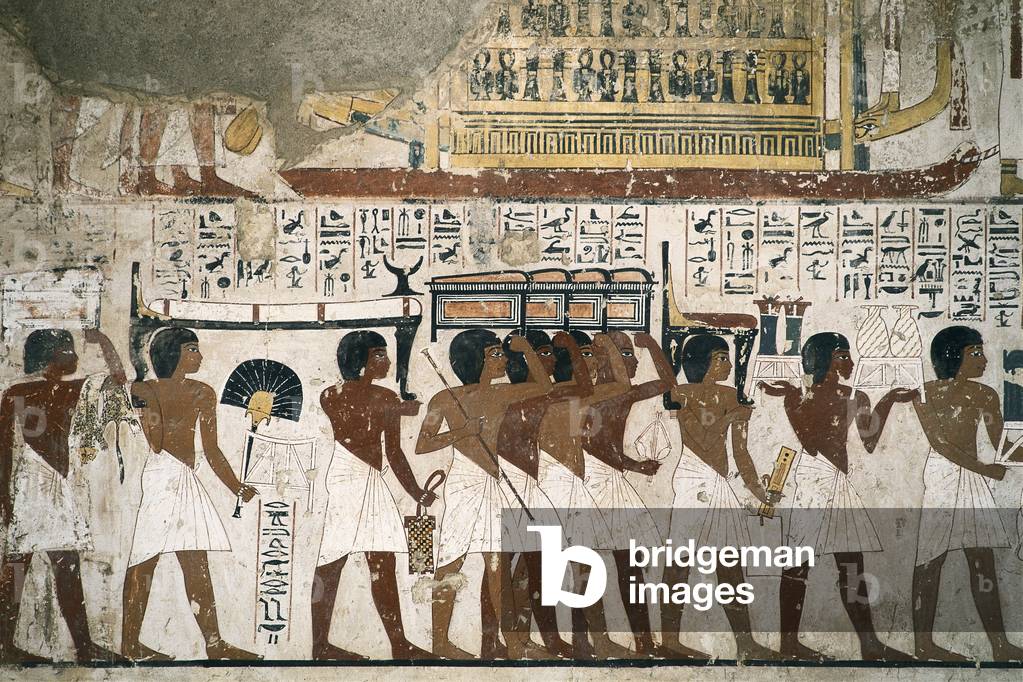
Funeral procession of Ramose, from the Tomb Chapel of Ramose, New Kingdom, c.1360 BC (wall painting)

IBE290187: Funeral procession of Ramose, from the Tomb Chapel of Ramose, New Kingdom, c.1360 BC (wall painting), Egyptian 18th Dynasty (c.1567-1320 BC) / Bridgeman Images

Shabti figure of the king from the Tomb of Tutankhamun (c.1370-1352 BC) New Kingdom (gilded wood)

XBP341829: Shabti figure of the king from the Tomb of Tutankhamun (c.1370-1352 BC) New Kingdom (gilded wood), Egyptian 18th Dynasty (c.1567-1320 BC) / Bridgeman Images

Spoon with a flattened handle in the shape of a young girl carrying a vessel which forms the lidded bowl, New Kingdom (wood)

XIR95056: Spoon with a flattened handle in the shape of a young girl carrying a vessel which forms the lidded bowl, New Kingdom (wood), Egyptian 18th Dynasty (c.1567-1320 BC) / Bridgeman Images

Egyptian antiquite: shabti (chaouabti, oushebti) (burial statuette in gold wood) of King Tutankhamun represented in Osiris being part of the Tresor of the Pharaoh, Around 1340 BC, From the tomb of All-Ankh-Amon (Tutankhamun or Tutankhamun), Vallee of the Kings, Deir el Bahari (Al-Bahri), 18th Dynasty - Cairo, Egyptian Museum - Shabti from the treasure of Tutankhamun - Funerary giltwood sculpture, c.1340 BC, from the pharaoh tomb, in the Valley of the Kings (Egypt) - Museum of Egyptian Antiquities, Cairo (Egypt)

LRI4639793: Egyptian antiquite: shabti (chaouabti, oushebti) (burial statuette in gold wood) of King Tutankhamun represented in Osiris being part of the Tresor of the Pharaoh, Around 1340 BC, From the tomb of All-Ankh-Amon (Tutankhamun or Tutankhamun), Vallee of the Kings, Deir el Bahari (Al-Bahri), 18th Dynasty - Cairo, Egyptian Museum - Shabti from the treasure of Tutankhamun - Funerary giltwood sculpture, c.1340 BC, from the pharaoh tomb, in the Valley of the Kings (Egypt) - Museum of Egyptian Antiquities, Cairo (Egypt), Egyptian 18th Dynasty (c.1567-1320 BC) / Bridgeman Images

Ibis, in squatting position, c.1350 BC (wood, bronze, glass & gilt)

GLS3481813: Ibis, in squatting position, c.1350 BC (wood, bronze, glass & gilt), Egyptian 18th Dynasty (c.1567-1320 BC) / Bridgeman Images

Block Statue of Ay (r.1325-1321 BC) New Kingdom (limestone)

TBM180902: Block Statue of Ay (r.1325-1321 BC) New Kingdom (limestone), Egyptian 18th Dynasty (c.1567-1320 BC) / Bridgeman Images

Scribe statue of Amunhotep, son of Nebiry, c.1426-1400 BC (limestone) (see 200925)

TBM200932: Scribe statue of Amunhotep, son of Nebiry, c.1426-1400 BC (limestone) (see 200925), Egyptian 18th Dynasty (c.1567-1320 BC) / Bridgeman Images

Egyptian antiquite: canopy cover in albaster representing the face of the pharaoh, From the treasure of Tutankhamun (all-Ankh-amun or Tutankhamun) (1345-1327 BC) 18th dynasty, found in the Valley of kings, Thebes, 1342 BC - Cairo, Egyptian museum - The Pharaoh Tutankhamun (134442 BC) 5-1327 BC) - Lid of an Alabaster Canopic Jar, Part of Tutankhamun's Treasures, c.1340 BC, From the Tomb of Tutankhamun, Valley of the Kings, Thebes - Egyptian Museum, Cairo, Egypt

LRI4639750: Egyptian antiquite: canopy cover in albaster representing the face of the pharaoh, From the treasure of Tutankhamun (all-Ankh-amun or Tutankhamun) (1345-1327 BC) 18th dynasty, found in the Valley of kings, Thebes, 1342 BC - Cairo, Egyptian museum - The Pharaoh Tutankhamun (134442 BC) 5-1327 BC) - Lid of an Alabaster Canopic Jar, Part of Tutankhamun's Treasures, c.1340 BC, From the Tomb of Tutankhamun, Valley of the Kings, Thebes - Egyptian Museum, Cairo, Egypt, Egyptian 18th Dynasty (c.1567-1320 BC) / Bridgeman Images

Necklace with lunar pectoral, from the Tomb of Tutankhamun, New Kingdom (electrum, feldspar, lapis lazuli & gold beads) (detail of 391005)

XBP391004: Necklace with lunar pectoral, from the Tomb of Tutankhamun, New Kingdom (electrum, feldspar, lapis lazuli & gold beads) (detail of 391005), Egyptian 18th Dynasty (c.1567-1320 BC) / Bridgeman Images

Detail of the fallen obelisk of Queen Hatshepsut (c.1503-1482 BC) depicting the Queen with Amun Ra, Temple of Amun, New Kingdom (stone)

HED191300: Detail of the fallen obelisk of Queen Hatshepsut (c.1503-1482 BC) depicting the Queen with Amun Ra, Temple of Amun, New Kingdom (stone), Egyptian 18th Dynasty (c.1567-1320 BC) / Bridgeman Images

Lid of an alabaster jar decorated with a bird in a nest containing eggs, from the tomb of Tutankhamun (c.1370-52 BC) New Kingdom (painted and stuccoed wood)

XZL149415: Lid of an alabaster jar decorated with a bird in a nest containing eggs, from the tomb of Tutankhamun (c.1370-52 BC) New Kingdom (painted and stuccoed wood), Egyptian 18th Dynasty (c.1567-1320 BC) / Bridgeman Images

Fishing and fowling in the marshes, detail of the birds, from the Tomb Chapel of Menna, New Kingdom (wall painting)

XIR183733: Fishing and fowling in the marshes, detail of the birds, from the Tomb Chapel of Menna, New Kingdom (wall painting), Egyptian 18th Dynasty (c.1567-1320 BC) / Bridgeman Images
Detail from the little shrine of Tutankhamun depicting the Queen fastening a necklace round the king's neck, New Kingdom, c.1340 BC (gold-plated) (see also 228562)

XZL148127: Detail from the little shrine of Tutankhamun depicting the Queen fastening a necklace round the king's neck, New Kingdom, c.1340 BC (gold-plated) (see also 228562), Egyptian 18th Dynasty (c.1567-1320 BC) / Bridgeman Images

View of the Tomb Chapel of Meryre, New Kingdom (photo)

XIR226162: View of the Tomb Chapel of Meryre, New Kingdom (photo), Egyptian 18th Dynasty (c.1567-1320 BC) / Bridgeman Images

Detail from the Golden Shrine, Tutankhamun's Treasure (wood overlaid with a layer of gesso and coverd with sheet gold)

XZL74098: Detail from the Golden Shrine, Tutankhamun's Treasure (wood overlaid with a layer of gesso and coverd with sheet gold), Egyptian 18th Dynasty (c.1567-1320 BC) / Bridgeman Images

Egyptian antiquite: cup of the Immortalite of the benefactors of Thebes. Lotus shaped albaster chalice. From the treasor of Tutankhamun (all-Ankh-amun or Tutankhamun) (1345-1327 BC) 18th dynasty. found in the Valley of kings, Thebes. 1342 BC. Cairo, Egyptian Museum - Egyptian Antiquities: cup of Immortality of the benefactors of Thebes. Alabaster chalice in the shape of a lotus flower. From the treasure of Tutankhamun (All-Ankh-amun or Tutankhamun) (1345-1327 BC), 18th Dynasty. Found in the Valley of the Kings, Thebes. 1342 BC. Egyptian Museum, Cairo, Egypt

LRI4639806: Egyptian antiquite: cup of the Immortalite of the benefactors of Thebes. Lotus shaped albaster chalice. From the treasor of Tutankhamun (all-Ankh-amun or Tutankhamun) (1345-1327 BC) 18th dynasty. found in the Valley of kings, Thebes. 1342 BC. Cairo, Egyptian Museum - Egyptian Antiquities: cup of Immortality of the benefactors of Thebes. Alabaster chalice in the shape of a lotus flower. From the treasure of Tutankhamun (All-Ankh-amun or Tutankhamun) (1345-1327 BC), 18th Dynasty. Found in the Valley of the Kings, Thebes. 1342 BC. Egyptian Museum, Cairo, Egypt, Egyptian 18th Dynasty (c.1567-1320 BC) / Bridgeman Images

Egyptian antiquite: representation of Roy and his wife Nebtawy facing a high priest. Painting of the Tomb of Roy (TT255). 18th dynasty. From the West Bank of Luxor, Egypt

LRI4681505: Egyptian antiquite: representation of Roy and his wife Nebtawy facing a high priest. Painting of the Tomb of Roy (TT255). 18th dynasty. From the West Bank of Luxor, Egypt, Egyptian 18th Dynasty (c.1567-1320 BC) / Bridgeman Images

Egyptian antiquitis: earring with the effigy of Tutankhamun being part of the Tresor of the Pharaoh. Around 1340 BC. From the tomb of All-Ankh-Amon (Tutankhamun or Tutankhamun), Valley of the Kings, Deir el Bahari (Dayr al-Bahri). 18th dynasty. Cairo. Egyptian Museum

LRI4639745: Egyptian antiquitis: earring with the effigy of Tutankhamun being part of the Tresor of the Pharaoh. Around 1340 BC. From the tomb of All-Ankh-Amon (Tutankhamun or Tutankhamun), Valley of the Kings, Deir el Bahari (Dayr al-Bahri). 18th dynasty. Cairo. Egyptian Museum, Egyptian 18th Dynasty (c.1567-1320 BC) / Bridgeman Images

Painting decorating the tomb of Rekhmire, represented surrounded by his servants (fresco)

LRI4682720: Painting decorating the tomb of Rekhmire, represented surrounded by his servants (fresco), Egyptian 18th Dynasty (c.1567-1320 BC) / Bridgeman Images


Back to top