Dixon, Don (b.1951) Assets (259 in total)
Results

PIX4573617: Artist's view of a terrestrial type exoplanet - Artist's view of a terrestr type exoplanet, Dixon, Don (b.1951) / Bridgeman Images

PIX4573654: Collision of a white dwarf with a solar star. - Artist's view showing the last moments of a star similar to our sun struck by a white dwarf, Dixon, Don (b.1951) / Bridgeman Images

PIX4573622: Artist's view of an exoplanet around Antares - Artist's view of an exoplanet around Antares - Artist's view of the surface of an extrasolar planet whose water evaporated when the star became a red geante, Dixon, Don (b.1951) / Bridgeman Images

PIX4573639: Ruins on an extrasolar planet - Ruins on an extrasolar planet - A civilization left its planet made uninhabitable by its star turned into a red geant, Dixon, Don (b.1951) / Bridgeman Images

PIX4573670: Surface of an extrasolar planet - Artist's view of an inhabited extrasolar planet, Dixon, Don (b.1951) / Bridgeman Images
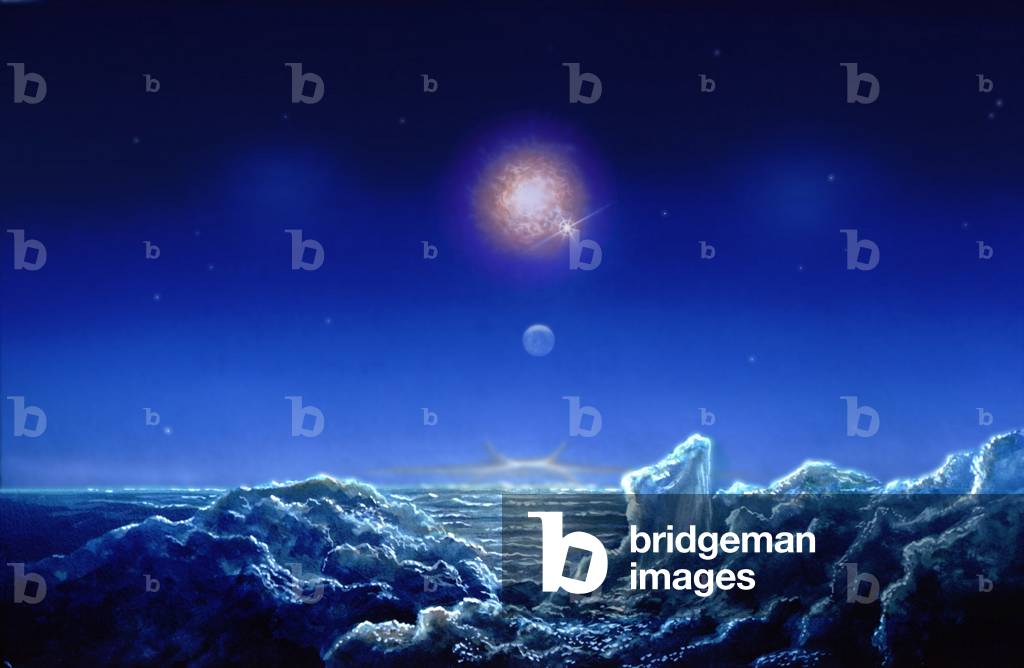
PIX4574195: Ice extrasolar planet - Illustration - Ice extrasolar planet - Illustratio, Dixon, Don (b.1951) / Bridgeman Images

PIX4574971: Jupiter's Rings and Satellites - Illustration - Jupiter's Rings and Satellites - Illustration - Jupiter is surrounded by a system of very dark rings composed of dust removed from some of its satellites. This system consists of a main ring, located between the Metis and Adrastee satellites, then rings very held on the orbits of the Amalthee and Thebe satellites., Dixon, Don (b.1951) / Bridgeman Images

PIX4575085: Io transit seen from Europe - Illustration - Io transit seen from Europe - Illustratio, Dixon, Don (b.1951) / Bridgeman Images

PIX4575267: Jupiter from his satellite Amalthee - Illustration - Jupiter from his satellite Amalthee - Illustratio, Dixon, Don (b.1951) / Bridgeman Images

PIX4573559: View of artist of galaxies colliding in the sky of an exoplanet - View of artist of galaxies colliding in the sky of an exoplanet, Dixon, Don (b.1951) / Bridgeman Images


PIX4584542: Black hole in the center of the galaxy - Artist view - Black hole in the galaxy's center - Artist view - Artist view from the black hole in the center of the galaxy. Clouds of gas and dust swirl into the black hole at the core of the Milky Way galaxy, Dixon, Don (b.1951) / Bridgeman Images

PIX4580003: The Earth seen from the Moon - Illustration - The Earth seen from the Moon - Illustratio, Dixon, Don (b.1951) / Bridgeman Images

PIX4580036: Eclipse seen from the Moon - Illustration - Eclipse seen from the Moon - Illustration - Earth eclipse the Sun seen from the Moon. Illustration from 1981. Earth as seen from the Moon during an eclipse - Illustration, 1981, Dixon, Don (b.1951) / Bridgeman Images

PIX4584082: Collision de deux asteroides- Vue d'artiste - Asteroid collision - Artist view - A large asteroid is struck by a smaller one. Since both bodies are porous, most of the energy is absorbed as heat, rather than dispersed with ejecta, thus explaining the internal melting of asteroids, Dixon, Don (b.1951) / Bridgeman Images

PIX4606342: Viking probe orbiting around Mars - Artist's view - Viking probe orbiting around Mars - Artist's view, Dixon, Don (b.1951) / Bridgeman Images

PIX4606356: The Viking probe lander deploys his parachute - Artist's view - The Viking probe lander deploys his parachute - Artist's view, Dixon, Don (b.1951) / Bridgeman Images

PIX4607548: Object of Thorne-Zytkow - Artist's view - Thorne-Zytkow object - Artwork: An object of Thorne-Zytkow is a star shaped like a red supergiant star whose heart is occupied by a neutron star. A Thorne- ytkow object is a conjectured type of star wherein a red giant or supergiant contains a neutron star at its core, formed from the collision of the giant with the neutron star. Such objects were hypothesized by Kip Thorne and Anna ytkow in 1977, Dixon, Don (b.1951) / Bridgeman Images

PIX4607486: Interstellar nuclear propulsion ship - Artist's view - Starship nuclear pulsed - Artist view - A spaceship declines its nuclear propulsion mode as it passes the hidden face of the Moon. This huge ship is essentially food and fuel reserves could reach the nearest star, Alpha of the Centaur, in less than 50 years. Inspired by the Daedalus project. An interstellar ship ignites its nuclear pulse rocket engine over the farside of the moon. The 10 - kilometer - long vessel consists mostly of fuel and other consumables. After 10 years, it will have achieved 10 percent the speed of light, making possible a voyage to the nearest star, Alpha Centauri, in 50 years, when some of the original voyagers might still be alive, Dixon, Don (b.1951) / Bridgeman Images

PIX4632714: Early Earth - First Seas - Early Earth - First Seas - Artist's view of Earth about 4 billion years ago when the Earth began to cool. Seas formed in the impact basins, Dixon, Don (b.1951) / Bridgeman Images

PIX4632719: Early Earth - First Seas - Early Earth - First Seas - Artist's view of Earth about 4 billion years ago when the Earth began to cool. Seas formed in the impact basins, Dixon, Don (b.1951) / Bridgeman Images

PIX4632705: Early Earth - First rains fill crateres - Early Earth - First rains fill crateres - Artist's view of Earth about 4 billion years ago when Earth began to cool, Dixon, Don (b.1951) / Bridgeman Images

PIX4632594: Asteroid Strikes Early Earth - Asteroid Strikes Early Earth - Artist's View, Dixon, Don (b.1951) / Bridgeman Images

PIX4565239: Old Star Clusters - Artist View - Star clusters - Artist view - Strange clusters that seem to be a cross between open and globular clusters harbor stars that may provide clues to the evolution of the early universe, Dixon, Don (b.1951) / Bridgeman Images

PIX4583304: Supernova and Planet - Artist's View - Supernova Explosion - A Planet Devastee by the intense radiation emitted by the explosion of a star, Dixon, Don (b.1951) / Bridgeman Images

PIX4629374: Le Soleil vu en coupe - Sun cutaway: Cutaway of the sun, showing core, radiative and convective zones, and corona, Dixon, Don (b.1951) / Bridgeman Images

PIX4630259: The Birth of the Sun -Artist's View - The Birth of the Sun -Artist's View, Dixon, Don (b.1951) / Bridgeman Images

PIX4645712: Mission New Worlds: The New Worlds mission is a space mission proposal being studied by NASA. Its concept is based on the association of a space telescope with a large occulter (starshade) which places in space a long distance from it (several tens of thousands of kilometres) and designed to block the light of the central star in order to observe its exoplanets. Observations could be made with an existing space telescope, such as the James-Webb Space Telescope (JWST) once launched. A space telescope observes planets orbiting a distant star whose glare has been blocked by a flower-shaped screen the size of a football field. In reality, the starshade would be almost as far from the telescope as the moon is from earth., Dixon, Don (b.1951) / Bridgeman Images

PIX4650344: Removal of Earth by aliens-Artist's view - Kidnapping of a terrian by aliens - Artist view - Abduction of an Earth by aliens, Dixon, Don (b.1951) / Bridgeman Images

PIX4633508: The End of the Earth - Artist's View - The End of the Earth - Artist's View of the Earth sitting with the Sun becoming a red giant. The Moon is visible in the sky, Dixon, Don (b.1951) / Bridgeman Images

PIX4634481: The first galaxies - The first galaxies - Artist's view of the appearance of giant stars at the intersection of hydrogen filaments, which will form the nuclei of the first galaxies. Giant stars form at the intersections of great filaments of primordial hydrogen, forming the nuclei of the first galaxies, Dixon, Don (b.1951) / Bridgeman Images

PIX4634133: Artist's view of the Big Bang - Artist's view of the Big Ban, Dixon, Don (b.1951) / Bridgeman Images

PIX4634144: Artist's view representing the theory of inflation. - Artist's view representing the theory of inflation, Dixon, Don (b.1951) / Bridgeman Images

PIX4638196: Our Galaxy, the Lactee Way -Artist's View - Our Galaxy, the Lactee Way -Artist's View - In the distance the Andromede Galaxy and its satellite galaxies are represented, Dixon, Don (b.1951) / Bridgeman Images

PIX4639784: Permanent base on Phobos-Vue d'artiste - Phobos base - Artist view - Artist view of a base on Phobos, one of the two satellites of Mars. A spaceship orbits above a domed base on Mars' inner moon, Dixon, Don (b.1951) / Bridgeman Images
