Curtis, Edward Sheriff (1868-1952) Assets (238 in total)

Search options

Orientation
Colour

Display options

View

Print

To print search results, use print friendly version of this page.

Results

At the water edge: camp piegan at the edge of a water body. Photo taken from volume 6 of the encyclopedia published by Edward S. Curtis (1868-1952) on the Indians of North America, with a foreword by Theodore Roosevelt. Between 1907 and 1930, 20 volumes were published.

PCT4263755: At the water edge: camp piegan at the edge of a water body. Photo taken from volume 6 of the encyclopedia published by Edward S. Curtis (1868-1952) on the Indians of North America, with a foreword by Theodore Roosevelt. Between 1907 and 1930, 20 volumes were published., Curtis, Edward Sheriff (1868-1952) / Bridgeman Images

Two Bear, piegan woman. As for the Piegans of today and tomorrow, we would have to be very optimistic to find hope in their present situation. The promise of a better life, which had always been made to them by civilization, was an empty shell. Photo taken from volume 6 of the encyclopedia published by Edward S. Curtis (1868-1952) on the Indians of North America, with a foreword by Theodore Roosevelt. Between 1907 and 1930, 20 volumes were published.

PCT4263798: Two Bear, piegan woman. As for the Piegans of today and tomorrow, we would have to be very optimistic to find hope in their present situation. The promise of a better life, which had always been made to them by civilization, was an empty shell. Photo taken from volume 6 of the encyclopedia published by Edward S. Curtis (1868-1952) on the Indians of North America, with a foreword by Theodore Roosevelt. Between 1907 and 1930, 20 volumes were published., Curtis, Edward Sheriff (1868-1952) / Bridgeman Images

North Native Americans: Prayer to the mystery, 1907-1930 (photo)

PCT4263809: North Native Americans: Prayer to the mystery, 1907-1930 (photo), Curtis, Edward Sheriff (1868-1952) / Bridgeman Images

In the Badlands. This amazing image was made in Sheep Mountain, on the Pine Rige Reserve, Badlands, South Dakota. Photo taken from volume 3 of Edward S. Curtis's encyclopedia (1868-1952) on North American Indians, with a foreword by Theodore Roosevelt. Between 1907 and 1930, 20 volumes were published.

PCT4263827: In the Badlands. This amazing image was made in Sheep Mountain, on the Pine Rige Reserve, Badlands, South Dakota. Photo taken from volume 3 of Edward S. Curtis's encyclopedia (1868-1952) on North American Indians, with a foreword by Theodore Roosevelt. Between 1907 and 1930, 20 volumes were published., Curtis, Edward Sheriff (1868-1952) / Bridgeman Images

Wolf, Indian Apsaroke (Wolf - Apsaroke also sometimes written Absaroke) Photo taken from volume 4 of the encyclopedia published by Edward S. Curtis (1868-1952) on the Indians of North America, with a foreword by Theodore Roosevelt. Between 1907 and 1930, 20 volumes were published.

PCT4263858: Wolf, Indian Apsaroke (Wolf - Apsaroke also sometimes written Absaroke) Photo taken from volume 4 of the encyclopedia published by Edward S. Curtis (1868-1952) on the Indians of North America, with a foreword by Theodore Roosevelt. Between 1907 and 1930, 20 volumes were published., Curtis, Edward Sheriff (1868-1952) / Bridgeman Images

Crazy Thunder, a Sioux Teton (Oglala or Ogalala) Photo from volume 3 of Edward S. Curtis's encyclopedia (1868-1952) on North American Indians, with a foreword by Theodore Roosevelt. Between 1907 and 1930, 20 volumes were published.

PCT4263889: Crazy Thunder, a Sioux Teton (Oglala or Ogalala) Photo from volume 3 of Edward S. Curtis's encyclopedia (1868-1952) on North American Indians, with a foreword by Theodore Roosevelt. Between 1907 and 1930, 20 volumes were published., Curtis, Edward Sheriff (1868-1952) / Bridgeman Images

Qahatika girl. Young Qahatika girl. These desert Indians live about 60 kilometres from the Pimas Reserve (Arizona). Photo taken from volume 2 of Edward S. Curtis's encyclopedia (1868-1952) on North American Indians, with a foreword by Theodore Roosevelt. Between 1907 and 1930, 20 volumes were published.

PCT4263820: Qahatika girl. Young Qahatika girl. These desert Indians live about 60 kilometres from the Pimas Reserve (Arizona). Photo taken from volume 2 of Edward S. Curtis's encyclopedia (1868-1952) on North American Indians, with a foreword by Theodore Roosevelt. Between 1907 and 1930, 20 volumes were published., Curtis, Edward Sheriff (1868-1952) / Bridgeman Images

Sioux invocation. Sanctuaries are most often large boulders of rolling stone or other rocks that [...] were charged with mythical significance. Priests and warlords went there to invoke the help of supernatural powers. The large block of stone on which this supplicator stands would have the power to reveal to the warrior the outcome of the raid he is planning. Its surface carries what the Indians call the footprint of the human foot and it is to this particularity that it must have become sacred. Photo taken from volume 3 of Edward S. Curtis's encyclopedia (1868-1952) on North American Indians, with a foreword by Theodore Roosevelt. Between 1907 and 1930, 20 volumes were published.

PCT4263761: Sioux invocation. Sanctuaries are most often large boulders of rolling stone or other rocks that [...] were charged with mythical significance. Priests and warlords went there to invoke the help of supernatural powers. The large block of stone on which this supplicator stands would have the power to reveal to the warrior the outcome of the raid he is planning. Its surface carries what the Indians call the footprint of the human foot and it is to this particularity that it must have become sacred. Photo taken from volume 3 of Edward S. Curtis's encyclopedia (1868-1952) on North American Indians, with a foreword by Theodore Roosevelt. Between 1907 and 1930, 20 volumes were published., Curtis, Edward Sheriff (1868-1952) / Bridgeman Images

The Mealing Trough - Hopi by Edward S. Curtis, 1906 (silver print photograph)

GRC2630138: The Mealing Trough - Hopi by Edward S. Curtis, 1906 (silver print photograph), Curtis, Edward Sheriff (1868-1952) / Bridgeman Images

Operation Petticoat  (photo)

DIL2560602: Operation Petticoat (photo), Curtis, Edward Sheriff (1868-1952) / Bridgeman Images

Bird on High Land, Crow indian, Montana, USA, c. 1908, photo Edward S. Curtis

PVD1695105: Bird on High Land, Crow indian, Montana, USA, c. 1908, photo Edward S. Curtis, Curtis, Edward Sheriff (1868-1952) / Bridgeman Images

Navajo woman wearing silver squash blossom necklace, concho belt, blanket draped over shoulders, c. 1904, photo Edward S. Curtis

PVD1695117: Navajo woman wearing silver squash blossom necklace, concho belt, blanket draped over shoulders, c. 1904, photo Edward S. Curtis, Curtis, Edward Sheriff (1868-1952) / Bridgeman Images

Wisham (i.e. Wishran) girl, profile, indian, c. 1910

PVD1695129: Wisham (i.e. Wishran) girl, profile, indian, c. 1910, Curtis, Edward Sheriff (1868-1952) / Bridgeman Images

Running Rabbit (Aatsista-Mahkan 1833-1911), Blackfeet Indian, c. 1900, photo Edward S. Curtis

PVD1695144: Running Rabbit (Aatsista-Mahkan 1833-1911), Blackfeet Indian, c. 1900, photo Edward S. Curtis, Curtis, Edward Sheriff (1868-1952) / Bridgeman Images

Atlumhl-Koskimo, c.1914 (b/w photo)

BAL145760: Atlumhl-Koskimo, c.1914 (b/w photo), Curtis, Edward Sheriff (1868-1952) / Bridgeman Images

Fasting, from 'The North American Indian', 1907 (photogravure) (b&w photo)

BAL105311: Fasting, from 'The North American Indian', 1907 (photogravure) (b&w photo), Curtis, Edward Sheriff (1868-1952) / Bridgeman Images

Kwakiutl village at Alert Bay, 1914 (b&w photo)

XJF105329: Kwakiutl village at Alert Bay, 1914 (b&w photo), Curtis, Edward Sheriff (1868-1952) / Bridgeman Images

Apache Medicine Man, 1907 (b/w photo)

XJF441987: Apache Medicine Man, 1907 (b/w photo), Curtis, Edward Sheriff (1868-1952) / Bridgeman Images

Dancing to Restore an Eclipsed Moon - Qágyuhl, 1914 (photogravure)

HST2908554: Dancing to Restore an Eclipsed Moon - Qágyuhl, 1914 (photogravure), Curtis, Edward Sheriff (1868-1952) / Bridgeman Images

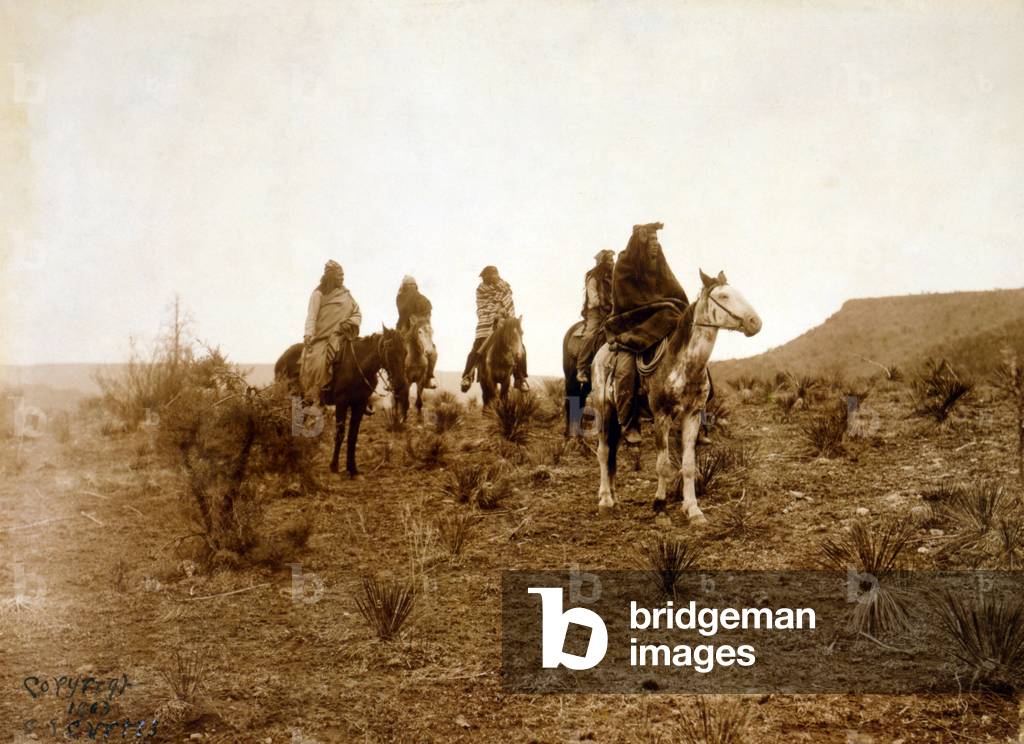
Apaches. Desert rovers- Five Apache on horseback in desert. photo by Edward S. Curtis, 1903

EVB2931094: Apaches. Desert rovers- Five Apache on horseback in desert. photo by Edward S. Curtis, 1903, Curtis, Edward Sheriff (1868-1952) / Bridgeman Images

The Rush Gatherer, Montana (b/w photo)

PNP245681: The Rush Gatherer, Montana (b/w photo), Curtis, Edward Sheriff (1868-1952) / Bridgeman Images

Kalispel Indian woman, white stripes painted on hair, shell disk earrings, wearing blanket dress decorated with elks' teeth, c. 1910, photo Edward S. Curtis

PVD1695103: Kalispel Indian woman, white stripes painted on hair, shell disk earrings, wearing blanket dress decorated with elks' teeth, c. 1910, photo Edward S. Curtis, Curtis, Edward Sheriff (1868-1952) / Bridgeman Images

Red Bird, Cheyenne, c. 1927

PVD1695106: Red Bird, Cheyenne, c. 1927, Curtis, Edward Sheriff (1868-1952) / Bridgeman Images

The Hamatsa, Nakoaktok c. 1910 Half-length portrait of Nakoaktok man, facing left, wearing cedar root ceremonial loop.

PVD1695121: The Hamatsa, Nakoaktok c. 1910 Half-length portrait of Nakoaktok man, facing left, wearing cedar root ceremonial loop., Curtis, Edward Sheriff (1868-1952) / Bridgeman Images

A Hopi woman, indian, c. 1904, photo by Edward S. Curtis

PVD1695124: A Hopi woman, indian, c. 1904, photo by Edward S. Curtis, Curtis, Edward Sheriff (1868-1952) / Bridgeman Images

Upshaw, Apsaroke (Crow), c. 1905, photo Edward S. Curtis

PVD1695133: Upshaw, Apsaroke (Crow), c. 1905, photo Edward S. Curtis, Curtis, Edward Sheriff (1868-1952) / Bridgeman Images

Two Zuni girls standing in front of pueblo buildings, New Mexico, c. 1903

PVD1695104: Two Zuni girls standing in front of pueblo buildings, New Mexico, c. 1903, Curtis, Edward Sheriff (1868-1952) / Bridgeman Images

Red Thunder, Nez Perce (Nephew of Chief Joseph), 1903 (toned platinum print on heavy paper)

CH1766837: Red Thunder, Nez Perce (Nephew of Chief Joseph), 1903 (toned platinum print on heavy paper), Curtis, Edward Sheriff (1868-1952) / Bridgeman Images

The Chief-Klamath, plate from 'The North American indian, Portfolio 2, 1899-1910', 1907-30 (large format photogravure)

CH378656: The Chief-Klamath, plate from 'The North American indian, Portfolio 2, 1899-1910', 1907-30 (large format photogravure), Curtis, Edward Sheriff (1868-1952) / Bridgeman Images

Fish Shows - Apsaroke, 1908 (photogravure)

STM752653: Fish Shows - Apsaroke, 1908 (photogravure), Curtis, Edward Sheriff (1868-1952) / Bridgeman Images

A Zuni Girl, 1907 (photogravure in sepia)

CH985780: A Zuni Girl, 1907 (photogravure in sepia), Curtis, Edward Sheriff (1868-1952) / Bridgeman Images

Shows As He Goes by Edward S. Curtis, c.1904 (toned silver print)

GRC2622387: Shows As He Goes by Edward S. Curtis, c.1904 (toned silver print), Curtis, Edward Sheriff (1868-1952) / Bridgeman Images

Indians of America: a young Indian girl, daughter of chief of the Skokomish tribe, 1912 (photo)

JLJ4602674: Indians of America: a young Indian girl, daughter of chief of the Skokomish tribe, 1912 (photo), Curtis, Edward Sheriff (1868-1952) / Bridgeman Images

Shot in the hand, Apsaroke. In 1841 he obtained the “power of the hawk” during his vision quest. He used to develop a mixture based on falcon heart, glycery (medical grass) and vegetable tincture, which he reduced to powder and ingested a little before the fight. Photo taken from volume 4 of the encyclopedia published by Edward S. Curtis (1868-1952) on the Indians of North America, with a foreword by Theodore Roosevelt. Between 1907 and 1930, 20 volumes were published.

PCT4263803: Shot in the hand, Apsaroke. In 1841 he obtained the “power of the hawk” during his vision quest. He used to develop a mixture based on falcon heart, glycery (medical grass) and vegetable tincture, which he reduced to powder and ingested a little before the fight. Photo taken from volume 4 of the encyclopedia published by Edward S. Curtis (1868-1952) on the Indians of North America, with a foreword by Theodore Roosevelt. Between 1907 and 1930, 20 volumes were published., Curtis, Edward Sheriff (1868-1952) / Bridgeman Images

Black Eagle, Assiniboin. In 1834 on Missouri, south of Williston, South Dakota, he was only 13 years old when he first went to war, without distinguishing himself, nor on the following two expeditions. In the fourth, he alone captured 6 Yanktonese horses and led 3 warfare expeditions. He was 18 years old. Photo taken from volume 3 of Edward S. Curtis's encyclopedia (1868-1952) on North American Indians, with a foreword by Theodore Roosevelt. Between 1907 and 1930, 20 volumes were published.

PCT4263810: Black Eagle, Assiniboin. In 1834 on Missouri, south of Williston, South Dakota, he was only 13 years old when he first went to war, without distinguishing himself, nor on the following two expeditions. In the fourth, he alone captured 6 Yanktonese horses and led 3 warfare expeditions. He was 18 years old. Photo taken from volume 3 of Edward S. Curtis's encyclopedia (1868-1952) on North American Indians, with a foreword by Theodore Roosevelt. Between 1907 and 1930, 20 volumes were published., Curtis, Edward Sheriff (1868-1952) / Bridgeman Images

Male doctor. Probably Sioux, squid in hand and buffalo skull has his feet. Photo taken from volume 3 of Edward S. Curtis's encyclopedia (1868-1952) on North American Indians, with a foreword by Theodore Roosevelt. Between 1907 and 1930, 20 volumes were published.

PCT4263894: Male doctor. Probably Sioux, squid in hand and buffalo skull has his feet. Photo taken from volume 3 of Edward S. Curtis's encyclopedia (1868-1952) on North American Indians, with a foreword by Theodore Roosevelt. Between 1907 and 1930, 20 volumes were published., Curtis, Edward Sheriff (1868-1952) / Bridgeman Images


Back to top